Owen Edge: The Business-Minded Statesman of New Jersey
Owen Edge was a formidable figure in American politics, blending the precision of a successful businessman with the ambition of a career politician. After amassing significant wealth through his advertising and publishing ventures, Edge dedicated his life to public service, serving as the Governor of New Jersey twice, a United States Senator, and the U.S. Ambassador to France. His career was defined by a commitment to government efficiency, a moderate approach to the Progressive Era, and a lifelong struggle against political machines.
Early Political Ascent
Edge began his political journey in the late 19th century, utilizing his financial security to enter the arena of New Jersey politics. He first gained experience as a journal clerk for the New Jersey Senate (1897–1899) and later as the senate secretary (1901–1904), roles that allowed him to master parliamentary procedures and build vital networks with state legislators.
Though he initially faced defeat in a 1904 primary run for the state senate—having challenged the established Republican machine using his own newspaper, the Atlantic City Daily Press—Edge eventually aligned himself with the party organization. This strategic shift led to his election to the New Jersey General Assembly in 1909 and the New Jersey Senate in 1910, where he eventually rose to become senate president in 1915.
During the Progressive Era, Edge occupied a moderate middle ground. While not a radical reformer, he championed practical social improvements. He traveled to Europe to study compensation systems, leading to the sponsorship of a workers' compensation law signed by Governor Woodrow Wilson. He also advocated for safety laws for factory workers and a ten-hour workday for women.
First Term as Governor (1917–1919)
Edge's path to the governorship in 1916 was marked by an unusual alliance. To defeat the reformer H. Otto Wittpenn, Edge's campaign manager, Enoch "Nucky" Johnson, collaborated with Frank Hague, the Democratic boss of Hudson County. Hague encouraged his supporters to cross party lines in the Republican primary to secure Edge's victory. Edge ran on the slogan "A Business Man with a Business Plan," promising to make government more effective.
His first term focused on modernization and infrastructure. He consolidated state boards, improved civil service, and reformed corporation law. Most notably, Edge secured the funding and approval for two massive infrastructure projects by linking their interests: the Benjamin Franklin Bridge (connecting Camden and Philadelphia) and the Holland Tunnel (connecting Jersey City and Manhattan).
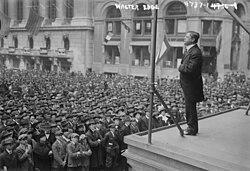
The bridge opened in 1926 and the tunnel in 1927, forever altering the transit landscape of the region. Some historians suggest the tunnel's placement in Jersey City was a reward for Frank Hague's early political support.
United States Senate and International Diplomacy
Elected to the U.S. Senate in 1918, Edge brought his focus on efficiency to the federal level. He introduced the joint resolution that became the Budget and Accounting Act of 1921, which created the General Accounting Office and the Bureau of the Budget (now the Office of Management and Budget).
In the Senate, Edge was known as a "mild reservationist" regarding the Treaty of Versailles. While he supported the United States joining the League of Nations, he believed specific reservations were necessary to protect national sovereignty. He also sponsored the Edge Act of 1919, allowing National Banks to engage in international banking through subsidiaries.
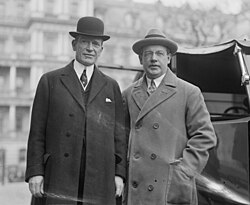
Edge was a vocal opponent of prohibition, voting against the Volstead Act and proposing legislation to legalize low-alcohol beer and beverages. Despite a bid for the vice presidency in 1920—which was blocked by Hudson County Republican leader William P. Verdon—Edge was reelected to the Senate in 1924.
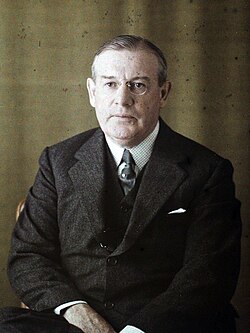
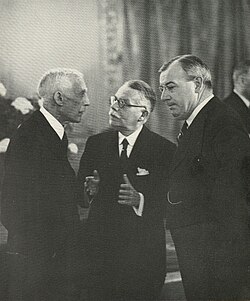
His legislative career concluded with a shift toward protectionism, as he supported the Smoot-Hawley Tariff Act. In 1929, President Herbert Hoover appointed him as the United States Ambassador to France, where he spent four years navigating strained trade relations, war debts, and disarmament issues.
Return to the Governorship (1944–1947)
After a decade of retirement, Edge returned to politics during World War II. In 1943, he defeated Democratic candidate Vincent J. Murphy to become Governor of New Jersey for a second time. This term was defined by an aggressive campaign to dismantle the political machine of Frank Hague.
Edge fought Hague on multiple fronts, including the allocation of railroad tax money and the implementation of voting machines in Hudson County to curb electoral fraud. He also appointed Walter D. Van Riper as state attorney general, who led raids on illegal horse race betting rooms in Hudson County, effectively eliminating the practice.
Beyond his battles with Hague, Edge's second term saw significant social progress. In 1945, he signed landmark laws banning racial or religious discrimination in employment, public schools, hospital care, jury service, and public accommodations. He also established a Taxation and Finance Department and enacted benefits for returning veterans.
Key Facts
- Infrastructure Legacy: Orchestrated the simultaneous approval of the Benjamin Franklin Bridge and the Holland Tunnel.
- Federal Impact: Instrumental in creating the Bureau of the Budget and the General Accounting Office via the Budget and Accounting Act of 1921.
- Civil Rights: Signed 1945 legislation banning racial and religious discrimination in various public sectors in New Jersey.
- Diplomacy: Served as the U.S. Ambassador to France from 1929 to 1933.
- Political Stance: A moderate Republican who opposed prohibition and supported protectionist tariffs.
| Role | Period | Key Achievement/Focus |
|---|---|---|
| NJ State Legislator | 1909–1916 | Workers' compensation law; safety laws for factory workers. |
| Governor of New Jersey (1st) | 1917–1919 | Infrastructure (Bridge/Tunnel); state board consolidation. |
| U.S. Senator | 1919–1929 | Budget and Accounting Act of 1921; Edge Act. |
| U.S. Ambassador to France | 1929–1933 | Franco-American trade and war debt negotiations. |
| Governor of New Jersey (2nd) | 1944–1947 | Anti-discrimination laws; dismantling the Hague machine. |
Frequently Asked Questions
How did Owen Edge contribute to New Jersey's infrastructure?
Edge successfully navigated political divides between North and South Jersey by combining the proposals for the Benjamin Franklin Bridge and the Holland Tunnel, ensuring both projects received statewide support and funding.
What was the "Edge Act"?
The Edge Act was a 1919 amendment to the Federal Reserve Act of 1913 that permitted National Banks to engage in international banking through the use of federally chartered subsidiaries.
What was Edge's relationship with Frank Hague?
Their relationship evolved from a strategic alliance in 1916, which helped Edge win his first gubernatorial election, to a fierce political rivalry during his second term (1944–1947), during which Edge worked to dismantle Hague's influence in Hudson County.
Did Owen Edge support the League of Nations?
Yes, but as a "mild reservationist." He believed the U.S. should join the League of Nations but argued that specific reservations were necessary to protect national sovereignty and ensure Senate ratification.
What civil rights milestones did Edge achieve?
In 1945, Governor Edge signed a series of laws that prohibited racial or religious discrimination in public accommodations, employment, hospital care, jury service, and admissions to public schools.