Ottawa Evening Journal: A History of Ottawa's Independent Daily
The Ottawa Evening Journal served as a cornerstone of the Canadian capital's media landscape for nearly a century. Founded on the principle of providing a high-moral, independent alternative to the partisan press of the late 19th century, the publication evolved from a small printing operation into a major journalistic force before its eventual closure in 1980.
The Founding and Early Years
The newspaper was established in 1885 by Alexander Smith Woodburn, a veteran of the printing industry. Woodburn's expertise was rooted in decades of experience, beginning with an apprenticeship in the late 1840s under Dawson Kerr, the publisher of The Orange Lily. By 1860, Woodburn had partnered with John George Bell to form Bell & Woodburn on Elgin Street, a business Woodburn continued alone after Bell's retirement in 1872.
The first edition of the Ottawa Evening Journal was published on December 10, 1885, from offices at 36 Elgin Street. Woodburn launched the paper to fill a void in the city, arguing that Ottawa lacked an "able and independent" daily that was free from party prejudices. At the time, the existing English-language daily, the Ottawa Citizen, was viewed by Woodburn as being too partisan.
Early Leadership and Financial Struggles
The paper's inaugural editor was John Wesley Dafoe, who departed in May 1886 for the Manitoba Free Press (later the Winnipeg Free Press). He was succeeded by Arthur H. U. Colquohoun of the Montreal Star. Despite its mission, the Journal faced early financial instability, accumulating several thousand dollars in debt by the end of 1886.
This crisis led to a partnership with Philip Dansken (P. D.) Ross, the editor of the Montreal Star, who invested $4,000 for a half-interest in the company on January 1, 1887. By October 31, 1891, Ross purchased Woodburn's remaining interest, taking full control of the publication.
Growth and Industrial Expansion
Under Ross's leadership, the Journal expanded its reach and capacity. In June 1887, the Saturday edition doubled to eight pages, and the Semi-Weekly Journal was launched to serve rural communities. This rural publication would later be renamed the Ottawa Valley Journal in 1899 and the Ottawa Farm Journal in 1917.
The business transitioned into a joint stock company in 1892, operating as The Journal Printing Company (Limited). A significant technological leap occurred in 1893 with the purchase of a Goss Straight-Line Newspaper Perfecting Press, which accelerated printing speeds and allowed the daily paper to expand to eight pages.
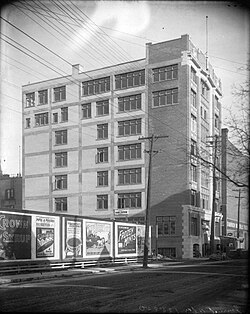
As the operation grew, so did its physical footprint. After moving to 34 Elgin Street in 1894, the paper eventually occupied both 34 and 36 Elgin Street by 1912. This growth culminated in 1913 with the construction of a purpose-built headquarters at 233-237 Queen Street.
Designed by architect Arthur LeBaron Weeks, the eight-storey building cost approximately $180,000. Constructed from brick and Indiana limestone using the Kahn system (a method of reinforced concrete), the building was marketed as fireproof. The newspaper moved into the facility on January 10, 1914, utilizing the basement, first, second, and top three floors, while leasing the middle floors to the public.
Consolidation and the World War I Era
The landscape of Ottawa journalism was highly competitive, featuring the Conservative-leaning Citizen, the Independent (but Conservative-leaning) Evening Journal, and the Liberal Ottawa Free Press. In a strategic move to manage competition, P. D. Ross and the Southam family (owners of the Citizen) had previously purchased the Free Press in 1905, later selling it to editor Ernest Norman Smith in 1907 to avoid public criticism regarding a monopoly on political voices.
However, the economic pressures of the First World War—specifically rising costs for labour, equipment, and newsprint—made maintaining three English dailies unsustainable. Consequently, the Journal Publishing Co. absorbed the Ottawa Free Press at the end of 1916.
The final edition of the Free Press was published on December 30, 1916. On January 1, 1917, the company launched the Morning Journal-Press, which was later shortened to the Morning Journal in February 1919. E. Norman Smith transitioned from president of the Free Press to Vice President of the Journal Publishing Co. and editor of both the morning and evening papers.
Decline and Controversial Closure
By 1959, the newspaper was acquired by F.P. Publications. While it maintained a strong rural readership, it began to trail behind its primary competitor, the Ottawa Citizen. Labour disputes in the 1970s further weakened the publication's stability.
In 1980, Thomson Newspapers purchased the Journal and closed it on August 27, 1980. This left the Ottawa Citizen as the only major English-language daily in the city (while Le Droit remained the sole French-language daily).
The closure sparked a national controversy. A day after the Journal closed, Southam closed the Winnipeg Tribune, the rival to Thomson's Winnipeg Free Press. This sequence of events led to allegations of collusion to reduce competition and prompted the Canadian government to establish the Royal Commission on Newspapers (the Kent Commission). Although charges were brought against Southam and Thomson in 1981 under the Combines Investigation Act, they were dismissed in December 1983.
Ottawa remained without a second major English newspaper until the launch of the Ottawa Sun in 1988.
Key Facts
- Founded: December 10, 1885, by Alexander Smith Woodburn.
- Political Leanings: Generally regarded as conservative, though founded to be independent.
- Headquarters: A fireproof, eight-storey Kahn system building at 233-237 Queen St. (opened 1914).
- Major Mergers: Absorbed the Ottawa Free Press in 1916.
- Closure Date: August 27, 1980, under Thomson Newspapers.
- Legacy: Its closure contributed to the creation of the Royal Commission on Newspapers (Kent Commission).
| Year | Event |
|---|---|
| 1885 | Founded by Alexander Smith Woodburn. |
| 1887 | P. D. Ross enters partnership; Semi-Weekly Journal launched. |
| 1892 | Incorporated as The Journal Printing Company (Limited). |
| 1914 | Moved to new headquarters at 233-237 Queen St. |
| 1917 | Absorbed Ottawa Free Press; launched Morning Journal-Press. |
| 1959 | Purchased by F.P. Publications. |
| 1980 | Purchased by Thomson Newspapers and closed. |
Frequently Asked Questions
Why was the Ottawa Evening Journal founded?
Alexander Smith Woodburn founded the paper because he believed Ottawa lacked an independent daily newspaper with a high moral tone that was free from the partisan prejudices prevalent in other publications of the time, such as the Ottawa Citizen.
What was the Kahn system used in the Journal building?
The Kahn system was a method of reinforced concrete construction used for the newspaper's eight-storey building on Queen Street, which allowed the structure to be claimed as fireproof.
How did World War I affect the newspaper?
The war increased the costs of newsprint, labour, and equipment, making it financially impossible for three English-language newspapers to coexist in Ottawa. This led to the absorption of the Ottawa Free Press by the Journal in 1916.
What was the significance of the Kent Commission?
The Royal Commission on Newspapers (Kent Commission) was established following the controversial closures of the Ottawa Evening Journal and the Winnipeg Tribune, as the government investigated potential illegal collusion between Southam and Thomson Newspapers to eliminate competition.
Who owned the paper at the time of its closure?
The newspaper was owned by Thomson Newspapers when it was closed on August 27, 1980.