Ostrubel: The Currency of German-Occupied Eastern Territories
During the turmoil of World War I, the German Empire established a specialized monetary system to manage the economies of the eastern territories under its control. This currency, known as the Ostrubel (also referred to as ostrublis in Latvian and Lithuanian, and острубль in Russian), was introduced to address a critical shortage of circulating currency in the region.
Issued on April 17, 1916, the Ostrubel was designed for use in the Ober Ost (the military administration of the eastern territories) and the Government General of Warsaw. At its inception, the Ostrubel was pegged to be equal in value to the Imperial rouble.
Key Facts
- Introduction Date: April 17, 1916.
- Issuing Authority: Ostbank für Handel und Gewerbe (via the Darlehnskasse in Posen).
- Exchange Rate: 1 Ostrubel = 2 Ostmark.
- Subunit: 100 copecks (копѣйка) = 1 rubel.
- Primary Users: Ober Ost, Duchy of Courland, and the United Baltic Duchy.
Issuance and Administration
The production of Ostrubel banknotes was handled by the Darlehnskasse, a specialized unit of the Ostbank für Handel und Gewerbe located in Posen (modern-day Poznań). The currency was essential for maintaining trade and administrative functions in occupied zones where local currency was scarce.
The Ostrubel did not exist in isolation. Starting April 4, 1916, it circulated concurrently with the Ostmark within the Ober Ost region. The fixed exchange rate between the two was established at 2 Ostmark for every 1 Ostrubel.
Denominations and Physical Forms
The currency was issued in both paper and metallic forms to facilitate different levels of commerce, from small daily transactions to larger trade agreements.
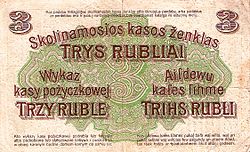
Banknotes
Banknotes were issued in a wide variety of denominations to ensure flexibility in the economy:
- Fractional notes: 20 and 50 copecks.
- Full rubel notes: 1, 3, 10, 25, and 100 rubels.
Coins
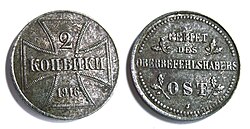
For smaller transactions, the administration issued coinage in three denominations:
- 1 copeck
- 2 copecks
- 3 copecks
Geographic Reach and Obsolescence
While officially utilized by the Ober Ost, the Duchy of Courland, and the United Baltic Duchy, the Ostrubel also saw unofficial use in several emerging states following the war. This included Poland (1918–1920), Lithuania (1918–1922), and Estonia (1918–1919).
The lifespan of the Ostrubel varied by region. In the Government General of Warsaw, the currency was phased out relatively quickly, replaced by the Polish marka on April 14, 1917.
| Feature | Details |
|---|---|
| Issuing Bank | Ostbank für Handel und Gewerbe |
| Base Unit | Rubel |
| Subunit | Copeck (1/100th of a rubel) |
| Official Users | Ober Ost, Duchy of Courland, United Baltic Duchy |
| Unofficial Users | Poland, Lithuania, Estonia |
| Conversion | 1 Ostrubel = 2 Ostmark |
Frequently Asked Questions
What was the Ostrubel?
The Ostrubel was a currency issued by Germany in 1916 for use in eastern territories under German occupation, specifically the Ober Ost and the Government General of Warsaw.
Why was the Ostrubel created?
It was introduced primarily to resolve a shortage of available currency in the occupied eastern regions during World War I.
What was the relationship between the Ostrubel and the Ostmark?
The two currencies circulated together in the Ober Ost area, with a fixed exchange rate of 2 Ostmark to 1 Ostrubel.
Which banknotes were available in the Ostrubel system?
Banknotes were issued in denominations of 20 and 50 copecks, as well as 1, 3, 10, 25, and 100 rubels.
When did the Ostrubel cease to be used in Warsaw?
In the Government General of Warsaw, the Ostrubel was replaced by the Polish marka on April 14, 1917.