Orcadas Base: The Oldest Permanent Station in Antarctica
Located on Laurie Island within the South Orkney Islands, Orcadas Base holds the distinction of being the oldest permanently inhabited scientific station in Antarctica. Operated by Argentina, this outpost serves as a critical hub for long-term environmental monitoring and polar research, maintaining a continuous human presence for over a century.
The base is situated at an elevation of 8 meters (26 ft) and is positioned approximately 170 meters from the coastline. It operates as an all-year-round facility, providing a strategic vantage point for studying the complex interactions between the Antarctic atmosphere and the surrounding Southern Ocean.
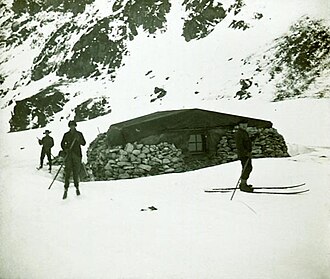
Key Facts
- Established: April 1, 1903, by the Scottish National Antarctic Expedition.
- Status: Oldest operational permanent base in Antarctica.
- Location: Laurie Island, South Orkney Islands.
- Primary Research: Meteorology, seismology, and continental and sea-ice-zone glaciology.
- Population: Ranges from 17 in winter to 35 (or up to 65) in summer.
- Governance: Managed by the Argentine Dirección Nacional del Antártico.
Historical Evolution
The origins of Orcadas Base date back to 1903, when Dr. William S. Bruce and the Scottish National Antarctic Expedition established Omond House as a meteorological station. Due to ice conditions, the crew was forced to winter at the site. In December 1903, Bruce traveled to Buenos Aires to secure supplies and offered the station and its instruments to the Argentine government for 5,000 pesos, provided the scientific mission continued.
The Argentine government accepted the offer via presidential decree on January 2, 1904. The first Argentine personnel arrived on January 14, 1904, aboard the ship Scotia. While the United Kingdom contested the permanent nature of the base, asserting the islands were British territory, Argentina maintained its presence.
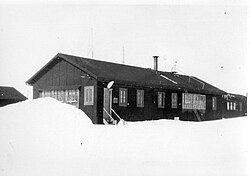
Technological milestones followed, most notably in 1927 when naval officer Emilio Baldoni established the first radiotelegraph link between the base and Ushuaia, ending the station's total isolation between annual relief visits. In 1952, the base was formally placed under the Service of Maritime Hydrography as the Destacamento Naval Orcadas.
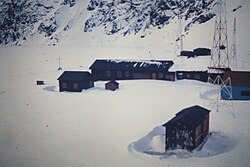
Scientific Research and Facilities
The base consists of 11 buildings, including the Laboratorio Antártico Mutidisciplinario en Base Orcadas (LABORC), a multidisciplinary laboratory where the bulk of scientific work is conducted. The station focuses on four primary research areas:
- Meteorology: Continuous observations since 1904.
- Continental Glaciology: Studying the movement and composition of land-based ice.
- Seismology: Monitoring tectonic activity in the region.
- Sea-ice-zone Glaciology: Specialized research initiated in 1985.
Climate and Environmental Conditions
Under the Köppen climate classification, Orcadas Base is categorized as having a tundra climate (ET), bordering on an ice cap climate (EF). The environment is heavily influenced by the Antarctic Circumpolar Current and strong westerly winds, making it colder than the northwestern Antarctic Peninsula.
The weather is characterized by extreme variability due to passing low-pressure systems. When these systems pass to the south, temperatures can become exceptionally mild; the record high was 15.2 °C (59.4 °F) in 1987. Conversely, systems passing to the north bring cold, dry air, with temperatures dropping as low as −44.0 °C (−47.2 °F).
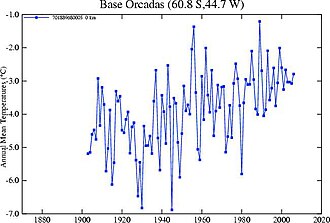
Visibility is a constant challenge, with fog occurring on average 110 days per year. The base is also one of the cloudiest places on Earth, receiving only about 13.5% of possible sunshine annually. Precipitation is distributed evenly throughout the year, with snowfall occurring frequently, averaging 227 days per year between 1961 and 1990.
| Metric | Summer (Feb) | Winter (July) | Annual Average/Record |
|---|---|---|---|
| Mean Daily Max Temp | 3.4 °C (38.1 °F) | −5.3 °C (22.5 °F) | Annual Mean: −3.1 °C |
| Mean Daily Min Temp | −0.4 °C (31.3 °F) | −14.1 °C (6.6 °F) | Record Low: −44.0 °C |
| Avg Precipitation | 73.5 mm (Feb) | 44.8 mm (July) | Annual: 398.4 mm |
| Sunshine Hours | 36.8 hrs (Feb) | 6.2 hrs (July) | Annual: 413.7 hrs |
The Destacamento Lighthouse
In addition to its scientific mission, the base hosts the Destacamento Lighthouse. This navigation light is mounted on a square pyramidal skeletal radio tower featuring white and red horizontal bands. Maintained by the Argentine Navy, the lighthouse provides essential maritime guidance for vessels navigating the treacherous waters of the South Orkney Islands.
Frequently Asked Questions
Who originally founded the Orcadas Base?
The base was established in 1903 by Dr. William S. Bruce as part of the Scottish National Antarctic Expedition before being transferred to Argentina in 1904.
What makes Orcadas Base unique among Antarctic stations?
It is the oldest permanently inhabited and operational scientific station on the Antarctic continent.
What are the primary scientific activities at the base?
The station focuses on meteorology, seismology, continental glaciology, and sea-ice-zone glaciology.
How does the population of the base change seasonally?
The population fluctuates based on the season, typically housing around 17 people during the winter and increasing to 35, and sometimes up to 65, during the summer.
What is the climate like at Orcadas Base?
It has a tundra climate characterized by strong winds, frequent fog, and very low sunshine hours, with mean monthly temperatures ranging from −9.4 °C in June to 1.0 °C in February.