Operation Desert: Nazi Germany's WWII Synthetic Fuel Project
As the tide of World War II turned against the Axis powers, the German army faced a critical shortage of conventional petroleum. In a desperate bid to maintain mobility and fuel their war machine, the Third Reich launched Operation Desert (German: Unternehmen Wüste). This ambitious but flawed project aimed to establish a massive industrial complex to extract synthetic fuel from the Posidonia Shale deposits found in the Swabian Alb region.
The Origins of Operation Desert
The drive for synthetic fuel led to the formation of several pilot initiatives. In September 1942, LIAS-Ölschiefer-Forschungsgesellschaft mbH began testing in Frommern. This was followed by the Kohle-Öl-Union von Busse KG, established in July 1943 in Berlin, which experimented with in-situ retorting—a process of extracting oil from shale while it remains underground—on the outskirts of Schörzingen.
By September 20, 1943, the Deutsche Ölschiefer-Forschungsgesellschaft mbH was founded in Schömberg, eventually becoming the central pillar of Operation Desert. The project quickly attracted high-level attention, with Hermann Göring and the Schutzstaffel (SS) becoming personally involved in late 1943. On May 2, 1944, the SS established its own entity, Deutsche Schieferöl GmbH, to manage a plant near Erzingen. The chemical giant IG Farben also participated in the effort, and by July 1944, Operation Desert was integrated into the broader Geilenberg Programme.
Forced Labor and Infrastructure
Under the direction of Edmund Geilenberg, the regime ordered the construction of ten shale oil extraction plants across Württemberg and Hohenzollern. The construction was managed by Deutsche Bergwerks- und Hüttenbau GmbH, a subsidiary of Reichswerke Hermann Göring.
The human cost of this project was immense. The workforce consisted primarily of prisoners from seven subcamps of the Natzweiler-Struthof concentration camp, strategically located along the Tübingen-Aulendorf and Balingen-Rottweil railway lines. Approximately 5,000 prisoners were forced into construction work, and over 10,000 were exploited within the oil-shale works themselves. Additionally, as Soviet forces advanced into Estonia in 1944, roughly 200 oil shale specialists from Baltische Öl GmbH (an IG Farben affiliate) were evacuated to Schömberg to provide technical expertise.
Technical Failures and Production Results
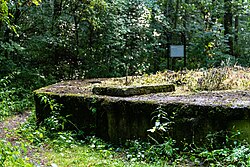
Despite the scale of the mobilization, Operation Desert was a technical failure. Of the ten planned plants, only four ever became operational. The method used was a primitive form of carbonization (the process of heating organic material in the absence of oxygen to produce fuel).
The process involved heaping mined oil shale into mounds, covering them with peat, and igniting them. The resulting distilled shale oil and gas were collected via 300-millimetre (12 in) perforated pipes, with electric filters used to separate the oil from the gas. This inefficient system yielded very little fuel; by the end of the war, the project had produced only 1,500 tonnes of shale oil.
| Category | Details |
|---|---|
| Primary Goal | Synthetic fuel production from Posidonia Shale |
| Key Locations | Swabian Alb (Frommern, Schörzingen, Schömberg, Erzingen) |
| Planned vs. Operational Plants | 10 planned / 4 operational |
| Total Oil Produced | 1,500 tonnes |
| Labor Force | Over 15,000 concentration camp prisoners |
| Main Contractor | Deutsche Bergwerks- und Hüttenbau GmbH |
Key Facts
- Operation Desert was a WWII German project to extract oil from the Swabian Alb's Posidonia Shale.
- The project was integrated into the Geilenberg Programme in July 1944.
- It relied on the forced labor of over 15,000 prisoners from Natzweiler-Struthof subcamps.
- The production method involved primitive carbonization using peat-covered mounds.
- Only 1,500 tonnes of oil were produced before the war ended.
- Post-war attempts by French occupation forces to continue production failed due to unprofitability by 1948.
Frequently Asked Questions
What was the purpose of Operation Desert?
Operation Desert was designed to create a synthetic fuel production complex using oil shale deposits in the Swabian Alb to compensate for the dwindling petroleum supplies available to the German army during the final stages of World War II.
Who provided the labor for the construction of the plants?
The workforce consisted of prisoners from seven subcamps of the Natzweiler-Struthof concentration camp, totaling approximately 5,000 construction workers and over 10,000 workers in the oil-shale plants.
Why was the oil production so low?
Production was low because the technology used was primitive. The process of igniting shale mounds covered in peat was inefficient, resulting in only four of the ten planned plants becoming operational and a total output of just 1,500 tonnes.
Did the project continue after World War II?
Yes, French occupation forces attempted to maintain shale oil production after the war, but the operation was halted in 1948 because it was not profitable.
Which companies were involved in the project?
Several entities were involved, including LIAS-Ölschiefer-Forschungsgesellschaft mbH, Kohle-Öl-Union von Busse KG, Deutsche Ölschiefer-Forschungsgesellschaft mbH, Deutsche Schieferöl GmbH (SS), IG Farben, and Deutsche Bergwerks- und Hüttenbau GmbH.