Open-Pit Mining: Techniques, Environmental Impacts, and Rehabilitation
Open-pit mining, also referred to as open-cast or open-cut mining—and on a massive scale as mega-mining—is a surface extraction technique used to recover rock or minerals from the earth. This method is typically employed when commercially viable ore deposits are located near the surface, meaning the overburden (the layer of soil and rock overlying the mineral deposit) is relatively thin. When deposits are too deep for surface extraction, underground mining is used instead.
While efficient for large-scale extraction, this form of mining presents significant risks to worker health and safety and can lead to substantial environmental degradation.
Key Facts
- Application: Used for shallow ore deposits where overburden is thin.
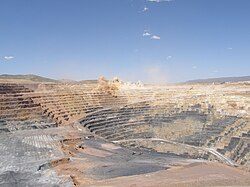
- Structure: Mines are dug in vertical levels called benches, typically 12–15 meters thick and 20–40 meters wide.
- Waste: Large mines can move nearly one million tons of ore and waste rock daily.
- Environmental Risks: Major concerns include deforestation, air pollution, and acid mine drainage.
- Rehabilitation: Closed pits may be converted into landfills or artificial lakes.
The Mechanics of Open-Pit Extraction
The process begins with exploration, where miners drill test holes to locate the underground ore body. By analyzing these samples, engineers determine the extent, commercial value, and location of the ore veins. When the target is building materials or dimension stone, the operation is commonly called a quarry.
Benches and Ramps
Open-pit mines are structured using benches, which are vertical levels of the excavation. The thickness of these benches (generally 12 to 15 meters) depends on the mineral being mined and the size of the machinery. Access between these levels is managed via a system of ramps. As mining progresses, downward ramps are created to start new levels, which gradually widen to form the new pit bottom.
Wall Stability and Safety
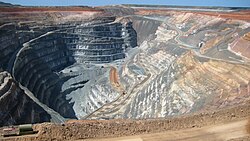
To prevent catastrophic rock falls, pit walls are rarely vertical; they are mined at an angle. The walls are stepped, consisting of a flat part called the berm (or bench) and an inclined section known as the batter. This stepped design prevents debris from sliding down the entire face of the wall.
Stability depends on the rock type and structural weaknesses such as joints, shears, faults, or foliations. In unstable areas, engineers use rock bolts, cable bolts, or shotcrete (sprayed concrete) for support. Additionally, de-watering bores may be drilled horizontally into the wall to relieve water pressure that could otherwise cause wall failure.
Hauling and Logistics
A haul road is typically constructed along the side of the pit. This ramp allows heavy trucks to transport extracted ore and waste rock out of the excavation site.
Waste Management and Environmental Pollutants
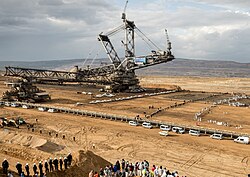
The scale of waste produced in open-pit mining is immense. The primary operations contributing to this load are drilling, blasting, loading, and hauling. Waste rock is transported to waste dumps, which may be located on the surface or within previously exhausted pits.
Tailings and Toxicity
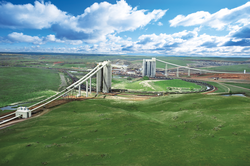
Processing ore creates tailings, which are leftover waste usually in the form of a slurry. This slurry is pumped into settling ponds or tailings dams. These areas can become toxic due to unextracted sulfide minerals, gangue (worthless mineral accompanying ore), or chemicals like cyanide used in gold leaching. Without strict protections, these toxins can leak into the surrounding ecosystem.
Air and Land Impact
The disruption of ground and the transportation of minerals create significant air pollutants, which can cause lung issues and increase mortality rates for nearby populations. Specific mining types have distinct impacts:
- Gold: High potential for altering air and water chemistry; dust may be radioactive or toxic.
- Nickel: A primary driver of deforestation in Indonesia and the Philippines.
- Cobalt: Linked to habitat destruction and deforestation in the Democratic Republic of Congo.
![Kittilä Gold Mine in Kittilä, Finland is the largest primary gold producer in Europe.[3][4]](/images/15/5e/155eab1ca6112dca6c564308fb67f4a7b005c3c6c00603760d7ef06b3a4c9550.jpg)
Hydrology and Mine Stability
Groundwater can pose severe risks, including the bursting or heaving of the mine floor due to uplift pressure. To manage this, mines implement groundwater control systems, including dewatering and depressurization wells. Depressurization—the removal of tension or pressure from specific areas—can increase mine stability and extend a mine's operational life by 10 to 15 years.
One advanced technique used in this context is annealing (the slow heating and cooling of materials), which relieves internal stress and increases durability. Horizontal drains are also used to lower pore pressure and prevent large-scale slope failure.
Mine Closure and Rehabilitation
Mining continues until the resource is exhausted or the ratio of overburden to ore becomes uneconomic. Once closed, pits may be converted into landfills or artificial lakes, such as those in Germany's Lusatian Lake District.
Land Rehabilitation Process
- Contouring: Waste dumps are flattened and stabilized.
- Capping: If sulfides are present, a clay layer is added to prevent rain and oxygen from creating sulfuric acid, a process known as acid mine drainage.
- Vegetation: Soil is added and plants are grown to consolidate the material.
- Water Management: Pits are often fenced off and allowed to fill with groundwater. In some cases, river water or basic chemicals (like calcium oxide) are added to neutralize the pH value of the water.
Untopping
In some cases, a process called untopping is used. This occurs when a previous underground mine (often using room and pillar mining) is no longer economic. By removing the overburden from above, previously trapped minerals can be recovered using modern bulk excavation techniques.
Economic Extraction Grades
| Mineral | Typical Economic Grade | Notes |
|---|---|---|
| Gold | 1 to 5 ppm | Can be as low as 0.75 ppm via bulk heap leaching. |
| Nickel | Down to 0.2% | Generally extracted as laterite. |
| Copper | 0.11% to 0.2% | Extracted at very low percentages. |
Frequently Asked Questions
What is the difference between an open-pit mine and a quarry?
While both are surface mines, a quarry specifically refers to an open-pit mine that produces building materials or dimension stone. Quarries are also typically shallower and often do not utilize the bench system found in larger mineral mines.
What is acid mine drainage?
Acid mine drainage occurs when sulfide minerals in waste rock are exposed to oxygen and water, oxidizing to produce sulfuric acid. This can contaminate water sources and requires mitigation through clay capping or chemical neutralization.
How do benches improve mine safety?
Benches create a stepped wall profile. The flat parts (berms) act as catchments that stop falling rocks from continuing down the entire face of the mine wall, protecting workers and equipment at the bottom.
What is the purpose of mine depressurization?
Depressurization removes groundwater pressure from the mine slopes. This increases the overall stability of the pit, reduces the risk of slope failure, and can allow for the expansion of the mine, extending its life by over a decade.
How is land rehabilitated after an open-pit mine closes?
Rehabilitation involves contouring waste dumps, capping sulfide-rich materials with clay to prevent acid formation, adding topsoil, and planting vegetation. In some regions, pits are intentionally flooded to create artificial lakes.