Oleksa Tykhyi: The Struggle and Sacrifice of a Ukrainian Dissident
The history of the Ukrainian struggle for human rights is marked by individuals of immense fortitude who faced the oppressive machinery of the Soviet state. Among them was Oleksa Tykhyi, a founding member of the Ukrainian Helsinki Group, whose life and death became a symbol of nonviolent resistance against totalitarianism.
The 1977 Arrest and Trial
In February 1976, Tykhyi helped establish the Ukrainian Helsinki Group, an organization dedicated to monitoring Soviet compliance with the Helsinki Accords. This activism quickly made him a target of the Soviet authorities. On February 4, 1977, Tykhyi was arrested by the Soviet police.
The charges against him were twofold: anti-Soviet agitation and the illegal possession of firearms. The latter charge was based on a World War II-era German rifle that Tykhyi had sealed with clay and stored in his shed's attic. During his trial on June 23, 1977, in Druzhkivka, the court focused on a statement Tykhyi had made regarding the Russification (the imposition of Russian language and culture) in the Donbas area.
The Donetsk Regional Court sentenced Tykhyi to ten years of corrective labour and five years of internal exile. He was subsequently transported to Mordovia to serve his sentence.
International Outcry and Prisoner Status
Tykhyi's imprisonment did not go unnoticed by the global community. On May 16, 1977, the United States Congress issued a resolution calling for the release of Tykhyi and other dissidents, including Valentyn Moroz, Mykola Rudenko, and Yurii Shukhevych.
Amnesty International designated Tykhyi as a prisoner of conscience—a term used for individuals imprisoned for their political or religious beliefs who have not used or advocated violence. He held this status until his death.
Hardships in Mordovia and Perm-36
Upon arriving in Mordovia, Tykhyi began suffering from severe digestive issues, specifically a stomach ulcer. Despite his failing health, he remained defiant, launching a 52-day hunger strike to protest the conditions faced by political prisoners.
Even within the confines of the camp, Tykhyi continued his intellectual and political work. He collaborated with fellow dissident Vasyl Romaniuk to write a tract advocating for nonviolent resistance to Soviet rule. His cellmate, Vasyl Ovsienko, noted that Tykhyi maintained a deep and constant interest in education.
Tykhyi's health reached a crisis point on April 1, 1979, when he began a third hunger strike. After 17 days, he was hospitalized with a stomach hernia and peritonitis. He famously refused to recant his political views in exchange for medical treatment. Following the operation, the Kharkiv Human Rights Protection Group reported that a doctor told him, "Your life will be short and full of pain." Ovsienko later alleged that Tykhyi's stomach had been surgically sewn in a manner designed to make digestion painful and difficult.
Between January and February 1980, Tykhyi was placed in solitary confinement for refusing to work, refusing to stand for prison authorities, and allegedly ripping off his breast tag. During this period, his weight dropped to no more than 40 kilograms (88 lb) amidst unsanitary conditions.
From February 27 to March 1, 1980, Tykhyi was transferred to the Perm-36 labour colony. He faced further solitary confinement for six months due to his refusal to shave, his refusal to work, and continued hunger strikes. The author and political prisoner Vasyl Stus later described Tykhyi's appearance as looking "as if he [had] just been lifted from the cross."
Death and Legacy
Oleksa Tykhyi died on May 5 or 6, 1984, at the age of 57. The primary cause of death was stomach cancer, though Amnesty International noted he was also suffering from angina (chest pain due to reduced blood flow to the heart), arteriosclerosis (hardening of the arteries), anemia, and chronic back pain.
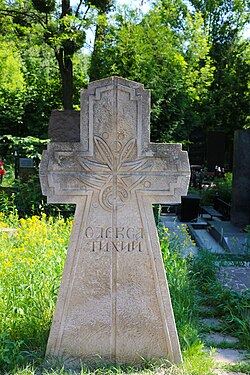
The Soviet authorities did not return his body to his son immediately. It was not until 1989 that Tykhyi, along with Vasyl Stus and Yuriy Lytvyn, was reburied in the Baikove Cemetery in Kyiv. The ceremony was a massive public event attended by approximately 30,000 people.
Key Facts
- Role: Founding member of the Ukrainian Helsinki Group.
- Conviction: Sentenced to 10 years of corrective labour and 5 years of internal exile.
- Resistance: Conducted multiple hunger strikes, including one lasting 52 days.
- Imprisonment Sites: Mordovia and the Perm-36 labour colony.
- Cause of Death: Stomach cancer, compounded by multiple systemic health failures.
- Final Resting Place: Baikove Cemetery, Kyiv (reburied in 1989).
| Period/Date | Location/Event | Key Detail |
|---|---|---|
| February 4, 1977 | Arrest | Charged with anti-Soviet agitation and illegal firearm possession. |
| June 23, 1977 | Trial in Druzhkivka | Convicted based on statements regarding Russification in Donbas. |
| 1977–1980 | Mordovia | Suffered stomach ulcer; conducted 52-day hunger strike. |
| 1980–1984 | Perm-36 | Extended solitary confinement and severe health decline. |
| May 1984 | Death | Died at age 57 from stomach cancer. |
Frequently Asked Questions
Why was Oleksa Tykhyi arrested in 1977?
Tykhyi was arrested due to his involvement with the Ukrainian Helsinki Group and was charged with anti-Soviet agitation and the illegal possession of a World War II-era German rifle.
What was the basis for his conviction?
While several texts were reviewed, he was ultimately convicted based on a statement he made regarding the Russification of the Donbas region.
How did the international community respond to his imprisonment?
The United States Congress passed a resolution urging his release in May 1977, and Amnesty International designated him a prisoner of conscience.
What forms of protest did Tykhyi use while imprisoned?
Tykhyi engaged in multiple hunger strikes, including one that lasted 52 days, and refused to work or follow certain prison regulations as a form of nonviolent resistance.
Where is Oleksa Tykhyi buried?
He is buried in the Baikove Cemetery in Kyiv, where he was reburied in 1989 during a ceremony attended by 30,000 people.