Old World Flycatchers
The Old World flycatchers, known scientifically as the family Muscicapidae, are a diverse group of small passerine birds. Found primarily across Europe, Africa, and Asia, these birds are specialized insectivores. While most are restricted to the Old World, a few species, such as the northern wheatear (Oenanthe oenanthe) and the bluethroat (Luscinia svecica), are also found in North America as vagrants.
Most members of this family are arboreal, meaning they live in trees, and are famous for their ability to catch prey on the wing. With 357 species divided into 57 genera, the Muscicapidae family represents a significant portion of the avian biodiversity in their native regions.
Key Facts
- Species Count: 357 species across 57 genera.
- Distribution: Primarily Europe, Africa, and Asia.
- Diet: Mainly insectivorous, often catching prey in flight.
- Size: Small to medium birds, typically ranging from 9 to 22 cm in length.
- Taxonomy: Divided into four main subfamilies: Muscicapinae, Niltavinae, Erithacinae, and Saxicolinae.
Taxonomy and Evolutionary History
The family name Muscicapidae was introduced by Scottish naturalist John Fleming in 1822, derived from the Latin musca (fly) and capere (to catch). The classification of these birds has undergone significant revision over the last century as scientific methods evolved.
In the early 20th century, ornithologists like Ernst Hartert struggled to define the boundaries between flycatchers, Old World warblers (Sylviidae), and thrushes (Turdidae). For decades, many of these groups were lumped together into a massive "primitive insect eater" family. However, modern DNA–DNA hybridization and molecular phylogenetic studies revealed that these groups were not as closely related as previously thought.
By 1998, the American Ornithologists' Union officially separated thrushes into their own family, though some genera like Myophonus and Brachypteryx were later moved back into Muscicapidae after molecular evidence proved they were more closely related to flycatchers than to true thrushes.
Physical Characteristics and Behavior
Old World flycatchers exhibit a wide variety of appearances. While many species are a subtle, dull brown, others—particularly males—possess vibrant plumage. Their most defining physical feature is the broad, flattened bill, which is an evolutionary adaptation for snatching insects from the air. In contrast, species that forage on the ground typically possess finer bills.
Their vocalizations are generally characterized by harsh calls and relatively weak songs. In terms of habitat, they are highly adaptable, inhabiting everything from the dense forests of the tropics to the montane woodlands of the Himalayas and open scrublands.
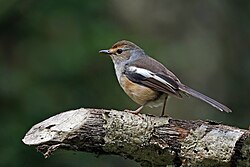
To maintain a steady diet of insects, many species living in northern latitudes migrate south during the winter months.
Nesting and Reproduction
Nesting habits vary significantly across the family. Some species build well-constructed cup nests on cliff ledges or in tree branches. Others are hole-nesters, utilizing pre-existing cavities in trees. Interestingly, hole-nesting species tend to have larger clutches, averaging eight eggs, whereas cup-nesting species typically lay between two and five eggs.
Classification Summary
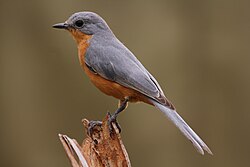
The family is currently organized into several subfamilies and tribes, reflecting their evolutionary divergence which likely began in the early Miocene.
| Subfamily | Notable Groups/Genera | Examples |
|---|---|---|
| Muscicapinae | Copsychini, Muscicapini | Magpie-robins, typical flycatchers |
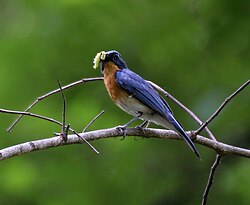
| Niltavinae | Cyornis, Niltava | Blue flycatchers |
| Erithacinae | Erithacus, Cossypha | European robin, forest robins |
| Saxicolinae | Saxicola, Oenanthe, Monticola | Stonechats, wheatears, rock thrushes |
Diverse Genera and Species
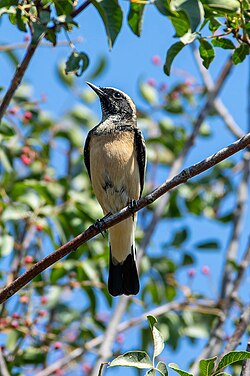
The diversity of the family is evident in its various genera. For instance, the genus Oenanthe contains 32 species of wheatears, while Cyornis includes 32 species of blue flycatchers.
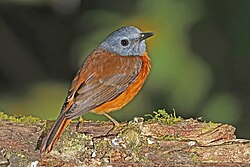
Other specialized groups include the rock thrushes (Monticola) and the stonechats (Saxicola), both of which have adapted to more open or rocky environments.
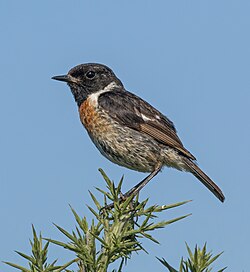
Recent studies in 2016 and 2023 continue to refine these groupings, resurrecting old genera or creating new ones to better reflect the genetic reality of the birds' ancestry.
Frequently Asked Questions
What is the difference between Old World and New World flycatchers?
Old World flycatchers (Muscicapidae) are found in Europe, Africa, and Asia. New World flycatchers (Tyrannidae), also known as tyrant flycatchers, are a separate family found in the Americas.
Why were thrushes once included in the flycatcher family?
Early ornithologists grouped them together based on physical similarities and their shared diet of insects. However, DNA analysis later proved that thrushes (Turdidae) are a distinct lineage.
How do Old World flycatchers catch their food?
Most species are aerial insectivores, meaning they use their broad, flattened bills to catch insects while flying. Ground-foraging species use finer bills to pick insects from the earth.
Do all Old World flycatchers migrate?
No, but many of the species that live in northern regions migrate south during the winter to ensure a continuous supply of insects.
What are the typical nesting habits of these birds?
They either build cup-shaped nests in trees or on cliff ledges, or they nest in existing tree holes. Hole-nesters generally lay more eggs (average of eight) than cup-nesters (two to five).