Ojibwe Culture: Traditions, Kinship, and the Sacred Manoomin
The Ojibwe, also known as the Anishinaabe, possess a rich cultural heritage defined by a deep connection to the land, complex social structures, and a spiritual worldview that emphasizes interconnectedness. Historically settled in the Great Lakes region, the Ojibwe developed a sophisticated society based on sustainable harvesting, intricate kinship systems, and a unique form of pictorial communication.
Key Facts
- Manoomin (wild rice) is a central spiritual and nutritional staple of the Ojibwe diet.
- The doodem (clan) system traditionally governs social conduct and marriage.
- The jingle dress, a staple of modern powwows, originated with the Ojibwe.
- Midewiwin teachings preserve spiritual beliefs through oral tradition and birch bark scrolls.
- Traditional dwellings include the wiigiwaam (wigwam), built from birch bark and willow saplings.
Traditional Lifestyle and Social Organization
Historically, the Ojibwe organized themselves into bands. While the Great Plains bands were more nomadic, most Ojibwe lived settled lifestyles. They relied on a combination of fishing, hunting, and the cultivation of maize and squash, supplemented by the harvesting of manoomin. Their traditional homes, known as wiigiwaam (wigwams), were constructed as either domed-lodges (waginogaan) or pointed-lodges (nasawa'ogaan) using juniper bark, birch bark, and willow saplings.
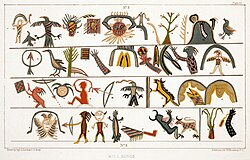
The Ojibwe developed a specific form of pictorial writing used in the religious rites of the Midewiwin. These records, often found on birch bark scrolls or rock, communicate mathematical, geometrical, and historical knowledge. This tradition extends to petroforms, petroglyphs, and pictographs used as mnemonic devices for spiritual concepts and astronomical events.
Trade and Connectivity
Evidence of vast, ancient trade networks is found in the use of the miigis (cowry shell), which originates from distant coastal areas. Similarly, the trade of copper—dating back as far as the Hopewell tradition—and specific rocks for arrowheads demonstrate that the Ojibwe were part of a continent-wide exchange system.
Manoomin: The Sacred Wild Rice
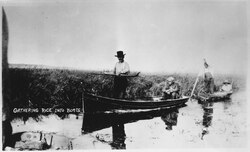
Manoomin, or wild rice, is more than a food source; it is a spiritual entity. The Ojibwe maintain a reciprocal relationship with the rice, offering tobacco and prayers to ensure its health. The harvesting process, known as "ricing," involves families in canoes using knocking sticks to gather ripe grain from the Manito Gitigaan (the Great Spirit's Garden).
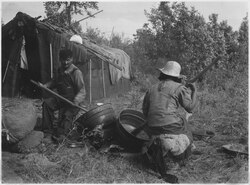
Once harvested, the rice is processed through a series of steps: parching in an iron kettle, "jigging" (walking on the rice to remove hulls), and winnowing. Despite its importance, manoomin ecosystems have been threatened by colonization, including the draining of marshes, dam construction, and the introduction of invasive species.
Commercialization and Rights
In the 20th century, the University of Minnesota developed non-shattering varieties for mass cultivation, which led to a decline in hand-harvested rice during the 1970s. In a landmark move in 2018, the White Earth Band of Ojibwe adopted the "rights of manoomin," asserting that the wild rice has an inherent right to exist and flourish.
Kinship and the Doodem System
The Ojibwe utilize a complex modified bifurcate merging kinship system. This system reflects a philosophy of balance across generations, where siblings and parallel cousins often share the same kinship terms. Traditionally, the society was patrilineal, meaning children belonged to the father's clan.
The doodemag (clans) are named after animal or bird totems. The five original totems include:
- Wawaazisii (Bullhead)
- Baswenaazhi/Ajiijaak (Crane)
- Aan'aawenh (Pintail Duck)
- Nooke (Bear)
- Moozwaanowe (Little Moose-tail)
Clans dictated social responsibilities and marriage rules, as individuals were required to marry outside their own clan. The traditional greeting, "Aaniin gidoodem?" (What is your clan?), allowed people to establish their social relationship immediately.
Spiritual Beliefs and Ceremonies
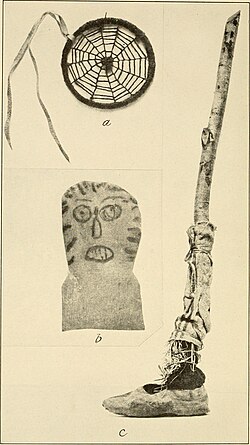
Spiritual life is guided by the Midewiwin teachings and oral traditions. The sweatlodge remains a vital site for recounting oral history and conducting ceremonies related to the four directions. Another significant contribution is the "spider web charm," a protective hoop for infants inspired by the Spider Woman (Asibikaashi). This charm is the ancestor of the modern dreamcatcher.

The Jingle Dress
The Ojibwe are the originators of the jingle dress, worn by female powwow dancers. These dresses are decorated with rows of tin cones—originally made from tobacco can lids—that create a distinct sound during dance. This garment has since become a symbol of Pan-Indianism.
Funeral and Burial Practices
Traditional Ojibwe burial focuses on the spirit's four-day journey to Gaagige Minawaanigozigiwining (the land of happiness). To aid this journey, the body is buried quickly in an inflexed position, with food and a fire kept at the grave to provide sustenance and guidance.
Burial mounds are often marked by a jiibegamig (spirit house) and a wooden marker inscribed with the deceased's doodem. In the modern era, while caskets are common, birch bark fire matches are still buried with the body to light the way to the afterlife.
Ethnobotany and Traditional Medicine
The Ojibwe possess extensive knowledge of local flora for medicinal and practical use. This includes using Abies balsamea (balsam fir) for coughs and as a canoe pitch, and Pinus strobus (white pine) resin for treating infections. Other plants, such as Sagittaria cuneata, are used both as food and to treat indigestion.
| Plant Name | Traditional Use |
|---|---|
| Abies balsamea | Cough medicine, headache relief, and canoe pitch |
| Pinus strobus | Treatment for infections and gangrene |
| Agrimonia gryposepala | Urinary problems |
| Sagittaria cuneata | Indigestion and food source |
| Onoclea sensibilis | Stimulating milk flow in female patients |
Frequently Asked Questions
What is manoomin and why is it important?
Manoomin is wild rice, a staple food and spiritual symbol for the Ojibwe. It is harvested traditionally in late summer and early autumn and is viewed as having an inherent right to exist and flourish.
What is the purpose of the doodem system?
The doodem (clan) system organizes Ojibwe society, defining family lineages, social responsibilities, and marriage eligibility, ensuring that individuals marry outside their own clan.
How did the jingle dress originate?
The jingle dress was created by the Ojibwe, featuring dark cloth decorated with tin cones (often from tobacco can lids) that make a jingling sound during powwow dances.
What is the significance of the four-day period after death?
The Ojibwe believe it takes four days for the spirit of the deceased to journey to Gaagige Minawaanigozigiwining (the land of happiness), during which time food and fire are provided to guide and sustain them.
What are the Midewiwin teachings?
The Midewiwin are spiritual teachings passed down through oral tradition and recorded on birch bark scrolls, covering creation stories, rituals, and historical knowledge.