Oil Extraction: Methods, Recovery Stages, and Industry Safety
Petroleum is a vital fossil fuel formed over millions of years from the mixture of plants, algae, and sediments in shallow seas under intense pressure. To access these underground reservoirs, the oil industry employs a complex series of geological surveys and engineering techniques. Once extracted, this crude oil is refined into essential products ranging from gasoline to materials used in tires and refrigerators.
Key Facts
- Primary recovery typically extracts only 5-15% of a reservoir's oil.
- Secondary recovery can bring the total recovery rate to between 35% and 45%.
- Tertiary recovery (Enhanced Oil Recovery) can add another 5-15% to the total yield.
- Seismic surveys are the primary tool used by geologists to locate potential oil fields.
- Upstream services encompass the entire process of exploration and drilling.
Locating the Oil Field
Before drilling begins, geologists and geophysicists must identify where petroleum is trapped. They primarily use seismic surveys to map underground geological structures. The classic approach involves creating a controlled underground explosion and measuring the seismic response. Alternatively, passive methods analyze naturally occurring seismic waves. To refine their search, experts also utilize gravimeters and magnetometers.
Once a potential site is identified, drilling begins. A specialist known as a mudlogger monitors the well to confirm the presence of oil. While some oil historically rose naturally to the surface—a phenomenon still seen in parts of Alaska—most modern extraction requires active intervention. To maintain economic viability, operators often drill multilateral wells (multiple wells into one reservoir) or secondary wells to inject fluids that maintain reservoir pressure.
The Drilling Process
An oil rig is used to bore a deep hole into the earth. To ensure the well does not collapse, a steel pipe called a casing is inserted to provide structural integrity. Once the casing is set, holes are drilled into the base to allow oil to enter the bore. The process concludes with the installation of a Christmas tree, a complex assembly of valves used to regulate pressure and control the flow of oil to the surface.
Stages of Oil Recovery
Oil extraction is categorized into three main stages based on the energy used to move the oil from the reservoir to the surface.
Primary Recovery
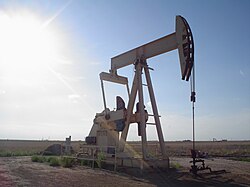
In the primary stage, oil is extracted using natural reservoir drive. This occurs through several mechanisms: natural water displacing oil, the expansion of petroleum gas at the top of the reservoir, the expansion of gas dissolved within the crude oil, or gravity drainage. If natural pressure is insufficient, artificial lifting mechanisms, such as beam pumps or electrical submersible pumps (ESPs), are employed.
Secondary Recovery
As a well ages, its natural pressure drops. Secondary recovery introduces external energy by injecting fluids to create an artificial drive. Common techniques include water injection, gas reinjection, and gas lift. These methods use water, carbon dioxide, or other inert gases to reduce the density of the oil-gas mixture and improve mobility. Water injection typically achieves a recovery factor of about 30%.
Enhanced Oil Recovery (Tertiary)
Tertiary recovery is used when secondary methods are no longer sufficient but extraction remains profitable. These methods focus on increasing the mobility of the oil:
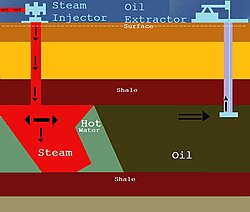
- Thermally Enhanced Oil Recovery (TEOR): This involves heating the oil to reduce its viscosity. Steam injection is the most common TEOR method, often powered by cogeneration plants that use waste heat from electricity generation. Fire flooding (in-situ burning) is another thermal option.
- Chemical and Gas Injection: Surfactants (detergents) are used to alter surface tension, while carbon dioxide flooding reduces viscosity.
- Microbial Treatments: Specialized microbes break down hydrocarbon chains to make oil easier to recover, often providing a more economical alternative.
Factors Influencing Recovery Rates
The amount of oil that can be successfully extracted depends on several geological and physical factors:
- Permeability: How easily fluid flows through the rock (e.g., sandstone is permeable, while shale is "tight").
- Porosity: The storage capacity of the reservoir rock.
- Viscosity: The thickness of the oil.
- Natural Drive Strength: The pressure provided by associated gas or adjacent water.
Because total recovery cannot be known until a well stops producing, engineers calculate the Estimated Ultimate Recovery (EUR) using mathematical models and decline rate projections. Predicting EUR for shale gas is particularly challenging.
| Stage | Mechanism | Typical Recovery Factor | Key Methods |
|---|---|---|---|
| Primary | Natural Pressure | 5% - 15% | Natural drive, Beam pumps, ESPs |
| Secondary | Artificial Pressure | 35% - 45% (Cumulative) | Water injection, Gas lift |
| Tertiary | Mobility Enhancement | Additional 5% - 15% | Steam injection, Surfactants, Microbes |
Health, Safety, and Environmental Impact
The extraction industry faces significant safety challenges. While the annual rate of occupational fatalities decreased by 36.3% between 2003 and 2013, the total number of deaths increased by 27.6% due to a growing workforce. Many fatalities are linked to transportation incidents and equipment contact, particularly among well-service companies. Between 2014 and 2019, the CDC reported 470 worker deaths.
Environmentally, the industry faces two major challenges. First, the burning of fossil fuels is responsible for 89% of carbon dioxide emissions, contributing to climate change and rising sea levels. Second, the risk of oil spills poses a severe threat to ocean pollution.
Frequently Asked Questions
What is a "Christmas tree" in oil drilling?
A Christmas tree is a collection of valves installed at the top of an oil well to regulate pressure and control the flow of petroleum as it is extracted.
How does steam injection help recover oil?
Steam injection is a form of Thermally Enhanced Oil Recovery (TEOR) that heats the oil, reducing its viscosity (making it thinner) so it can flow more easily toward the extraction well.
What is the difference between permeability and porosity?
Porosity refers to the rock's storage capacity (the amount of empty space), while permeability refers to how easily oil can flow through those spaces to the well.
What is the role of a mudlogger?
A mudlogger is a geologist on the drilling rig who monitors the drilling process and records the presence of oil as the well is tapped.
Why is tertiary recovery not always used?
Tertiary recovery is only implemented when secondary recovery is insufficient and when the cost of the method is lower than the market price of the crude oil being recovered.