NZSAS Operational History: A Legacy of Special Operations
The New Zealand Special Air Service (NZSAS) has a storied history of high-stakes deployments, ranging from deep-jungle warfare in Southeast Asia to complex counter-terrorism missions in the Middle East. As an elite unit of the New Zealand Defence Force (NZDF), the NZSAS specializes in reconnaissance, direct action, and unconventional warfare, often operating in the most challenging environments on Earth.
Key Facts
- The Originals: The first NZSAS Squadron deployed to Malaya between 1955 and 1957.
- Combat Record: Engaged in diverse conflicts including the Malayan Emergency, the Indonesia-Malaysia Confrontation, the Vietnam War, and the War in Afghanistan.
- High-Value Success: In Afghanistan (2009–2012), the unit executed over 90% of its raids without firing a shot, making 60 high-risk arrests.
- Gallantry: Members have received prestigious awards, including the Victoria Cross for New Zealand and the New Zealand Gallantry Star.
- Versatility: Capabilities extend beyond combat to include humanitarian evacuations, peacekeeping, and support for the New Zealand Police.
Early Deployments: Malaya and Thailand
The NZSAS first proved its capabilities during the Malayan Emergency. In November 1955, a 133-strong squadron attached to the British SAS began operations against the Malayan National Liberation Army (MNLA), the armed wing of the Malayan Communist Party. Operating primarily in the rugged mountains of Perak and Negri Sembilan, the squadron focused on protecting local populations and eliminating guerrilla groups.
Over a 24-month tour, the "Originals" were involved in 14 engagements, resulting in 15 enemy deaths and 10 captures. The unit suffered two fatalities: Trooper A.R. Thomas, who was fatally wounded in action, and Corporal A.G. Buchanan, who died of heat stroke.
Following this, a 30-man detachment was stationed in Thailand from June to September 1962 during the Laotian crisis. While they saw no direct enemy action, the deployment served as critical training in mounted and jungle operations alongside US Special Forces and Marines.
The Borneo Confrontation and Vietnam War
Between 1965 and 1966, the NZSAS deployed four successive detachments to Borneo. These units conducted patrols—including the secretive CLARET patrols—in the steep, rocky terrain of Sabah. As the conflict wound down, the focus shifted to "hearts-and-minds" campaigns to secure the support of the local Punan tribes before a peace treaty was signed between Indonesia and Malaysia in August 1966.
From 1968 to 1971, the NZSAS operated in the Republic of South Vietnam. Based in Nui Dat and attached to the 1st Australian Task Force, the unit focused on intelligence gathering and long-range reconnaissance patrols (LRRP). A notable success occurred during Operation Marsden in December 1969, where a parachute insertion helped defeat a Communist stronghold in the Mây Tào Mountains.
The Vietnam tour was marked by the loss of Sergeant G.J. Campbell, the unit's only fatality in the theater. The NZSAS conducted the final enemy contact of their rotation on February 4, 1971, killing two Viet Cong soldiers before withdrawing.
Peacekeeping and Regional Stability
In the late 1990s and early 2000s, the NZSAS transitioned toward peacekeeping and crisis response. In Bougainville (1997–98), a 19-man troop provided medical support and communications during Operation BELISI, utilizing negotiation and community relations rather than arms.
In 1998, 24 personnel deployed to Kuwait for Operation GRIFFIN to prepare for the potential rescue of downed airmen during tensions with Iraq. This provided a vital link to US Forces following the suspension of ANZUS relations in 1986.
The unit played a pivotal role in East Timor between 1999 and 2001. During Operation DORIX, they helped evacuate over 1,500 personnel from Dili. Later, a specialized troop of combat trackers was deployed in 2000 to locate militia crossing the border, leading to the deaths of three militia members and the successful extraction of UN staff from West Timor.
The War in Afghanistan (2001–2012)
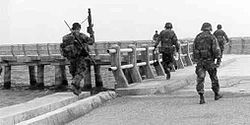
The NZSAS's involvement in Afghanistan spanned over a decade across several distinct operations. From 2001 to 2005, under Operations CONCORD I, II, and III, the unit performed special reconnaissance and direct action. This era saw the introduction of modified Humvees and Pinzgauer Special Operations Vehicles for long-range patrols covering up to 2,000 kilometers.
Trooper Willie Apiata was awarded the Victoria Cross for New Zealand for his bravery during a gun-battle in central Afghanistan in June 2004.
From 2009 to 2012, Operation WĀTEA shifted the focus to counter-insurgency in Kabul. The NZSAS mentored the Afghan Police's Crisis Response Unit (Task Force 24). This period was marked by high-risk arrests and the response to the 2011 Inter-Continental hotel attack, where Corporal "Steve" David Steven Askin and Commander Jamie Pennell earned the New Zealand Gallantry Star.
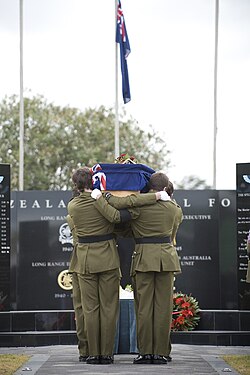
Tragedy struck during this deployment with the deaths of Corporal Douglas Grant, killed during an attack on the British Council building, and Lance Corporal Leon Smith, killed in Wardak Province.
Operation Burnham Allegations
The unit's legacy in Afghanistan has been subject to scrutiny following Operation Burnham in August 2010. In 2017, journalists Nicky Hager and Jon Stephenson alleged that NZSAS personnel committed war crimes by attacking villages in the Tirgiran Valley following the death of Lieutenant Tim O'Donnell.
2021 Evacuation
The NZSAS returned to Kabul in August 2021 for Operation Kõkako. Personnel, including the Female Engagement Team, were instrumental in guiding evacuees through crowds at Hamid Karzai International Airport to safety.
Domestic Support and Other Activities
Beyond international conflict, the NZSAS has provided critical support to the New Zealand Police. This includes training the Armed Offenders Squad and the Special Tactics Group. The unit has been called upon for high-risk domestic incidents, such as the search for fugitive David Maxwell Heron in 1968, the 1965 Mount Eden Prison riots, and securing the holding prison for French agents involved in the 1985 Rainbow Warrior sinking.
| Location | Period | Primary Role | Key Operation/Note |
|---|---|---|---|
| Malaya | 1955–1957 | Jungle Warfare | The "Originals" |
| Borneo | 1965–1966 | Patrolling/Hearts-and-Minds | CLARET patrols |
| South Vietnam | 1968–1971 | LRRP/Intelligence | Operation Marsden |
| East Timor | 1999–2001 | Evacuation/Combat Tracking | Operation DORIX |
| Afghanistan | 2001–2012 | Counter-Terrorism/Mentoring | Operation WĀTEA |
Frequently Asked Questions
Who are "The Originals" in NZSAS history?
"The Originals" refers to the first NZSAS Squadron that deployed to Malaya between 1955 and 1957 to fight against the Malayan National Liberation Army.
What was the role of the NZSAS in the Vietnam War?
The NZSAS focused on intelligence gathering, ambush patrols, and Long-range reconnaissance patrols (LRRP) while attached to the 1st Australian Task Force.
What is the significance of Operation WĀTEA?
Operation WĀTEA (2009–2012) was a counter-insurgency mission in Kabul, Afghanistan, where the NZSAS mentored the Afghan Police's Crisis Response Unit.
How has the NZSAS supported New Zealand Police?
The unit has provided training in field craft and weapon handling for the Armed Offenders Squad and the Special Tactics Group, and assisted in high-risk security operations like the Rainbow Warrior agent detention.
What were the CLARET patrols in Borneo?
CLARET patrols were specialized operations conducted by the NZSAS (and other SAS units) in Borneo during the Confrontation, often involving cross-border activity.