Norwegian Rock Music: From Early Influences to Global Black Metal
Rock music arrived in Norway during the late 1950s, riding the wave of the rock 'n' roll revolution sweeping through the United States and Great Britain. While Norway quickly produced highly capable musicians, the early scene was heavily shaped by Anglo-American styles. For decades, English remained the primary language for rock expression, while the Norwegian language was largely reserved for traditional pop and hit music.
Key Facts
- Early Influence: The scene began in the late 1950s, heavily influenced by US and UK rock 'n' roll.
- Language Shift: English dominated early rock, but singing in Norwegian became more acceptable starting in the mid-1970s.
- Global Success: TNT was the first Norwegian band to appear on the American Billboard charts.
- Genre Diversity: Norway is world-renowned for its underground black metal scene and unique progressive rock.
- Cultural Hubs: The Blitz-huset in Oslo and UFFA house in Trondheim served as critical centers for the punk movement.
The Formative Years: 1950s and 1960s
The 1950s were defined by pioneering performers such as Per Granberg, Per Hartvig (known as Rocke-Pelle), Jan Rohde, and Odd Gisløy (Smiling Tommy). Gisløy notably contributed to the era's songwriting with his composition "Dancing with My Rockin' Shoes".
By the early 1960s, "Shadow bands"—instrumental groups inspired by the British band The Shadows—gained popularity, with The Beatniks and The Vanguards leading the trend. The mid-1960s saw the emergence of The Pussycats, who recorded albums in both West Germany and Great Britain under the production of Sven-Erik Børja, with most songs written by member Trond Graff.
Evolution and Experimentation: 1970s and 1980s
The 1970s marked a period of diversification. In 1971, the band Titanic achieved international success, reaching #5 on the UK singles chart. Simultaneously, the progressive rock scene emerged, highlighted by Junipher Greene's Friendship, the first double album released in Norway.
During the mid-1970s, a shift toward national identity occurred as singing in Norwegian became more acceptable. Åge Aleksandersen, a "trønder rocker," pioneered this movement. Other bands, such as Folque, began blending rock with traditional Norwegian folk and old dance music. This era of experimentation was further fueled by the popularity of Frank Zappa in Norway, influencing bands like Ruphus, Aunt Mary, and Høst.
The Rise of Norwegian Punk
Punk rock arrived abruptly on July 20, 1977, when the Sex Pistols performed at the Penguin Club in Oslo and later in Trondheim. This sparked a domestic punk scene, with the first records debuting in 1979. While several bands are candidates for the first Norwegian punk single—including Pink Dirt, Graxelaget, Front Page, Kjøtt, Oslo Børs, and Børres Kork—researcher Trygve Mathiesen identifies Børres Kork as the earliest. The movement found a permanent home at the Blitz-huset in Oslo (established 1982) and the Hard Rock Kafé in Trondheim, which produced bands like Wannskrækk and Liliedugg.
The 1980s Pop and Rock Boom
The 1980s saw the rise of internationally recognized acts like a-ha, Artch, Return, and Stage Dolls. TNT made history as the first Norwegian group to feature on the American Billboard charts. Toward the end of the decade, a new generation of Norwegian-language bands emerged, known as the "4 great ones": DumDum Boys, DeLillos, Raga Rockers, and Jokke & Valentinerne. Except for Jokke (Joachim Nielsen, who passed away in 2000), these groups remain active.
Modern Era and Global Influence: 1990 to Present
Since 1990, Norway has maintained a strong international presence through bands like Turbonegro, Gluecifer, and Madrugada, while others such as BigBang, Euroboys, and Span focus on the domestic market. The hard rock band Kvelertak, hailing from Stavanger, has toured globally since their 2010 self-titled debut.
The Black Metal Phenomenon
Between the mid-1980s and early 1990s, an underground black metal scene grew into a global movement. This scene included influential bands such as Mayhem, Immortal, Enslaved, Darkthrone, Burzum, Gorgoroth, Satyricon, Solefald, and Dimmu Borgir.
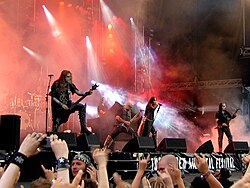
Other developments include the 1999 formation of the industrial rock band Zeromancer, featuring former members of Seigmen. Since 2001, Kaizers Orchestra has become a cornerstone of the scene, distinguished by their use of non-traditional percussion—such as oil barrels, car wheels, and garbage cans—alongside pump organs and accordions.
| Era | Key Characteristics | Notable Artists |
|---|---|---|
| 1950s-60s | Anglo-American influence, Shadow bands | Smiling Tommy, The Pussycats |
| 1970s | Progressive rock, shift to Norwegian lyrics | Titanic, Åge Aleksandersen, Folque |
| 1980s | Punk explosion, Billboard success, "4 Great Ones" | a-ha, TNT, DumDum Boys, Raga Rockers |
| 1990s-Present | Black metal global rise, industrial and experimental rock | Mayhem, Dimmu Borgir, Kaizers Orchestra |
Frequently Asked Questions
Which Norwegian band first appeared on the US Billboard charts?
TNT was the first Norwegian band to be featured on the American Billboard charts.
Who is credited with releasing the first Norwegian punk single?
While several bands were contenders, Trygve Mathiesen concludes that Børres Kork had the earliest release date.
What makes Kaizers Orchestra's sound unique?
They use a variety of unusual instruments, including pump organs and accordions, and utilize oil barrels, car wheels, and garbage cans for percussion.
Which bands are considered the "4 great ones" of the late 80s?
The "4 great ones" are DumDum Boys, DeLillos, Raga Rockers, and Jokke & Valentinerne.
What are the primary centers for the punk scene in Norway?
The punk scene is centered around the Blitz in Oslo and the UFFA house in Trondheim.