Northern Ireland Assembly 1982–1986: A Period of Political Deadlock
The Northern Ireland Assembly of 1982–1986 was established as an attempt to move toward devolution—the transfer of certain powers from a central government to a local administration. However, the period was defined by deep sectarian divisions, a lack of cross-community consensus, and an eventual collapse triggered by international diplomacy.
The Struggle for Participation
From its inception, the Assembly faced significant hurdles. The Ulster Unionist Party (UUP), led by James Molyneaux, initially attempted to block devolution and frustrate the Assembly's creation. While the UUP eventually agreed to serve on committees by Spring 1983, their leadership remained absent. In contrast, the Democratic Unionist Party (DUP) and the Alliance Party were enthusiastic supporters of the Assembly's scrutiny functions.
The Social Democratic and Labour Party (SDLP) chose to abstain entirely. They argued that the initiative lacked an "Irish dimension" and that Unionists had already signaled their refusal to engage in power-sharing—a system where different political factions share executive authority. This alienation was deepened when SDLP Deputy Leader Seamus Mallon was disqualified from the Assembly after accepting an appointment to Seanad Éireann (the Irish Senate), a move initiated by the UUP's Harold McCusker.
The SDLP's decision to abstain was supported by Taoiseach Garret FitzGerald, who viewed the Assembly as a "cul-de-sac" for moderate nationalists. He feared that forcing the SDLP into a body committed against power-sharing would only drive the frustrated minority population toward Sinn Féin.
Political Friction and Sectarian Tensions
Internal conflicts within the Assembly highlighted the era's volatility. In May 1983, motions regarding the future of devolved government were voted down as the UUP and DUP clashed with each other and united only to defeat the Alliance Party's call for power-sharing.
Secretary of State James Prior emphasized that substantial support from "both sides of the community" was an essential precondition for successful devolution. However, DUP member Jim Allister explicitly stated that his party would prefer no devolved government over one that shared power with the SDLP or republicans.
Tensions further escalated in June 1983 when the Assembly passed a motion demanding a crackdown on the flying of the Irish tricolour, citing the Flags and Emblems Act. Unionist members described the flag as a "provocative rebel rag" and a symbol of a state that harboured murderers.
Instability and the Path to Dissolution
The Assembly's stability remained fragile. In November 1983, the UUP briefly withdrew in protest over security concerns following a republican paramilitary attack on a church in Darkley. Although they returned in May 1984, the party continued to oppose the "rolling devolution" proposed by James Prior, rejecting both power-sharing and the Irish dimension.
By 1985, the British government, under Secretary of State Douglas Hurd, began openly discussing the involvement of the Irish government in Northern Ireland's internal affairs. This caused intense alarm among Unionists, who viewed such moves as a betrayal of their position.
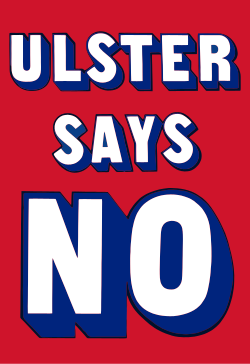
The breaking point arrived on November 15, 1985, with the signing of the Anglo-Irish Agreement by Margaret Thatcher and Garret FitzGerald. This landmark treaty gave the Irish government a consultative role in Northern Ireland's affairs via an Inter Governmental Conference. Unionists reacted with outrage, leading to street violence and a total breakdown of the Assembly's functions.
The Assembly ceased to be a legislative or scrutiny body, becoming instead a platform for Unionist opposition. In March 1986, all scrutiny committees were abolished. The end came on June 23, 1986, when the Secretary of State ordered the dissolution of the Assembly. The exit was chaotic, with twenty-one Unionist representatives, including Ian Paisley and Jeffrey Donaldson, requiring forcible removal by the Royal Ulster Constabulary (RUC).
Key Facts
- Duration: The Assembly operated from 1982 until its dissolution in June 1986.
- Major Parties: Included the UUP, DUP, Alliance Party, and the abstaining SDLP.
- Core Conflict: A fundamental disagreement over power-sharing and the "Irish dimension" of governance.
- Catalyst for Collapse: The 1985 Anglo-Irish Agreement, which granted the Irish government a consultative role.
- Final Act: The Assembly was dissolved by the Secretary of State, ending with the forced eviction of Unionist members.
| Party | Stance on Assembly | View on Power-Sharing | View on Irish Government Role |
|---|---|---|---|
| UUP | Initially obstructive; later participated | Opposed | Strongly Opposed |
| DUP | Enthusiastic advocate for scrutiny | Opposed | Strongly Opposed |
| SDLP | Abstained | Required for participation | Supported |
| Alliance | Enthusiastic advocate | Strongly Supported | Open/Moderate |
Frequently Asked Questions
Why did the SDLP refuse to join the Assembly?
The SDLP abstained because they believed the Assembly lacked a serious political solution, specifically citing the absence of an "Irish dimension" and the open refusal of Unionist parties to engage in power-sharing.
What was the significance of the Anglo-Irish Agreement?
Signed in 1985, the Agreement gave the Irish government its first consultative role in Northern Ireland's affairs. This was viewed as a betrayal by Unionists and directly led to the Assembly's dysfunction and eventual dissolution.
How did the UUP and DUP differ in their vision for devolution?
While both rejected power-sharing, the UUP proposed an Assembly that could make decisions within granted powers but not pass legislation. The DUP argued for the restoration of majority rule led by a Prime Minister of Northern Ireland, with minor safeguards for minorities.
What happened during the final dissolution of the Assembly?
On June 23, 1986, the Assembly was dissolved. Twenty-one Unionist members refused to leave the chamber and had to be forcibly evicted by the RUC, while protesters clashed with police outside.
What was the "Irish dimension" mentioned in the text?
The "Irish dimension" refers to the inclusion of the Republic of Ireland's government or interests in the political administration and decision-making processes of Northern Ireland.