Nineteenth Century English Education: From Class Divisions to Compulsory Schooling
During the nineteenth century, the English education system served as a mirror of the era's rigid social hierarchy. Education was not a universal right but a tool that reinforced class divisions, with separate institutions tailored to different social strata. While the wealthy accessed prestigious public schools and universities, the middle class relied on grammar schools and private academies, and the working class received basic literacy and moral instruction in elementary schools.
Beyond class, education was a fierce religious battleground. Rivalries between Anglicans, Nonconformists (Protestants who did not follow the Church of England), and Catholics actually accelerated the expansion of schools, as each group competed to establish their own institutions to secure the spiritual and intellectual loyalty of the population.
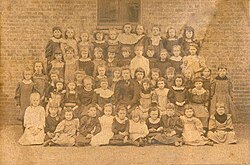
Key Facts
- Class-Based Tracks: Education was split between public schools (wealthy), grammar schools (middle class), and elementary schools (working class).
- Religious Influence: Early schooling was dominated by the Church of England and Nonconformist groups before state intervention.
- The 1870 Act: The Elementary Education Act 1870 established board schools to fill gaps in primary education.
- Women's Progress: The 19th century saw the founding of colleges like Girton and Somerville, allowing women to obtain university degrees.
- Compulsory Shift: By the end of the century, primary education became effectively free and compulsory for children up to age 12.
The Evolution of Higher Education
Higher education underwent a significant transformation during this period. University College London emerged as the first secular college, welcoming students regardless of their religious beliefs. This was followed by King's College London, and together they formed the University of London. Durham University was also established early in the century, and by the end of the era, the "redbrick" universities—new public institutions—began to appear.
The century also marked a pivotal shift in gender accessibility. The establishment of Lady Margaret Hall and Somerville College at Oxford, as well as Bedford College in London and Girton College at Cambridge, finally enabled women to pursue and obtain university degrees.
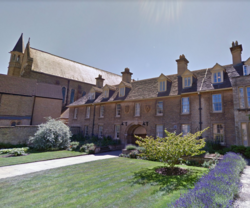
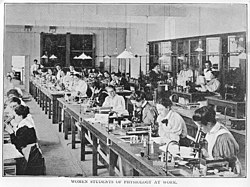
Professional Training for Women
Beyond traditional degrees, women began entering specialized scientific fields, as seen in the physiology laboratories of the London School of Medicine.
Religious and Charitable Schooling
Before the state took a leading role, education was primarily the domain of the church. The Church of England resisted secular state education, leading to the 1811 creation of the National Society for Promoting the Education of the Poor, which founded National Schools. Many of these institutions were later absorbed into the state system via the Butler Act of 1944.
In contrast, the British schools were established by the Society for Promoting the Lancasterian System for the Education of the Poor in 1808. These were non-denominational institutions supported by evangelical and non-conformist Christians. Additionally, Sunday Schools played a massive role; by 1831, they served 1.25 million children—roughly 25% of the population—acting as a precursor to the formal state system.
Ragged Schools
For the most destitute children, Ragged schools provided a vital lifeline. These charitable organizations operated in working-class districts for children who were often too unkempt or "challenging" for Sunday Schools. The London Ragged School Union, formed in 1844, expanded these services to include food, clothing, and lodging before the schools were phased out toward the end of the century.
The Rise of Government Intervention
State involvement began modestly in August 1833, when Parliament first voted annual funds for schools for poor children. This marked the first time the state intervened in English and Welsh education, trailing behind Scotland's earlier universal programs.
Reform efforts continued throughout the mid-century. The Grammar Schools Act of 1840 modernized curricula by adding science and literature to classical studies. Meanwhile, at Rugby, Thomas Arnold reformed public schools by emphasizing sports and teamwork to redefine masculinity.
A significant shift occurred under Robert Lowe, a Liberal politician who introduced "payment by results" in 1861. This system allocated grants based on student performance in reading, writing, and arithmetic examinations rather than the subjective opinions of inspectors.
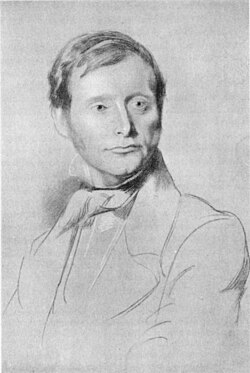
The Elementary Education Act 1870 and Beyond
By 1870, approximately 2 million primary-aged children had no access to schooling. To address this, William Forster introduced the Elementary Education Act 1870, which created board schools—partially state-funded institutions managed by elected boards.
The Act was fraught with religious tension. To appease Nonconformists, the Cowper-Temple clause ensured that religious teaching in state schools remained non-denominational. Additionally, parents were granted the right to withdraw their children from religious instruction.
The Path to Universal Education
The late 19th century saw a rapid succession of laws making education a legal requirement:
- 1876 (Sandon Act): Imposed a legal duty on parents to ensure their children were educated.
- 1880 (Mundella Act): Enforced compulsory attendance for ages 5 to 10.
- 1891: Primary education became effectively free as the state paid fees up to ten shillings per head.
- 1893: The school leaving age was raised to 11, and special schools were created for blind and deaf children.
- 1899: The school leaving age was further raised to 12.
Technical and Vocational Growth
As the industrial era progressed, the need for technical skill grew. The Technical Instruction Act 1889 allowed local authorities to levy taxes to support manual and technical instruction. This was further bolstered by the "whiskey tax" introduced via the Local Taxation Act. By April 1900, higher elementary schools were recognized, bridging the gap for students aged 10 to 15.
| Year | Act/Event | Primary Impact |
|---|---|---|
| 1833 | First Parliamentary Grants | First state funding for schools for the poor. |
| 1840 | Grammar Schools Act | Added science and literature to the curriculum. |
| 1861 | Payment by Results | Grants based on exam passes in core subjects. |
| 1870 | Elementary Education Act | Established state-funded board schools. |
| 1880 | Mundella Act | Compulsory attendance for ages 5 to 10. |
| 1891 | Fee Payment Act | Made primary education effectively free. |
| 1899 | Attendance Amendment Act | Raised school leaving age to 12. |
Frequently Asked Questions
What were Ragged schools?
Ragged schools were charitable organizations that provided free education, food, and clothing to the most impoverished children in working-class districts, specifically those excluded from other schools due to their appearance or behavior.
What was the "payment by results" system?
Introduced by Robert Lowe in 1861, this was a funding model where government grants were awarded to schools based on the number of students who passed standardized examinations in reading, writing, and arithmetic.
How did the Cowper-Temple clause resolve religious disputes?
The clause mandated that religious instruction in the new state board schools be non-denominational, avoiding specific doctrines that caused conflict between Anglicans and Nonconformists.
When did primary education become free and compulsory in England?
It became a gradual process: the 1880 Act made attendance compulsory for ages 5 to 10, and the 1891 Act made it effectively free by providing state payment for school fees.
What were "redbrick" universities?
Redbrick universities were new public universities founded toward the end of the nineteenth century, expanding higher education beyond the traditional ancient universities.