Nidd Valley Light Railway: The Industrial Lifeline of the Upper Nidd Valley
The story of the Nidd Valley Light Railway is a fascinating intersection of municipal ambition, civil engineering, and industrial logistics. Born from the necessity to secure a reliable public water supply for the city of Bradford, this railway served as the primary artery for the construction of massive reservoirs in the rugged terrain of North Yorkshire.
The project began in the late 19th century when the Bradford Corporation identified the upper Nidd Valley as an ideal site for water storage. Following the advice of geologist Professor Alexander Henry Green and engineer Alexander Binnie, the city sought parliamentary approval to harness the valley's waters, leading to a series of ambitious infrastructure projects that would reshape the landscape.
Key Facts
- Purpose: Built primarily to transport materials and labor for the construction of Angram and Scar House reservoirs.
- Route: Ran from the Nidd Valley Railway terminus at Pateley Bridge to Lofthouse, and later extended to Angram and Scar House.
- Gauge: Originally planned as a 2 ft 6 in (762 mm) light railway, it was eventually built to standard gauge (4 ft 8.5 in).
- Key Figures: Developed under the authority of the Bradford Corporation and constructed largely by contractor John Best.
- Peak Employment: The Scar House project employed approximately 780 men at its height.
The Path to Construction
The initial push for water security resulted in the Bradford Corporation Waterworks Acts of 1890 and 1892. These authorized the creation of four reservoirs: Angram, Haden Carr, High Woodale, and Gouthwaite. While Haden Carr and Gouthwaite were completed by 1901, the more remote Angram site required a more robust transport solution than existing roads could provide.
Initially, a private firm called Power & Traction Ltd sought to build a light railway to Lofthouse. However, the Bradford Corporation eventually took over these powers. After significant debate regarding the track gauge—with the North Eastern Railway (NER) pushing for standard gauge to avoid the need for transshipping goods—the Board of Trade granted a transfer order on December 30, 1903. This order was signed by Winston Churchill, then President of the Board of Trade.
Early Infrastructure and the 3 ft Gauge
Before the formal standard gauge line was established, a temporary 3 ft (914 mm) gauge contractor's railway was built by Holme and King to support road construction between Lofthouse and Angram. By mid-1904, this temporary line spanned 6.5 miles (10.5 km). This era saw the use of small 0-4-0 saddle tank locomotives, including engines named Xit and Angram, which were used to transport city officials during the ceremonial "first sod" events for the railway and the dam.
Operational Evolution and Rolling Stock
As the railway transitioned to a formal public and industrial service, the Bradford Corporation acquired second-hand equipment from the Metropolitan Railway in London. This included ten 4-wheeled coaches and two 4-4-0 Beyer Peacock side tank locomotives, named Holdsworth and Milner.
These locomotives proved too heavy for the original light railway axle loading limits of 6.5 tons, necessitating a request for increased weight allowances. Over time, the fleet evolved to include a Hudswell Clarke 0-6-0 and a Great Western Railway steam railmotor named Hill, which served the public section between Pateley Bridge and Lofthouse.
| Feature | Details |
|---|---|
| Primary Termini | Pateley Bridge to Lofthouse / Angram / Scar House |
| Key Reservoirs Served | Angram and Scar House |
| Main Contractor | John Best & Sons |
| Peak Passenger Year | 1923 (63,020 journeys) |
| Closure Date | December 31, 1929 (Public services) |
The Scar House Era
With the completion of Angram Reservoir in 1916, the corporation shifted focus to the even larger Scar House project. This required a massive expansion of the railway's capabilities. A dedicated village, Scar Village, was constructed between 1920 and 1921 to house up to 640 men in ten hostels, complete with a school, concert hall, and mission church.
The railway was upgraded with eased curves, new loops at Lofthouse and Woodale, and a specific 180-yard (160 m) tunnel near Goyden Pot designed for uphill trains only.
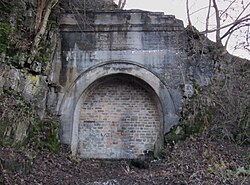
The logistics at Scar House were complex, featuring a network of zig-zagging sidings and several inclines. A double-track self-acting incline provided access to the Carle Fell Quarry, while a smaller 2 ft (610 mm) gauge line with battery-electric locomotives was used for diverting waters from Armathwaite Gill and Howstean Beck.
Decline and Legacy
Despite its industrial utility, the public side of the railway struggled financially. Competition from motor buses led to a one-third fare reduction in 1929, but the line continued to operate at a loss. Public passenger and goods services officially ceased on December 31, 1929.
The railway's physical existence was tied to the construction projects it served. The building of the main Scar House dam eventually severed the line to Angram in 1933. By 1936, the tracks were lifted, and the remaining assets were sold in a single lot at Pateley Bridge on March 1, 1937. The once-bustling Scar Village dwindled rapidly; its school closed in 1938, marking the end of an era of monumental municipal engineering.
Frequently Asked Questions
Why was the Nidd Valley Light Railway built?
The railway was constructed to facilitate the transport of materials, machinery, and labor required to build the Angram and Scar House reservoirs, which provided the public water supply for Bradford.
Who signed the order for the railway's gauge change?
Winston Churchill, serving as the President of the Board of Trade, signed the document that allowed the railway to be built to standard gauge.
What happened to the locomotives used on the line?
Many were second-hand acquisitions from the Metropolitan Railway. Some, like the original Milner, were sold to other companies (such as the North Wales Granite Company), while others were used as stationary steam supplies or sold during the 1937 liquidation sale.
How did the railway handle the steep terrain near the quarries?
The railway utilized a series of inclines, including a double-track self-acting incline for the Carle Fell Quarry and winch-operated inclines to move rock and materials between different elevations of the valley.
When did the railway officially close to the public?
Public passenger and goods services ended on December 31, 1929, although some private services for Scar Village residents continued until 1932.