Newton's Law of Universal Gravitation
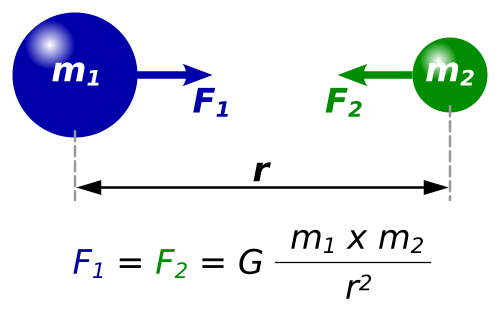
Newton's law of universal gravitation describes gravity as a fundamental force of attraction. It posits that every particle in the universe attracts every other particle with a force that is proportional to the product of their masses and inversely proportional to the square of the distance between their centers of mass. This discovery is often referred to as the first great unification, as it bridged the gap between the gravity observed on Earth and the astronomical behaviors of celestial bodies.
Formulated by Isaac Newton and published on July 5, 1687, in his seminal work Philosophiæ Naturalis Principia Mathematica (the Principia), this law is a cornerstone of classical mechanics. Newton arrived at this conclusion through inductive reasoning—deriving general physical laws from empirical observations.
Key Facts
- Universal Application: Gravity affects every object with mass in the universe.
- Inverse-Square Law: The force of gravity decreases rapidly as the distance between two objects increases.
- The Gravitational Constant (G): The value is approximately 6.674 × 10⁻¹¹ m³⋅kg⁻¹⋅s⁻².
- Symmetry: Spherically symmetrical objects act as if all their mass is concentrated at a single central point.
- Historical Milestone: The law unified terrestrial and celestial mechanics for the first time.
The Mathematical Framework
The gravitational force acting between two objects is expressed by the following equation:
F = G (m₁m₂ / r²)
- F is the gravitational force between the two objects.
- m₁ and m₂ are the masses of the objects.
- r is the distance between the centers of mass.
- G is the gravitational constant.
This mathematical structure closely resembles Coulomb's law of electrical forces. Both are inverse-square laws, meaning the force is inversely proportional to the square of the distance, though Coulomb's law utilizes electrical charge instead of mass.
Historical Development and Validation
Before Newton, theories of gravity were largely philosophical. Aristotle, for example, believed objects fell because seeking the ground was their inherent nature. By the 17th century, the scientific method emerged through the work of René Descartes, Galileo Galilei, and Johannes Kepler, whose laws of planetary motion provided the empirical basis Newton needed.
Around 1666, Newton hypothesized that Kepler's laws applied to the Moon and all objects on Earth. However, he delayed publishing his findings for twenty years until he could prove that the Earth's gravity acts as if its entire mass were concentrated at its center. By 1680, improved measurements of the Earth's diameter allowed him to calculate the Moon's orbit time within 1.6% of the known value.
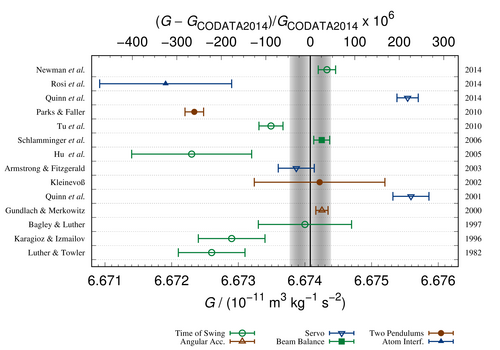
While Newton established the proportionality of the force, he did not determine the numerical value of G. This was achieved in 1798 by British scientist Henry Cavendish. The Cavendish experiment served as the first laboratory test of the law, occurring 111 years after the publication of the Principia.
Gravitational Fields and Spatial Extent
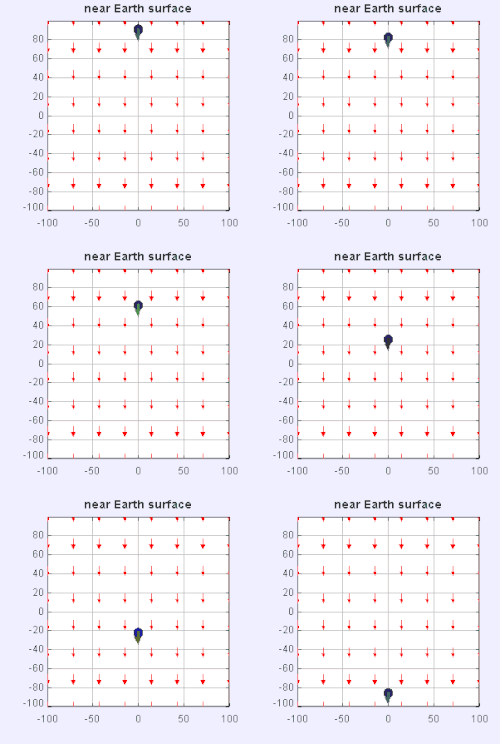
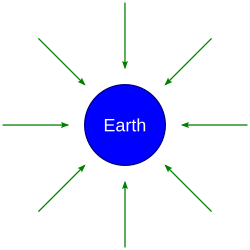
In modern physics, gravity is often described as a gravitational field—a vector field that describes the force applied per unit mass at any given point in space. This is equivalent to the gravitational acceleration at that point.
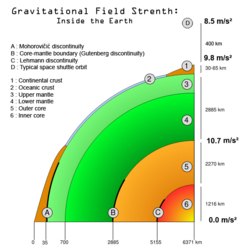
For objects with spatial extent, Newton's shell theorem provides critical insights:
- External Points: A spherically symmetric mass exerts the same attraction as if all its mass were concentrated at its center.
- Internal Points: For a point inside a symmetric mass distribution, only the mass located at a radius smaller than the point's distance from the center exerts a net force; the mass outside that radius cancels itself out.
Limitations and the Shift to General Relativity
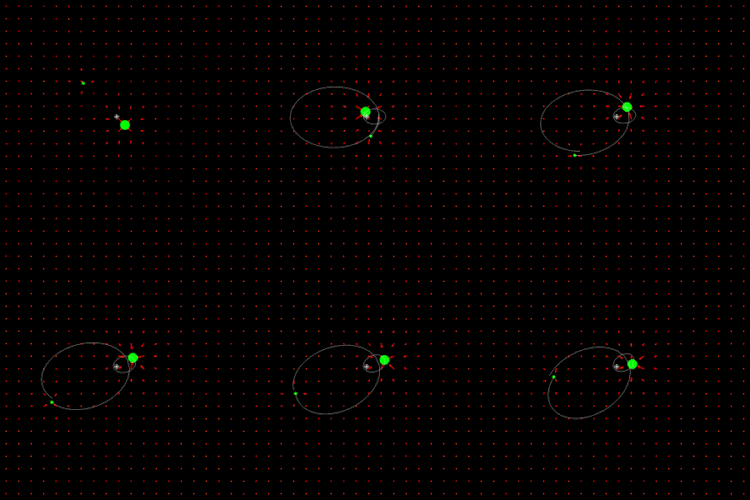
Despite its utility, Newton's law is an approximation. It is highly accurate for most applications, such as the Earth-Sun system, but fails in environments with extreme gravity or high velocities. These limitations are evident in two primary observations:
- Mercury's Orbit: There is a 43 arcsecond per century discrepancy in the precession of Mercury's perihelion that Newtonian physics cannot explain.
- Light Deflection: Newton's theory predicts only half of the actual angular deflection of light rays by gravity observed by astronomers.
Albert Einstein resolved these conflicts with the theory of general relativity. Einstein proposed that gravity is not a force acting at a distance, but a manifestation of curved spacetime. Energy and momentum distort the geometry of spacetime, and objects follow these curves (geodesics). Newton's law is now viewed as the "low-gravity limit" of general relativity.
Summary of Gravitational Theories
| Feature | Newtonian Gravitation | General Relativity |
|---|---|---|
| Nature of Gravity | An attractive force between masses | Curvature of spacetime |
| Mathematical Basis | Inverse-square law | Einstein field equations |
| Accuracy | High for low mass/velocity | High for all conditions |
| Key Limitation | Cannot explain Mercury's precession | Mathematically more complex |
Frequently Asked Questions
What is the difference between Newton's law and General Relativity?
Newton's law describes gravity as a force acting instantly between two masses. General Relativity describes gravity as the curvature of spacetime caused by mass and energy, which dictates how objects move.
Why is the Cavendish experiment important?
The Cavendish experiment was the first to measure the gravitational attraction between masses in a laboratory setting, which allowed for the first accurate determination of the gravitational constant (G).
Does Newton's law still apply today?
Yes. While superseded by relativity, Newton's law remains an excellent approximation for most practical applications where gravitational fields are not extremely strong and velocities are well below the speed of light.
What is the "inverse-square law"?
It is a principle stating that a physical quantity (in this case, gravitational force) decreases in proportion to the square of the distance from the source of that quantity.
How do astrophysicists explain stars that seem to disobey Newton's law?
In spiral galaxies, stars often orbit their centers at speeds that contradict both Newtonian gravity and general relativity. Scientists explain this by assuming the existence of large amounts of invisible dark matter.