Newmarket Park: From Landslides to Ecological Restoration
Newmarket Park has a complex history, evolving from a utilitarian rubbish dump into a sporting hub, and eventually into a protected recreational space. Located in a gully containing the Newmarket Stream (formerly known as Slaughter House Creek), the area has faced significant geological and environmental challenges that have shaped its current form.
A History of Transformation
In the early European history of the region, the gully was primarily used as a rubbish dump. This changed in the 1930s when an employment scheme was implemented to create a flat area on the higher western slope of the gully, situated roughly halfway up toward the railway line.
This newly leveled land served various purposes over the decades, including an athletics track, a golf driving range, and a venue for midget car racing. By 1962, the Auckland Football Association leased the site, transforming it into New Zealand's national soccer stadium and a venue for numerous international matches.
However, the site's geological instability led to its decline. A massive landslide in 1979 destroyed part of the playing field and one of the grandstands. A second major landslip occurred in 1988, leaving the park largely disused.
The Fight for Public Recreation
During the late 1990s, the Newmarket Park Protection Society (now the Newmarket Protection Society) launched a campaign to determine the future of the land. Various proposals were considered, including a Japanese cultural centre, a cultural theme park, botanical gardens, rugby fields, a bowling green, a driving range, or even an artificial skifield.
The society's efforts were successful, ensuring the area was preserved as a recreational park featuring a playground and a decorative small lake.
Environmental Remediation and Slope Stabilisation
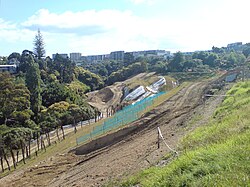
Recent works revealed that the park faced two primary threats: ongoing risk of large landslips and soil contamination resulting from its early use as a rubbish dump. There were significant concerns that toxins from the landfill could leach into the local watercourse.
To address these issues, the Council initiated a multi-year program to rebuild the slope into a more permanently stable, slightly less steep form. This project, with an estimated cost of $6.2 million, involves revegetating the landscape and restoring park facilities, including the local lake.
Community and Ecological Concerns
The remediation process has not been without controversy. Some local residents expressed concern over the removal of several hectares of trees, alleging that the Council chose the most affordable option rather than one that preserved more vegetation. In response, the Council defended the necessity of the works, and a spokesperson for Forest & Bird noted that sufficient trees would be retained around cleared areas to minimize the impact on local birdlife.
Specific concerns were raised regarding the northeastern section along Ayr Street. Residents urged the protection of mature trees and tree ferns, some aged between 60 and 80 years, claiming that preliminary works suggest rubbish layers do not extend into this specific area. The Council has indicated a willingness to assess these claims.
Despite these disputes, the project has made significant ecological strides. By early 2012, the remediation efforts had resulted in the planting of more than 10,000 native trees and plants.
Key Facts
- Original Use: Early European history saw the gully used as a rubbish dump.
- Sporting Legacy: Once served as New Zealand's national soccer stadium starting in 1962.
- Geological Events: Major landslides occurred in 1979 and 1988.
- Project Cost: The slope stabilisation and remediation works are expected to cost $6.2 million.
- Ecological Recovery: Over 10,000 native plants and trees were planted by early 2012.
| Era/Period | Primary Use or Event | Key Outcome |
|---|---|---|
| Early European | Rubbish Dump | Soil contamination |
| 1930s | Employment Scheme | Creation of flat western slope |
| 1962 - 1979 | National Soccer Stadium | International match venue |
| 1979 & 1988 | Major Landslides | Destruction of grandstand and field |
| Late 1990s | Protection Campaign | Designated as recreational park |
| 2011 - Present | Remediation Works | Slope stability and native planting |
Frequently Asked Questions
Why was Newmarket Park closed for a period of time?
The park fell into disuse following two major landslides in 1979 and 1988, which destroyed critical infrastructure including a grandstand and part of the playing field.
What were the environmental risks associated with the site?
The site suffered from slope instability and soil contamination due to its history as a rubbish dump, which created a risk of toxins leaching into the Newmarket Stream.
How much is being spent on the park's restoration?
The program to rebuild the slope for permanent stability and restore park facilities is expected to cost $6.2 million.
What happened to the trees during the remediation process?
While several hectares of trees were removed for stabilisation works—leading to some local concern—the project has since planted more than 10,000 native trees and plants to restore the landscape.
What other uses were proposed for the park in the 1990s?
Proposals included a Japanese cultural centre, a cultural theme park, botanical gardens, rugby fields, a bowling green, a driving range, and an artificial skifield.