New Zealand Herald: A History of Auckland's Leading Newspaper
The New Zealand Herald stands as one of the most enduring pillars of journalism in New Zealand. Founded during a period of rapid urban growth and political tension in Auckland, the publication has evolved from a partisan daily into a modern media entity, reflecting the social and political shifts of the nation over more than a century and a half.
The Founding and Early Rivalries
The newspaper was established by William Chisholm Wilson (1810–1876) and first published on November 13, 1863. Wilson had previously been a partner with John Williamson at The New-Zealander, but he departed to launch a rival daily to capitalize on Auckland's expanding population. This split was fueled by ideological differences; Wilson supported the war against the Māori—which the Herald referred to as "the native rebellion"—while Williamson opposed the conflict.
Beyond local conflict, the Herald sought to foster a more constructive relationship between the North and South Islands of New Zealand.
Competition with The Daily Southern Cross
Following the closure of The New Zealander in 1866, the Herald faced significant competition from The Daily Southern Cross. Originally launched in 1843 as The Southern Cross by William Brown, it transitioned to a daily publication in 1862. The paper saw a period of influence under Julius Vogel, who held a majority shareholding from 1868 until 1973, before being purchased by Alfred Horton in 1876.
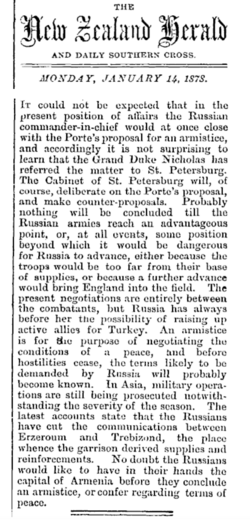
The rivalry ended in 1876 when the Wilson family and Alfred Horton entered a partnership, leading the New Zealand Herald to absorb The Daily Southern Cross.
Industry Collaboration and Corporate Evolution
As the media landscape matured, the Herald engaged in strategic collaborations to manage costs and expand reach. In 1879, the United Press Association was formed to allow main daily papers to share news stories; this organization later became the New Zealand Press Association (NZPA) in 1942, before eventually closing in 2011. Furthermore, in 1892, the Herald partnered with the Otago Daily Times and Press to share the expenses of an advertising salesman and a correspondent based in London.
Ownership Transitions
For decades, the company operated as Wilson & Horton, representing the interests of the founding families. This changed in 1996 when the Dublin-based Independent News & Media Group, led by Tony O'Reilly, purchased the Horton family's shares. Ownership later shifted to APN NZ, a subsidiary of APN News & Media.
In 2007, APN NZ outsourced much of the paper's copy editing—the process of reviewing and correcting text—to an Australian firm called Pagemasters. By 2014, the Herald became part of New Zealand Media and Entertainment, a company formed by the Sydney-based APN News & Media and the Radio Network (formerly owned by the Australian Radio Network).
Key Facts
- Founded: November 13, 1863, by William Chisholm Wilson.
- Major Merger: Absorbed The Daily Southern Cross in 1876.
- Format Change: Switched weekday editions from broadsheet to compact on September 10, 2012.
- Current Owner: New Zealand Media and Entertainment (since 2014).
- Historical Affiliation: Member of the NZPA (New Zealand Press Association) until its 2011 closure.
Notable Contributors
Throughout its history, the Herald has employed a variety of influential writers and artists:
- Editors: William Berry served as editor of the Herald in 1875 and the Daily Southern Cross in 1877. William Lane served as a leader writer from 1900 before becoming editor in 1913.
- Cartoonists: Gordon Minhinnick was a staff cartoonist from the 1930s to the 1980s. Laurence Clark served as the daily political cartoonist from 1987 to 1996, continuing weekly until 2000. Malcolm Evans was a staff cartoonist until 2003, when he was dismissed following complaints regarding his work on the Israeli–Palestinian conflict.
- Columnists: Dita de Boni wrote for the paper starting in 1995, focusing on business and politics from 2012 to 2015 before her column was discontinued for financial reasons following critical coverage of the Key government.
Format and Modernization
For 150 years, the New Zealand Herald was published in the traditional broadsheet format (large pages). This changed on September 10, 2012, when weekday editions moved to a compact format. However, the Weekend Herald retained its original broadsheet size.
This transition was accompanied by corporate restructuring; in November 2012, APN News and Media announced the cutting of eight senior roles across the Herald's titles.
| Year | Event |
|---|---|
| 1863 | Founded by William Chisholm Wilson |
| 1876 | Absorbed The Daily Southern Cross |
| 1879 | United Press Association formed |
| 1942 | United Press Association becomes NZPA |
| 1996 | Independent News & Media Group buys Horton family interest |
| 2012 | Transition to compact format for weekday editions |
| 2014 | Ownership moves to New Zealand Media and Entertainment |
Frequently Asked Questions
Who founded the New Zealand Herald?
The New Zealand Herald was founded by William Chisholm Wilson and first published on November 13, 1863.
Why did William Chisholm Wilson leave The New-Zealander?
Wilson left to start a rival daily due to Auckland's growing population and a disagreement with partner John Williamson over the war against the Māori.
When did the newspaper change its physical size?
On September 10, 2012, the Herald moved its weekday editions from a broadsheet to a compact format, though the Weekend Herald remained a broadsheet.
What happened to the New Zealand Press Association (NZPA)?
The NZPA, which evolved from the United Press Association formed in 1879, officially closed in 2011.
Who currently owns the New Zealand Herald?
The newspaper is owned by New Zealand Media and Entertainment, a company formed in 2014.