New York, New Haven and Hartford Railroad: A History of New England's Rail Giant
The New York, New Haven and Hartford Railroad, often referred to as "the Consolidated," was once the dominant force in transportation across southern New England. From its origins as a merger of regional lines to its eventual absorption into larger networks, the railroad's trajectory mirrors the broader rise and fall of the American rail industry, marked by periods of aggressive expansion, financial turmoil, and technological transition.
Predecessors and Formation (1839–1872)
The system was born from the intersection of two key railroads in New Haven, Connecticut. The Hartford and New Haven Railroad began service in 1839, reaching Springfield, Massachusetts, by 1844. Meanwhile, the New York and New Haven Railroad opened in 1848. While the two companies collaborated on steamship services and joint leases, a 1870 merger attempt was initially blocked by the Connecticut General Assembly due to monopoly concerns.
Approval finally came two years later, and on July 24, 1872, the New York, New Haven and Hartford Railroad was officially formed. This new entity controlled a main line from New York City to Springfield and reached New London via the Shore Line Railway.
Expansion and the Quest for Monopoly (1872–1900)
Throughout the late 19th century, the railroad aggressively expanded its footprint through leases and acquisitions. By 1882, it leased the Boston and New York Air-Line Railroad, securing a connection to Willimantic, Connecticut. In 1887, it added the New Haven and Northampton, Naugatuck, and Connecticut Valley railroads, bringing 10 of Connecticut's 22 railroads under its control.
The acquisition of the Old Colony Railroad in 1893 established a direct route to Boston and a network of branches in southeastern Massachusetts. The final piece of the regional puzzle fell in 1895 when the New York and New England Railroad, a long-time rival, was absorbed, cementing the company's virtual monopoly south of the Boston and Albany Railroad.
The Golden Age and Industrial Peak (1900–1935)
At the turn of the century, J.P. Morgan and other New York investors took control, installing Charles S. Mellen as President in 1903. This era saw massive infrastructure projects, including a $6 million contract in 1904 to build rail lines in the Bronx. The railroad also acquired the Central New England Railway (CNE) in 1904, which opened the Maybrook Line—a 110-mile freight corridor from Maybrook, New York, to Devon, Connecticut, utilizing the Poughkeepsie Bridge to bypass car float operations.
At its peak, the system was a behemoth, combining 175 different companies to operate 2,256 route miles. To manage this volume, the railroad developed the Cedar Hill Yard, which by 1925 became the largest classification yard (a facility for sorting freight cars) east of the Mississippi River. Other major hubs, including Hartford Yard and Northup Avenue Yard in Providence, were upgraded with retarders to safely sort cars.
However, the rise of road transport and the Great Depression began to erode profitability. By 1934, passenger service had been eliminated on over 1,000 miles of track.
Bankruptcy, Recovery, and Dieselization (1935–1954)
The company entered bankruptcy in 1935, remaining in trusteeship until 1947. This period of reorganization was legally complex, involving numerous Supreme Court and ICC reports, and saw over $300 million invested in capital improvements. However, it also led to the abandonment of over 300 route miles, including significant portions of the CNE.
Post-World War II, the railroad underwent rapid dieselization—the replacement of steam locomotives with diesel power. By 1952, steam was entirely phased out of regular service, replaced by ALCO PA, FA, and road switcher locomotives, as well as units from Fairbanks-Morse.
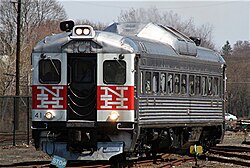
The railroad's recovery was briefly hampered by Frederic C. Dumaine, who took control in 1948 and slashed spending to increase dividends. His son, Buck Dumaine Jr., reversed these trends after 1951, investing in Budd Rail Diesel Cars (RDCs) and General Electric EP-5 electric locomotives, which improved public perception.
The McGinnis Era and Financial Collapse (1954–1961)
In 1954, Patrick B. McGinnis seized control via a proxy fight. His tenure was characterized by the deferral of essential maintenance to maximize shareholder returns. This negligence, combined with the 1955 Connecticut floods and a major derailment in Bridgeport, left the railroad financially ruined. McGinnis's experimental trainsets proved unreliable and were largely failures.
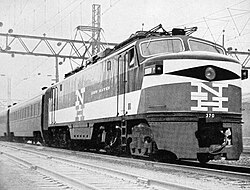
By 1959, the railroad discontinued passenger service on the Old Colony network after the state refused to subsidize losses. Despite the delivery of EMD FL9 locomotives via government loans, the company's comptroller admitted in 1960 that the railroad's survival was in imminent danger.
Second Bankruptcy and the Path to Merger (1961–1969)
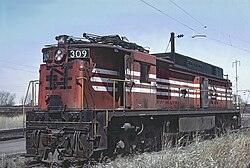
The New Haven entered its second bankruptcy on July 7, 1961. Under bankruptcy trustees, the railroad returned to electrification, purchasing EF-4 electric locomotives from the Norfolk and Western Railway and rebuilding the EP-5s. Despite these efforts, the trustees were forced to eliminate another 200 miles of unprofitable routes.
The trustees sought a merger with the New York Central (NYC) and Pennsylvania Railroad (PRR). While the ICC initially hesitated, the two larger railroads eventually agreed to assume both freight and passenger operations.
The End of an Era: Penn Central and Conrail (1969–Present)
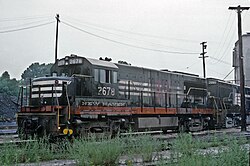
On December 31, 1968, the New Haven was merged into Penn Central. This merger was short-lived; Penn Central itself went bankrupt by 1970. In 1976, freight operations were transferred to the government-created Conrail.
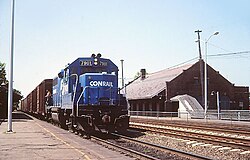
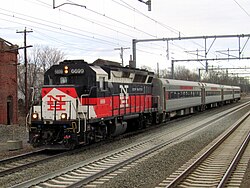
Over the following decades, Conrail abandoned much of the former New Haven territory or handed it over to smaller regional railroads. The remaining lines eventually became part of CSX Transportation in 1999. Today, the legacy of the New Haven lives on through Amtrak's New Haven–Springfield Line and the nostalgic use of the "NH" logo and McGinnis-era livery on Connecticut's commuter equipment.
Key Facts
- Peak Scale: Operated 2,256 route miles and combined 175 different companies.
- Infrastructure: Cedar Hill Yard was the largest classification yard east of the Mississippi River.
- Technological Shift: Fully phased out steam locomotives by 1952.
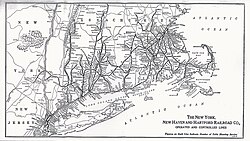
- Major Hubs: Key routes connected New York City, New Haven, Hartford, and Boston.
- Corporate Fate: Merged into Penn Central in 1968; freight assets later moved to Conrail and CSX.
| Year | Freight Traffic | Passenger Traffic |
|---|---|---|
| 1925 | 1,810 | 3,119 |
| 1933 | 916 | 2,178 |
| 1944 | 3,794 | 5,806 |
| 1948 | 2,223 | 4,267 |
| 1960 | 1,291 | 2,809 |
| 1967 | 954 | 2,928 |
Frequently Asked Questions
What was the Maybrook Line?
The Maybrook Line was a 110-mile freight corridor from Maybrook, New York, to Devon, Connecticut. It allowed the New Haven to move freight across the Hudson River via the Poughkeepsie Bridge, replacing slower car float operations.
Who was Patrick B. McGinnis and why is he significant?
Patrick B. McGinnis was a businessman who took control of the railroad in 1954. He is remembered for severely damaging the company's finances by deferring essential maintenance to pay higher dividends to shareholders.
When did the railroad stop using steam locomotives?
The New Haven phased out steam locomotives from regular service in 1952, which was earlier than many other American railroads of the time.
What happened to the New Haven's assets after the Penn Central merger?
After Penn Central's 1970 bankruptcy, freight operations passed to Conrail in 1976. Eventually, some lines were abandoned, some went to regional railroads, and the remainder became part of CSX Transportation in 1999.
How is the railroad remembered today?
The railroad's legacy persists through the "NH" logo and McGinnis-era colors used on modern Connecticut commuter rail equipment, as well as preservation efforts by the Valley Railroad in Essex, Connecticut.