New Poor Law of 1834: Resistance and Social Impact
In the early 19th century, the English government faced a growing crisis regarding the cost of supporting the impoverished. In the southern agricultural districts, a system of out-relief—where the poor received financial assistance while living in their own homes—had become a semi-permanent supplement to low wages. Known variously as the 'allowance system', 'Roundsman system', or the 'Speenhamland system', this approach was increasingly viewed by policymakers as unsustainable.
To address this, Parliament established a Royal Commission in 1832. The resulting recommendations sought to replace local charity with a rigid, centralized system designed to deter the able-bodied from seeking aid unless they were in absolute desperation.
The 1832 Royal Commission Recommendations
The Commission proposed a fundamental shift in how poverty was managed, focusing on deterrence and segregation. The core recommendations included:
- Abolition of Out-relief: Relief for the able-bodied would be provided only within workhouses. The conditions were intended to be so stringent that only the truly indigent would accept them, sacrificing their freedom and habits for basic survival.
- Segregation of Paupers: To ensure strict regulation, different classes of paupers were to be separated. This included the mandatory separation of husbands and wives.
- Centralized Administration: To prevent variations in treatment between different regions, a central board was proposed to set and enforce national standards.
- Reduced Support for Illegitimacy: The Commission suggested reducing support for mothers of illegitimate children and stopping efforts to recover child support costs from fathers, arguing that previous generosity encouraged "bastardy."
Because existing poorhouses were often inadequate for these goals, new purpose-built union workhouses were constructed. These buildings were intentionally designed to look like prisons to inspire a "salutary dread" among the poor.
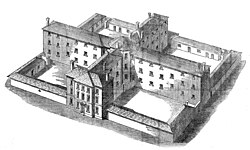
The Poor Law Amendment Act 1834
Based on these recommendations, Parliament passed the Poor Law Amendment Act 1834. While it adopted most of the Commission's views, it diverged on the issue of illegitimacy; fathers could still be pursued for support, though the mother's testimony now required corroborative evidence to establish paternity.
The Act created the Poor Law Commission, a three-man "quango" (quasi-autonomous non-governmental organization) that held significant power to make regulations without direct parliamentary oversight. While local ratepayers still elected Boards of Guardians, these local bodies were required to follow the mandates of the central Commission.
Key Facts
- The Goal: To reduce the cost of poor relief by making the workhouse the only option for the able-bodied poor.
- The Mechanism: The 1834 Act shifted power from local parishes to a centralized Poor Law Commission.
- The Deterrent: Workhouses were designed to be prison-like to discourage people from seeking aid.
- The Divide: Implementation was relatively smooth in the South of England but met with fierce resistance in the industrial North.
- The Human Cost: The system mandated the separation of married couples within the workhouse.
Opposition and Political Conflict
The Act faced immediate backlash from various political factions. Radical MP William Cobbett argued that the poor had an automatic right to relief and claimed the law served to enrich landowners. Richard Oastler, a "Tory Radical," condemned the law as un-Christian, particularly the separation of families.
Oastler warned the Duke of Wellington that the law would cause massive national confusion. Despite these warnings, Tory landowners—who were as eager as the Whigs to lower poor rates—offered little opposition in Parliament.
![Richard Oastler: "a gross and wicked law .. if it was truth, the Bible was a lie"[19]](/images/65/95/6595128a5fa4b308fb52497f367979c6beeb3a50ce6dfba50f3d85057e7eec91.jpg)
Resistance in the South vs. the North
In the South of England, the law was implemented first. While there were some riots in East Anglia and Buckinghamshire, they were largely suppressed by the Metropolitan Police and military force.
The North of England presented a different challenge. In industrial areas like Lancashire and Yorkshire, the cost of poor relief was already lower than in the South. Furthermore, out-relief was a vital tool for managing the trade cycle; when manufacturers laid off hundreds of workers during slack periods, workhouses could not possibly accommodate them all.
Industrial Unrest and Defiance
In the North, trade unions and Radical associations mobilized against the law. Richard Oastler used the press to denounce the "coarser-food" and cruelty of the new system. In Huddersfield, mass protests delayed the establishment of the New Poor Law administration.
Some resistance turned economic. Industrialist John Fielden closed his mills in Todmorden, putting nearly 3,000 people out of work, to protest the local Guardians. In other areas, "overseers of the poor" were intimidated into ignoring the Guardians' orders, and mobs attacked the homes of New Poor Law supporters, causing significant property damage.
Summary of the New Poor Law System
| Feature | Old Poor Law (Pre-1834) | New Poor Law (Post-1834) |
|---|---|---|
| Primary Relief Method | Out-relief (allowances in the home) | Workhouse-only for able-bodied |
| Administration | Local parish control | Central Poor Law Commission |
| Family Structure | Families remained together | Mandatory segregation of spouses |
| Objective | Community support/subsistence | Deterrence through hardship |
| Paternity Claims | Mother's word sufficient | Corroborative evidence required |
Frequently Asked Questions
What was the primary purpose of the New Poor Law?
The primary purpose was to reduce the financial burden of poor relief on ratepayers by ending out-relief for the able-bodied and making the workhouse the only option for aid, thereby deterring all but the most desperate from seeking help.
Why was the law more resisted in the North of England than the South?
The North had lower relief costs and relied on out-relief to manage the volatile industrial trade cycle. Forcing thousands of temporarily unemployed factory workers into workhouses was seen as both impractical and unnecessary.
Who were the 'Poor Law Guardians'?
The Guardians were local officials elected by ratepayers to manage the poor law provisions within their specific union, although they were required to follow the regulations set by the central Poor Law Commission.
How did the 1834 Act change the treatment of illegitimate children?
While the Act still allowed fathers to be pursued for support, it raised the legal bar for proof; a mother's sworn testimony was no longer sufficient on its own to establish paternity, requiring additional corroborative evidence.
What role did Richard Oastler play in the opposition?
Richard Oastler was a prominent critic who framed the New Poor Law as un-Christian and cruel. He used newspaper letters and mass meetings to mobilize the working class and lobbied political leaders to repeal the Act.