New Orleans Police Department
The New Orleans Police Department (NOPD) serves as the primary local civilian law enforcement agency for New Orleans, Louisiana. With a jurisdictional area covering 350.2 square miles and a population of approximately 383,997 residents as of the 2020 census, the NOPD manages a complex urban environment with a rich and often turbulent history.
From its early roots under colonial rule to modern-day challenges involving technology and civil rights, the department has undergone numerous structural reorganizations to improve efficiency and accountability.

Key Facts

- Founded: 1796 during the administration of Baron Francisco Luis Héctor de Carondelet.
- Current Leadership: Superintendent Anne Kirkpatrick.
- Workforce: 1,457 employees (2020).
- Annual Budget: $194 million (2020).
- Operational Reach: 8 patrol districts across 350.2 square miles.
- Demographics: 51% African-American/Black, 46% White, 2% Hispanic, and 1% Asian.
Historical Evolution

Before the formal establishment of the NOPD, policing in New Orleans was handled by military forces under alternating French and Spanish rule. By the mid-1790s, rising crime rates necessitated a dedicated city force, leading to the official recording of the department's formation in 1796.
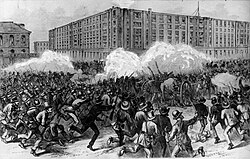
The department's history is marked by significant moments of social unrest and violence. In 1890, the acquittal of 11 Italian-Americans accused of murdering NOPD Chief David Hennessey sparked the largest lynching in American history. Later, in 1900, a suspect named Robert Charles killed four officers and mortally wounded a fifth during a violent resistance to arrest.
Administrative Reforms
In the early 21st century, the NOPD underwent significant leadership changes. Superintendent Ronal W. Serpas, who retired in 2014, implemented sweeping reforms in 2010. These changes included reducing the number of deputy superintendents and demoting several appointed majors back to their civil service rank of captain to restore the captain as the de facto district station commander.
In 2011, the New Orleans Civil Service Commission approved a new pay plan creating the rank of Police Commander. These commanders rank third in the command structure, below only the superintendent and deputy superintendents, and are responsible for the department's 17 core components, including the eight patrol districts.
Operational Structure and Personnel

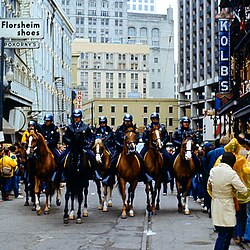
The NOPD operates through five bureaus and eight districts, with its headquarters located at 1615 Poydras St. The department utilizes a tiered rank system that distinguishes between commissioned officers and civilian leadership.
| Rank | Command Level | Shirt Color | Approx. Salary (2021) |
|---|---|---|---|
| Superintendent | Police Department | White | $179,348 |
| Deputy Superintendent | Bureau | White | $126,066 - $178,450 |
| Captain | Division/Unit | White | $87,502 - $123,311 |
| Lieutenant | Platoon/District Unit | Blue | $80,029 - $112,639 |
| Sergeant | Sector/Task Force | Blue | $73,262 - $102,977 |
| Officer (I-IV) | Patrol/Various | Blue | $50,449 - $94,228 |
The department's equipment includes Glock 22, 23, and 27 pistols, as well as Bushmaster XM-15 rifles.
Challenges and Misconduct

The NOPD has faced severe scrutiny over civil rights violations and misconduct. One of the most prominent incidents occurred at the Danziger Bridge following Hurricane Katrina. Reports indicated that officers fired on citizens seeking refuge or those allegedly attacking contractors. This led to the indictment of seven officers; while some charges were dismissed due to prosecutorial misconduct, five officers were eventually convicted in federal court for cover-ups and deprivation of civil rights.
Due to a pattern of unconstitutional conduct, the NOPD entered into a consent decree (a court-supervised agreement to implement reforms) with the U.S. Department of Justice in 2012. The department officially exited this decree on November 20, 2025.
Technological Controversies
In 2025, an investigation revealed that the NOPD used facial recognition technology on the general public via a network of over 200 cameras. This occurred despite a 2022 city ordinance limiting such use. The system automatically alerted officers to potential suspect matches, leading to at least four arrests for nonviolent crimes. The program was paused following public backlash.

Impact of Hurricane Katrina

Hurricane Katrina in 2005 caused a crisis within the department's personnel. Over 200 officers deserted the city during the storm. Following the event, 60 officers were fired and 25 were suspended, though many were later exonerated after hearings. Officers who remained in the city were awarded a special Hurricane Katrina lapel pin.
The storm also led to a significant personnel shortage. Before Katrina, the NOPD had 1,742 commissioned officers; by July 2015, that number had dropped to 1,106, prompting aggressive recruitment efforts.
Frequently Asked Questions


When was the New Orleans Police Department formed?
The NOPD was first recorded as a full-time city police force in 1796 during the administration of Baron Francisco Luis Héctor de Carondelet.
What is a consent decree?
A consent decree is a legal agreement between a law enforcement agency and the U.S. Department of Justice to implement specific reforms to address unconstitutional conduct. The NOPD was under such a decree from 2012 until November 20, 2025.
How did Hurricane Katrina affect NOPD staffing?
The storm led to the desertion of over 200 officers and a wave of resignations. The force decreased from 1,742 commissioned officers before the storm to 1,106 by July 2015.
What was the controversy regarding facial recognition technology?
The NOPD was found to have used a network of 200+ cameras to identify people in live feeds for immediate arrests, defying a 2022 city ordinance that limited the use of such AI technology.
Who is the current head of the NOPD?
The agency is currently led by Superintendent Anne Kirkpatrick.