New Jersey Local Government: Counties, Municipalities, and School Districts
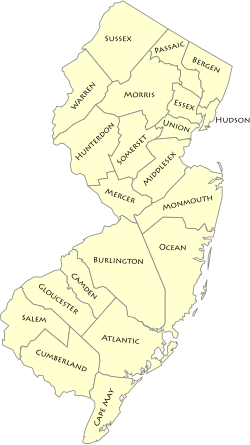
Local governance in New Jersey is characterized by a comprehensive and intricate structure. Unlike many other states, every square inch of New Jersey's land is part of an incorporated municipality. The state is organized into 21 counties, each containing multiple municipalities, with a total of 564 municipal jurisdictions. Notably, New Jersey has no independent cities or consolidated city-counties.
While the system may seem complex, all general-purpose local governments possess equivalent legal powers. The various titles and forms of government typically reflect the historical circumstances of a municipality's incorporation rather than a hierarchy of authority.
Key Facts
- Total Municipalities: 564 incorporated jurisdictions.
- Total Counties: 21 counties.
- Municipal Types: Five distinct types (Borough, City, Town, Township, and Village).
- Legal Standing: All municipal types have equal legal rights and powers.
- County Governance: Managed by a Board of County Commissioners; counties lack tax-collecting power.
- School Districts: Divided into Type I and Type II, with varying board appointment and election methods.
County Government Structure
New Jersey's 21 counties are primarily governed by a Board of County Commissioners, which generally handles both legislative and executive duties. These boards consist of three, five, seven, or nine members, elected either at-large, by district, or through a mixed system.
Executive authority varies by county. Five counties—Atlantic, Bergen, Essex, Hudson, and Mercer—elect a separate county executive. Union County appoints a county executive, similar to a council-manager system. In these instances, the Board of County Commissioners retains only legislative power. Other counties typically appoint a supervisor or administrator to manage daily operations.
Municipal Types and Forms of Government
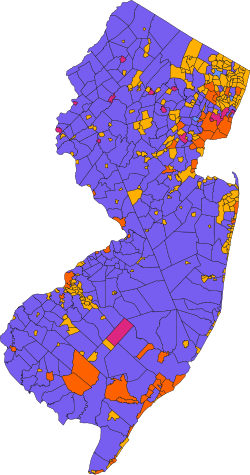
New Jersey is unique for having five distinct types of incorporated municipalities. While each type has a corresponding default form of government, municipalities may choose to adopt different optional forms provided by the state legislature.
Boroughs
The borough is the most common type, used by 253 municipalities. This prevalence is largely due to a late 19th-century trend known as "boroughitis," which saw a surge in new borough incorporations.
Cities
There are 52 cities in New Jersey. Despite the common association of "cities" with large urban centers, New Jersey cities vary significantly in size, ranging from densely populated hubs to small hamlets.
Towns
Currently, there are 15 towns. Under this form of government, a mayor is elected at-large alongside eight councilmen (two from each of four wards). The mayor presides over meetings, votes as a council member, and holds veto power over ordinances, which the council can override with a two-thirds vote.
Townships
Of the 240 townships in the state, 141 use the township form of government. This system uses a township committee of three or five members elected at-large to serve as both executive and legislative authority. The committee annually selects one member as "mayor" to act as a meeting moderator without additional special powers.
Villages
The village form, established by the Village Act of 1891, consists of a five-member Board of Trustees. While four municipalities still retain the "Village" type (Loch Arbour, Ridgefield Park, Ridgewood, and South Orange), none currently use the Village form of government. New incorporations under this form ceased in 1961.
Optional Forms of Municipal Government
Municipalities can move beyond their default type by adopting optional forms of government:
- Walsh Act of 1911: A specific legislative framework for municipal governance.
- 1923 Municipal Manager Law: An optional form where an elected council appoints a professional municipal manager as the chief executive. Only seven municipalities currently use this form.
- Optional Municipal Charter Law (Faulkner Act): Passed in 1950 to increase professionalism and executive strength. It offers four options: council-manager, mayor-council, mayor-council-administrator, and small municipality.
- Special Charter: A tailor-made government structure enacted by the state legislature for a specific community.
Residents seeking to change their government form can do so via a direct petition or, under the Faulkner Act, through a Charter Study Commission.
Summary of Municipal Types
| Type | Approx. Count | Key Characteristic |
|---|---|---|
| Borough | 253 | Most common type; grew during "boroughitis" era. |
| Township | 240 | Governed by a committee; derived from New England town meetings. |
| City | 52 | Varies widely in size from hamlets to urban centers. |
| Town | 15 | Mayor with veto power and a ward-based council. |
| Village | 4 | Rare; no municipalities currently use the Village form of government. |
School Districts and State Intervention
New Jersey classifies school districts as regional, consolidated, countywide, or single-municipality. Most are general-purpose districts with boundaries matching their municipality, categorized as Type I or Type II.
- Type I Districts: Typically found in cities. Board members are appointed by the mayor or chief executive. In cities with over 150,000 people, the board must have nine members.
- Type II Districts: Found in non-city municipalities, consolidated, or regional districts. Boards may be elected (usually nine members) or appointed by the mayor.
The state allows districts to share resources, such as superintendents, transportation, and nursing services. However, the State Commissioner of Education possesses the power of "state intervention." If a district fails to provide a thorough and efficient system of education, the state may appoint a district superintendent, reducing the local board of education to an advisory role.
Frequently Asked Questions
Do different municipal types have different powers?
No. All local general-purpose governments in New Jersey have equivalent legal powers regardless of whether they are classified as a borough, city, town, township, or village.
What is the difference between a municipal type and a form of government?
The type (e.g., Township) is the classification of the municipality, while the form (e.g., Faulkner Act) is the actual structure of its administration. While they often match by default, a municipality can choose an optional form of government different from its type.
Can a New Jersey county collect taxes?
No, counties in New Jersey do not have tax-collecting power.
What happens during state intervention in a school district?
When the Commissioner of Education intervenes, the local board of education becomes advisory, and ultimate authority is transferred to a state-appointed district superintendent.
Are there any areas of New Jersey not part of a municipality?
No. Every part of the state's territory is included within one of the 564 incorporated municipalities.