Nelson Street Cycleway: Transforming Auckland's Motorway Infrastructure
The Nelson Street Cycleway stands as a landmark achievement in urban planning, repurposing redundant motorway infrastructure into a high-capacity transit corridor for cyclists. By converting a former off-ramp into a dedicated path, Auckland has created a unique link that bypasses heavy traffic and connects the city center to surrounding districts.
The Evolution of the Nelson Street Off-Ramp
The story of the cycleway begins with a change in motorway logistics. In 2005, the original off-ramp connecting the Central Motorway Junction (CMJ)—the complex intersection of Auckland's main motorways—to Nelson Street was closed. The old ramp was deemed inefficient because drivers coming from the Auckland Southern Motorway had to weave right across lanes to access it. On July 3, 2005, an upgraded ramp was opened, adhering to the principle of keeping left when exiting the motorway.
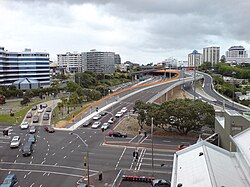
For several years, the old ramp remained unused until the NZ Transport Agency (NZTA) mentioned the concept of a cycleway in the 2012 Central Motorway Junction Walking and Cycling Masterplan. The vision was further propelled by Max Robitzsch, a transport engineer and member of Bike Auckland, who drew inspiration from New York City's High Line. Robitzsch advocated for the project through walking tours and blog posts, proposing a scaffolding-based ramp to link the off-ramp to the road network south of the city center via Karangahape Road.
Funding and Design
The project gained significant momentum in August 2014 when the National government announced a NZ$ 100 million package for cycling infrastructure. In January 2015, Minister of Transport Simon Bridges officially added the Nelson Street Cycleway to the priority list. The project was a collaborative effort between the NZ Transport Agency, Auckland Transport, and the Auckland Council.
The design of the Lightpath (the cycleway's distinctive name) was a joint effort between GHD and Novare Design, with Monk Mackenzie Architects handling the urban and architectural elements.
The Canada Street Bridge Engineering
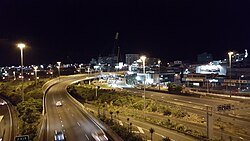
A critical component of the infrastructure is the Canada Street bridge, which connects Canada Street to the repurposed off-ramp. This 160-metre-long structure weighs 260 tonnes and required precise engineering to install over an active motorway.
Designed by Novare Design, the bridge was prefabricated in eight sections at a workshop in Hamilton. After being transported to Pukekohe for painting and corrosion protection, the sections were lifted into place. This process required the southbound motorway lanes to be closed overnight on seven separate occasions between August 20 and September 10, 2015.
Phased Implementation and Completion
The development of the cycleway was rolled out in three distinct stages to ensure seamless integration into the city's fabric.
Stage 1: The Ambitious Beginning
Opened on December 3, 2015, the first stage was described by the NZ Transport Agency as "New Zealand's most ambitious piece of cycling infrastructure." The opening ceremony was attended by Transport Minister Simon Bridges, Ernst Zöllner of the Transport Agency, Chris Darby of the Auckland Council, and Barbara Cuthbert of Bike Auckland.
Stage 2: Expanding the Reach
Completed in December 2017, Stage 2 extended the path along Nelson Street, stretching from Victoria Street West to Fanshaw Street, and continuing through a short section of Market Place to the Pakenham Street East intersection.
Stage 3: Completing the Loop
The final phase focused on creating a bi-directional cycleway covering Market Place, Customs Street West, and the western side of Lower Hobson Street. This stage became part of Project WAVE (Westhaven And Viaduct Enhancements). Following consultations in late 2017 and a trial layout in 2021, the final design was completed in early 2023, successfully closing the city center loop.
Key Facts
- Total Bridge Length: 160 metres.
- Bridge Weight: 260 tonnes.
- Inspiration: New York City's High Line.
- Key Partners: NZ Transport Agency, Auckland Transport, and Auckland Council.
- Completion Date: Final stage completed in early 2023.
| Phase/Component | Key Detail | Completion/Date |
|---|---|---|
| Original Off-Ramp Closure | Replaced by upgraded ramp | July 3, 2005 |
| Canada Street Bridge | 160m long, 260 tonnes | September 2015 |
| Stage 1 Opening | Initial infrastructure launch | December 3, 2015 |
| Stage 2 Opening | Extension to Pakenham St East | December 2017 |
| Stage 3 Opening | City centre loop completion | Early 2023 |
Frequently Asked Questions
Why was the original Nelson Street off-ramp closed?
The original ramp was closed in 2005 because it was difficult for drivers from the Auckland Southern Motorway to access, as it required weaving to the right within the Central Motorway Junction.
Who inspired the idea to turn the ramp into a cycleway?
Max Robitzsch, a transport engineer and member of Bike Auckland, is credited with helping realize the idea, drawing inspiration from the High Line in New York City.
How was the Canada Street bridge constructed?
The bridge was built in eight sections in a Hamilton workshop, treated for corrosion in Pukekohe, and lifted into place during seven overnight closures of the southbound motorway lanes.
What is Project WAVE?
Project WAVE (Westhaven And Viaduct Enhancements) is the initiative that encompassed the final stage of the cycleway, including the bi-directional paths on Market Place, Customs Street West, and Lower Hobson Street.
When was the city centre loop finally completed?
The loop was completed in early 2023 following a trial layout installed in 2021.