Neapolitan Language: History, Grammar, and Cultural Legacy
Neapolitan (autonym: 'o napulitano) is a vibrant Romance language belonging to the Italo-Dalmatian branch. Spoken across much of continental Southern Italy, it is named after the historic Kingdom of Naples, with the city of Naples serving as its cultural and linguistic capital. While often categorized as a dialect of Italian in casual conversation, it possesses distinct grammatical structures and phonological traits that define it as a unique linguistic entity.
In 2008, the Region of Campania passed a law to protect Neapolitan, recognizing its immense value to the region's identity. While the term can refer broadly to the languages of the former Kingdom of Naples, it most specifically refers to the variety spoken in the Naples metropolitan area, which has historically enjoyed significant literary and artistic prestige.
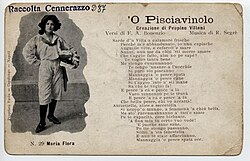
Key Facts
- Native Speakers: Approximately 5.7 million (as of 2002).
- Region: Primarily Campania and continental Southern Italy.
- Classification: Indo-European > Italic > Romance > Italo-Western > Italo-Dalmatian.
- ISO Code: nap.
- Legal Status: Protected by the Region of Campania; no official national status in Italy.
Distribution and Global Presence
Beyond the borders of Italy, Neapolitan is spoken in various diaspora communities due to massive migration waves in the late 19th and 20th centuries. Significant populations of speakers can be found in the United States, Canada, Australia, Brazil, Argentina, Uruguay, Mexico, and Venezuela.
Interestingly, the language has evolved differently depending on the location. In the United States, Neapolitan has been influenced by English and other Southern Italian languages, such as Sicilian and Calabrian. In contrast, the variety spoken in Naples is increasingly influenced by standard Italian, which often displaces Neapolitan in daily formal life.
Linguistic Classification and Characteristics
Neapolitan is part of the Southern Italo-Romance group. While various dialects exist—including Arianese, Barese, Benevento, and Molisan—they generally remain mutually intelligible. However, mutual comprehensibility between Neapolitan and standard Italian varies based on the speaker's linguistic background.
Phonology and the "Schwa"
The most striking difference between Neapolitan and Italian is the weakening of unstressed vowels into a schwa (pronounced like the 'a' in "about"). This phonological shift can make cognate words (words with a common origin) unrecognizable to those unfamiliar with the language.
Another distinct feature is the pronunciation of the letter 's'. When 's' appears at the beginning of a word followed by a consonant, it is often pronounced as [ʃ] (like the 'sh' in "ship"), unless followed by a dental occlusive like 't' or 'd'.

Grammar and Structure
Neapolitan grammar differs significantly from Italian. One notable difference is the use of neuter nouns and a unique method of forming plurals. While Italian uses final vowel changes to indicate gender and number, Neapolitan often expresses these through changes in the accented vowel because final unstressed vowels are neutralized.
In verbal conjugation, Neapolitan utilizes four finite moods (indicative, subjunctive, conditional, and imperative) and three non-finite modes. A key distinction from Italian is the use of the auxiliary verb (h)avé (to have) for active forms, including intransitive and reflexive verbs that would typically use essere (to be) in standard Italian.
Syntactic Gemination
A fascinating aspect of Neapolitan is syntactic gemination (raddoppiamento sintattico), where the initial consonant of a word is doubled in pronunciation. This occurs after specific "trigger" words, such as the conjunctions e (and) and né (nor), or the neuter definite article 'o.
For example, the phrase je so' pazzo ("I am crazy") is pronounced with a doubled 'p' (ppazzo). This doubling is a phonological event, though many modern written editions include the double consonant to reflect the actual speech.
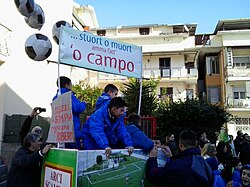
Cultural and Literary Heritage
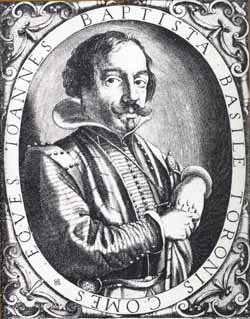
Neapolitan has a prestigious history in literature, theater, and music. From the early fairy tales of Giambattista Basile to the theatrical works of Eduardo Scarpetta and Eduardo De Filippo, the language has been a vehicle for high art and popular culture.
In the 20th century, artists like Renato Carosone, Pino Daniele, and the Nuova Compagnia di Canto Popolare brought the language to national and international prominence through music, ensuring its continued relevance in the modern era.
Language Summary Table
| Feature | Neapolitan (nap) | Standard Italian |
|---|---|---|
| Unstressed Vowels | Often reduced to schwa [ə] | Maintained as distinct vowels |
| Noun Genders | Masculine, Feminine, Neuter | Masculine, Feminine |
| Auxiliary Verbs | Predominantly uses "to have" | Uses "to be" for intransitives |
| Initial Consonants | Frequent syntactic gemination | Rare/Not reflected in writing |
| Alphabet | 22 letters (includes 'j') | 21 letters (excludes 'j') |
Frequently Asked Questions
Is Neapolitan a dialect or a language?
While often called a dialect in Italy, linguistically it is a Romance language with its own distinct grammar, phonology, and literary history. It is recognized by the ISO 639-3 standard with the code 'nap'.
Can an Italian speaker understand Neapolitan?
Mutual comprehensibility is variable. While they share much vocabulary, the use of the schwa vowel and different grammatical structures can make spoken Neapolitan difficult for a standard Italian speaker to understand without exposure.
Where is Neapolitan spoken today?
It is primarily spoken in the Campania region of Italy, specifically around Naples. It is also found in diaspora communities in the Americas and Australia.
Is Neapolitan taught in schools?
It has no official status in the Italian national school system. However, the University of Naples Federico II offers courses in Campanian Dialectology to study its history and social role.
What is the "schwa" in Neapolitan?
The schwa is a neutral vowel sound, similar to the 'a' in "about," that replaces most unstressed vowels in Neapolitan speech, creating a distinct rhythmic quality compared to Italian.