Navy Yard Puget Sound: A World War II Strategic Hub
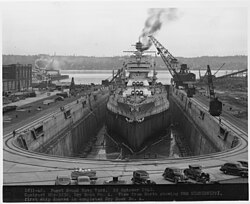
Between 1938 and the mid-1940s, the Navy Yard Puget Sound in Bremerton transformed into a critical industrial powerhouse for the United States Navy. As the global conflict of World War II intensified, the yard underwent massive expansions to accommodate the next generation of naval warfare, evolving from a standard repair facility into a sophisticated center for modernization and emergency salvage.
Infrastructure Expansion and Modernization
To prepare for the arrival of new fast battleships—a class of heavily armored warships designed for higher speeds—the yard initiated major improvements starting in 1938. These upgrades included the construction of Drydocks 4 and 5, each measuring 1,000 feet in length. Additionally, the facility installed new quays, piers, and shop buildings, along with two double shipbuilding ways specifically designed for the production of escort vessels.
Restoring the Pearl Harbor Fleet
Following the attack on Pearl Harbor on December 7, 1941, five severely damaged battleships were sent to Bremerton for extensive repairs and rebuilding:
- USS Tennessee: Underwent complete modernization, receiving new 14-inch rifles for its main battery and replacing older anti-aircraft guns with 20mm and 40mm batteries.
- USS Nevada: Extensively rebuilt and returned to service in time for the 1943 Aleutian campaign.
- USS California: After being sunk at Pearl Harbor, the ship was raised and towed to Bremerton, eventually rejoining the battle in January 1944.
- USS West Virginia: Having been struck by six or seven torpedoes, this vessel required a longer repair period, returning to the fleet in July 1944.
- USS Maryland: Returned to the yard in January 1944 for rebuilding, returning in time for the assault on the Marianas.
The yard also serviced other prominent battleships, including the USS Colorado, USS Pennsylvania, USS Washington, USS New Jersey, and USS South Dakota.
Aircraft Carrier Maintenance and Emergency Repairs
The facility played a vital role in maintaining the Navy's air superiority. The aircraft carrier USS Saratoga was sent to Bremerton for modernization and repairs after being torpedoed by a Japanese submarine in January 1942. Although the Navy hoped to have her ready for the Battle of Midway in June, the extent of the damage made this impossible. Other carriers serviced at the yard included the USS Enterprise, USS Bunker Hill, USS Franklin, USS Ticonderoga, USS Wasp, and USS Lexington.
The Kamikaze Challenge
As the war progressed, the emergence of kamikaze (suicide) attacks led to a surge in ships requiring urgent repairs. A notable example was the destroyer USS Lamson, which was hit off Leyte on December 6, 1944. The attack killed 25 men, wounded 54, destroyed the superstructure from the forecastle deck to the stacks, and flooded the forward fireroom. Between late January and mid-April 1945, the Bremerton yard replaced 90% of the ship's superstructure.
War Effort Impact and Presidential Visit
The demand for fast turnarounds increased as the war neared its end. By the conclusion of hostilities, the Navy Yard Puget Sound had repaired, overhauled, and modernized a total of 344 fighting ships of various types. The significance of the yard's contribution was recognized on August 12, 1944, when President Franklin D. Roosevelt arrived aboard the cruiser USS Indianapolis and thanked the workers from Drydock 2.
Key Facts
- Total Ships Serviced: 344 fighting ships were repaired, overhauled, or modernized by the end of the war.
- Major Infrastructure: Construction of two 1,000-foot drydocks (No. 4 and No. 5).
- Pearl Harbor Recovery: Five major battleships (Tennessee, Maryland, Nevada, California, and West Virginia) were repaired at the yard.
- Rapid Reconstruction: 90% of the USS Lamson's superstructure was replaced in approximately three months.
| Ship Name | Key Repair/Modernization Detail | Return to Service/Campaign |
|---|---|---|
| USS Tennessee | New 14-inch rifles; 20mm and 40mm AA batteries | Modernized |
| USS Nevada | Extensive rebuilding | 1943 Aleutian campaign |
| USS California | Raised from Pearl Harbor and repaired | January 1944 |
| USS West Virginia | Repaired after 6-7 torpedo hits | July 1944 |
| USS Maryland | Rebuilding | Assault on the Marianas |
Frequently Asked Questions
Why were Drydocks 4 and 5 constructed?
They were built to be 1,000 feet long, making them large enough to accommodate the new class of fast battleships being constructed during that era.
Which ship was raised from the bottom of Pearl Harbor and brought to Bremerton?
The USS California was raised after being sunk at Pearl Harbor and towed to the Navy Yard Puget Sound for repairs.
How did the yard handle the increase in kamikaze attacks?
The yard implemented fast turnarounds to handle the high volume of damaged ships, such as the USS Lamson, which had nearly its entire superstructure replaced in a few months.
Did President Franklin D. Roosevelt visit the yard?
Yes, President Roosevelt visited on August 12, 1944, arriving on the USS Indianapolis to thank the workers from Drydock 2.
Was the USS Saratoga ready for the Battle of Midway?
No. Although she was sent to Bremerton for repairs and modernization after being torpedoed in January 1942, the work was too extensive to meet the June deadline for the Battle of Midway.