National Expressways of South Korea: The Gosokgukdo Network
The National Expressways of South Korea, known locally as Gosokgukdo (고속국도), represent the highest tier of the country's road infrastructure. These controlled-access highways serve as the backbone of national transit, connecting major metropolitan hubs, industrial centers, and coastal regions. While most of the network is maintained by the Korea Expressway Corporation, certain routes are managed by approved private companies under government oversight.
From the historic opening of the first expressway in 1968 to the sophisticated grid-based numbering system used today, the South Korean expressway network has evolved into a highly organized and efficient system designed to facilitate rapid movement across the peninsula.
History and Evolution of the Network
The origins of the South Korean expressway system date back to 2 September 1967, when the first expressway—now known as the Gyeongin Expressway—was assigned via presidential decree. The very first section of the network officially opened to traffic on 21 December 1968.
Initially, these routes were categorized as part of the national highway system. However, a significant administrative shift occurred on 31 August 1971, when expressways were established as a distinct, separate class known as National Expressways. This distinction allowed for specialized management and development tailored to high-speed, long-distance travel.
The Modern Numbering System
On 25 August 2001, South Korea implemented a new numbering scheme inspired by the United States Interstate Highway System. This system reflects the layout proposed in the 1992 3rd Comprehensive National Territorial Planning and uses a grid-based logic:
- Trunk Routes: Identified by two-digit numbers. North–south routes are assigned odd numbers, while east–west routes receive even numbers. Primary routes increase progressively from south to north or west to east.
- Branch Routes: These use three-digit numbers, where the first two digits correspond to the parent trunk route.
- Circular Routes: These are numbered in increments of 100, based on the postal code system used between 1988 and 2015. Examples include the Capital Region First Ring Expressway (100) and the Busan Ring Expressway (600).
Notably, the Gyeongbu Expressway is an exception to these rules; due to its critical role in the national economy, it retains the number 1. Additionally, route numbers from 70 to 99 are currently reserved for potential future use following Korean reunification.
Key Facts
- Official Name: National Expressways (Gosokgukdo).
- Primary Operator: Korea Expressway Corporation.
- First Opening: 21 December 1968.
- Numbering Logic: Odd numbers for North-South; even numbers for East-West.
- Toll System: Uses the Hi-pass electronic collection system.
- Motorcycle Policy: All motorcycles are prohibited from expressways (except police motorcycles).
Major Expressways and Routes
The network comprises a vast array of routes, ranging from massive trunk lines to specialized private operations. Below is a summary of some of the most significant expressways in the system.
| Name (English) | Name (Korean) | Origin | Terminus | Length (km) |
|---|---|---|---|---|
| Gyeongbu | 경부고속도로 | Geumjeong, Busan | Seocho, Seoul | 416.1 |
| Seohaean | 서해안고속도로 | Samhyang, Muan | Geumcheon, Seoul | 336.1 |
| Jungang | 중앙고속도로 | Sasang, Busan | Chuncheon | 388.1 |
| Honam | 호남고속도로 | Seo, Suncheon | Mokcheon, Cheonan | 276.2 |
| Yeongdong | 영동고속도로 | Namdong, Incheon | Seongsan, Gangneung | 234.4 |
Operational Features and Regulations
Electronic Toll Collection: Hi-pass
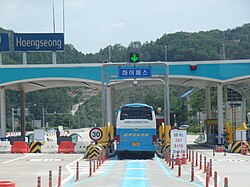
To facilitate seamless travel, South Korea utilizes Hi-pass, an electronic toll collection system. This technology allows vehicles to pass through toll gates without stopping, significantly reducing congestion. Some interchanges are specifically designed as "Hi-pass only" lanes to accommodate this system.
Traffic Restrictions and Bus Lanes
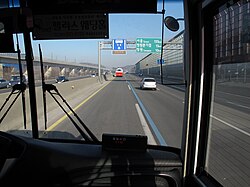
Certain sections of the expressway feature dedicated lanes to manage high-volume traffic. For example, between the Sintanjin interchange (Daejeon) and the Yangjae interchange (Seoul), central lanes are dedicated to buses on holidays. On weekdays, this restriction is applied between the Anseong and Yangjae interchanges. These lanes often operate under HOV-6 rules, meaning they are reserved for vehicles with a capacity of 9 or more passengers.
Motorcycle Prohibitions
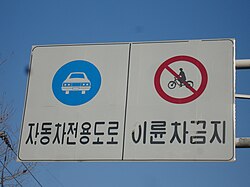
Since 1 June 1972, all motorcycles—regardless of engine displacement—have been prohibited from driving on South Korean expressways, with the sole exception of police motorcycles. Furthermore, since 1992, motorcycles are also banned from specific roads designated for motor vehicles only, which are marked by a circular blue sign featuring a white car silhouette.
Frequently Asked Questions
What is the Hi-pass system?
Hi-pass is South Korea's electronic toll collection system that allows vehicles to pay tolls automatically while moving through designated lanes.
Are motorcycles allowed on South Korean expressways?
No. Since 1972, all motorcycles are prohibited from expressways, except for official police motorcycles.
How are expressway numbers assigned?
Numbers are assigned based on a grid: odd numbers for North-South routes and even numbers for East-West routes. Branch routes use three digits, and circular routes use increments of 100.
Who manages the South Korean expressways?
The majority of the network is managed by the Korea Expressway Corporation, though some routes are operated by approved private companies.
Why is the Gyeongbu Expressway numbered '1'?
The Gyeongbu Expressway is an exception to the standard numbering rules due to its critical importance to the national transportation network.