National Assembly of the Republic of Korea: Structure, Powers, and Political Dynamics
The National Assembly of the Republic of Korea (Daehanminguk Gukhoe) serves as the unicameral national legislature of South Korea. As a central pillar of the nation's democratic framework, the Assembly is responsible for enacting laws, approving national budgets, and exercising oversight over the executive branch. Unlike many parliamentary systems, the South Korean National Assembly is protected by constitutional safeguards that prevent the President from dissolving it before its term expires.
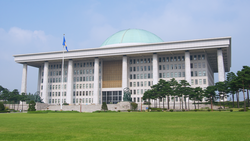
Key Facts
- Type: Unicameral legislature
- Total Seats: 300
- Term Length: 4 years
- Voting Age: 18 years old
- Current Speaker: Cho Jeong-sik (Independent)
- Meeting Place: Yeouido, Seoul
Legislative Structure and Composition
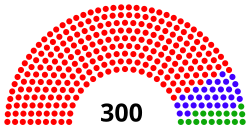
The National Assembly is composed of 300 members. The distribution of these seats is determined through a complex electoral system designed to balance local representation with party-based proportionality.
The Electoral System
South Korea utilizes a mixed-member majoritarian representation system. While it is legally defined as an additional member system (AMS), in practice, it functions as parallel voting due to the widespread use of "decoy lists" by major political parties. The seat allocation is broken down as follows:
- 254 seats are elected via First-Past-The-Post (FPTP) in individual constituencies.
- 46 seats are allocated through proportional representation (PR) using the largest remainder method.
Political Groups and Negotiation Units
Political parties play a vital role in the Assembly's operation. Under Article 33 of the National Assembly Act, parties holding at least 20 seats can form floor negotiation groups (gyoseop danche). These groups are granted significant advantages, including priority in debate allocation, representation on the Steering Committee, and eligibility for additional state funding.
Powers, Duties, and Limitations
The Constitution of the Republic of Korea (Articles 40–65) vests legislative power in the Assembly. Its primary responsibilities include:
- Enacting and amending national laws.
- Approving the national budget.
- Ratifying significant international treaties.
- Conducting audits and investigations of executive agencies.
- Initiating impeachment proceedings against high-ranking officials, including the President and Constitutional Court judges.
Despite these extensive powers, the Assembly operates within a presidential system, which introduces certain constraints. For instance, the President holds the power to veto legislation. Overriding such a veto requires a two-thirds majority of the members present, a threshold that is difficult to reach in the current highly polarized political landscape. Furthermore, while individual members can submit bills, many major policy initiatives originate within the executive branch.
Political Landscape and Party Dynamics
Since the transition to democracy in 1987, the South Korean party system has been characterized by cycles of merger, fragmentation, and realignment. The political spectrum is generally divided into four ideological camps: Progressive (socialist), Liberal, Centrist, and Conservative.
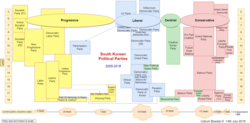
Recent years have seen increased polarization between the liberal and conservative blocs. This division often leads to divided government—a situation where the President's party does not hold a majority in the Assembly—which can result in legislative gridlock. Additionally, the 2020 electoral reforms led to the strategic creation of "satellite parties" by major players to maximize seat gains under the proportional representation rules.
Historical Context and Public Perception
The National Assembly has a long history dating back to the first elections held under UN supervision on 10 May 1948. Over the decades, it has transitioned from the authoritarian eras of the Fourth and Fifth Republics to the current Sixth Republic, which provides greater legislative independence.
Historically, the Assembly has faced periods of intense physical conflict. Between 2004 and 2009, the chamber gained international notoriety for "legislative violence," including physical combat during impeachment proceedings and disputes involving sledgehammers and fire extinguishers. Since then, preventive measures have been implemented to maintain order.
Despite its importance, public trust in the National Assembly remains a challenge. According to 2024 OECD data, only 21% of South Koreans express high or moderate trust in the parliament, a figure notably lower than the trust levels for the national government. Analysts often attribute this to perceived partisanship and legislative gridlock.
Summary of the 22nd National Assembly
| Category | Details |
|---|---|
| Total Seats | 300 |
| Government/Democratic Bloc | 161 seats |
| Opposition Bloc | 130 seats |
| Speaker | Cho Jeong-sik (Independent) |
| Deputy Speakers | Nam In-soon (Democratic), Park Duk-hyum (People Power) |
Frequently Asked Questions
Can the President dissolve the National Assembly?
No. Under the current Sixth Republic, the President does not have the authority to dissolve the National Assembly before its four-year term concludes.
How are seats allocated in the National Assembly?
The Assembly uses a mixed system: 254 seats are filled through constituency-based voting (First-Past-The-Post), and 46 seats are allocated via proportional representation using the largest remainder method.
What is a floor negotiation group?
A floor negotiation group is a formal organization of political parties that hold at least 20 seats. These groups receive special privileges, such as priority in debates and representation on the Steering Committee.
What is the term length for a member of the National Assembly?
Members of the National Assembly serve a fixed term of four years.
How old must a person be to run for the National Assembly?
According to applicable laws, candidates for election to the National Assembly must be at least thirty years of age.