National Anthem Ordinance: The Legislative Journey and Implementation in Hong Kong
The passage of the National Anthem Ordinance in Hong Kong was marked by intense political friction, procedural disputes, and significant social unrest. What began as a draft bill in early 2019 evolved into a protracted legislative battle that tested the boundaries of the Legislative Council (LegCo) and its internal governance.
The Initial Deadlock and Filibustering
The process began on January 8, 2019, when the Executive Council drafted the national anthem bill, submitting it to LegCo two weeks later. However, the legislation immediately faced opposition. Pro-democracy councillors successfully blocked the process following its first reading, a stalemate that persisted through months of social unrest during the 2019–20 Hong Kong protests until the summer recess in July.
When the new session commenced in October 2019, the political tension shifted to the House Committee. Starry Lee, a pro-establishment councillor, stepped down as chairperson to participate in re-election, leaving Deputy Chair Dennis Kwok of the Civic Party to preside. During this period, pan-democratic legislators employed filibustering—the tactic of using lengthy discussions to delay legislative action. By focusing on issues such as police authority within the LegCo building and COVID-19 operations, they successfully delayed the election of a new chairperson.
Because a chairperson must be elected before any bills can be discussed, the national anthem bill remained effectively blocked for several months.
The May 2020 Confrontation
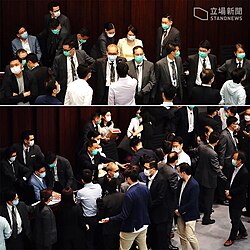
The deadlock broke on May 8, 2020, in a highly contentious session. Starry Lee declared her authority to preside over the meeting, citing her previous occupancy of the chair in 2019, and physically took the vacant committee chair to end the impasse.
During the meeting, pro-Beijing lawmakers and security staff prevented pro-democracy lawmakers from intervening. Lee maintained that she was the incumbent chairperson and had not "seized power." The session resulted in scuffles, with reports of at least one pro-democracy lawmaker being injured, leading most of the pan-democratic members to walk out.
Lee and LegCo legal adviser Connie Fung justified the move by citing the "abnormal situation" caused by six months of filibustering. Meanwhile, the director of Hong Kong Watch noted that the logjam was a result of a broken system where filibustering became the only available strategy for the democratic majority.
Final Passage and Legal Enactment
Following the resolution of the leadership dispute, the bill moved rapidly through the remaining stages. On May 28, 2020, the bill passed its second reading, though the session was marred by a protest in which pan-democracy legislator Ted Hui dropped a rotten plant in front of LegCo President Andrew Leung, resulting in a fine for Hui.
The bill passed its third reading on June 4, 2020, with a vote of 41 in favor and 1 against. The voting breakdown was as follows:
- Pro-establishment: 41 out of 42 voted in favor; President Andrew Leung abstained.
- Pan-democracy: 1 out of 23 voted against; the remainder abstained in protest.
The final vote was preceded by a dramatic protest where legislators Raymond Chan and Eddie Chu splashed a jar of reeking liquid in front of the rostrum, accusing Andrew Leung of being a "rubber stamp." Both were subsequently fined.
The National Anthem Ordinance was signed by Chief Executive Carrie Lam on June 11, 2020, and came into force the day after its publication in the Hong Kong Government Gazette.
Key Facts
- Drafting Date: January 8, 2019.
- Enactment Date: June 2020.
- Final Vote: 41 in favor, 1 against.
- Key Figures: Starry Lee (Pro-establishment), Carrie Lam (Chief Executive), Andrew Leung (LegCo President).
- First Arrest: Occurred on July 30, 2021, involving a 40-year-old man in Kwun Tong.
| Date | Event | Outcome |
|---|---|---|
| January 2019 | Bill drafted and submitted | Initial block by pro-democracy councillors |
| October 2019 | House Committee re-election | Filibustering delays chairperson election |
| May 8, 2020 | Starry Lee resumes chair | Legislative deadlock broken; scuffles occur |
| June 4, 2020 | Third reading vote | Bill passes (41-1) |
| June 11, 2020 | Signing by Chief Executive | Ordinance becomes law |
| July 30, 2021 | First enforcement action | Arrest of a man for urging booing of the anthem |
Frequently Asked Questions
What is filibustering in the context of LegCo?
Filibustering refers to the tactic used by pan-democratic legislators to delay the legislative process by holding excessively long discussions on unrelated topics, thereby preventing the election of a chairperson or the discussion of specific bills.
How did Starry Lee resolve the legislative deadlock in May 2020?
Starry Lee physically occupied the vacant committee chair and declared her authority to preside over the meeting based on her previous role as chairperson in 2019, which allowed the committee to proceed with the bill.
What happened during the final vote on June 4, 2020?
The bill passed with 41 votes in favor and 1 against. The session was marked by protests, including the splashing of a foul-smelling liquid by legislators Raymond Chan and Eddie Chu.
When did the National Anthem Ordinance officially take effect?
The ordinance was signed by Chief Executive Carrie Lam on June 11, 2020, and became law the day after it was published in the Hong Kong Government Gazette.
What was the first arrest made under this law?
On July 30, 2021, police arrested a 40-year-old man in Kwun Tong who allegedly encouraged people to boo the national anthem during a live screening of an Olympics award ceremony.