Nassau Hall: The Historic Heart of Princeton University
Standing as a testament to American resilience and academic ambition, Nassau Hall—affectionately known as "Old Nassau"—is the oldest building at Princeton University. Located in Princeton, Mercer County, New Jersey, this iconic structure is more than just a campus landmark; it is a site of profound national significance that has served as a center for education, a battlefield during the American Revolution, and the provisional capital of the United States.
When it was completed in 1756, Nassau Hall was the largest academic building in the American colonies and the largest building in colonial New Jersey. Today, it serves as a metonym for the university itself and continues to house the administrative offices of Princeton University, including the office of the university president.
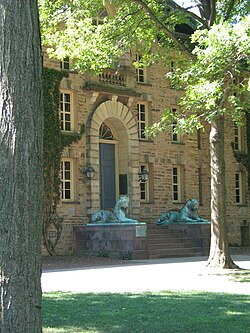
Key Facts
- Built: 1756
- Designations: U.S. National Historic Landmark (1960), National Register of Historic Places (1966), and New Jersey Register of Historic Places (1971).
- Political Significance: Served as the U.S. Capitol building for four months in 1783.
- Architectural Style: Renaissance (with various modifications over time).
- Historical Role: Site of conflict during the Battle of Princeton (1777).
The Origins and Naming of Old Nassau
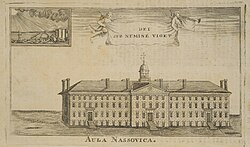
The institution, originally called the College of New Jersey, operated in Elizabeth and Newark for a combined decade before Nassau Hall was finished. The building's name carries a royal legacy. While the college board initially wished to name the hall after Jonathan Belcher, the royal governor of New Jersey, Belcher declined the honor. He requested instead that the building be dedicated to King William III of the Dutch House of Orange-Nassau.
A Witness to the American Revolution
Nassau Hall played a pivotal role during the American Revolutionary War. In 1776, it hosted the first meeting of the New Jersey Legislature on August 27. However, the building soon became a strategic point of contention, occupied by British forces in 1776.
During the Battle of Princeton on January 3, 1777, the Continental Army attacked the hall. The building was struck by two cannonballs; one left a mark on the south side that remains visible today. Another reportedly flew through a window in the faculty room, decapitating a portrait of King George II. This specific shot is attributed to the artillery company commanded by Alexander Hamilton. The battle ended in a Patriot victory, returning the hall to American control.
The Provisional Capital of the United States
From June 30 to November 4, 1783, Princeton served as the provisional capital of the United States after a mutiny by Continental Army soldiers forced the government to vacate Philadelphia. During this period, the Congress of the Confederation met in the second-floor library of Nassau Hall. It was here that Congress congratulated George Washington on ending the war, received news of the peace treaty with Great Britain, and welcomed the first foreign minister from the Netherlands.
Architectural Evolution and Resilience
The original 1756 design by Robert Smith featured a central corridor, a two-story prayer hall, and approximately forty student rooms. However, the building's history is marked by two devastating fires that necessitated major reconstructions.
- The 1802 Fire: This blaze destroyed the interior and nearly 3,000 library books. Benjamin Latrobe, the first professionally trained architect in the U.S., oversaw the reconstruction. He replaced horizontal lintels with triangular pediments and added a fanlight to the central pediment.
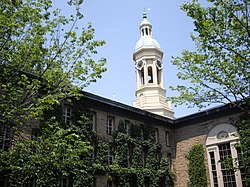
- The 1855 Fire: The hall was gutted again in March 1855. John Notman led the reconstruction in the Italian Renaissance style, adding towers and a cupola, though many of these flourishes were later removed.
Traditions and Legacy
Nassau Hall is woven into the cultural fabric of Princeton. Since 1869, every graduating class has added a sprig of ivy to the building's walls. The building also inspired the university's alma mater, "Old Nassau," adopted in 1859. The lyrics were written by Harlan Page Peck, with a melody composed by Professor Karl A. Langlotz, a student of Franz Liszt.
| Category | Details |
|---|---|
| Location | Princeton, New Jersey |
| Architects | Robert Smith, Benjamin Latrobe, John Notman |
| Key Events | Battle of Princeton (1777), U.S. Capitol (1783) |
| Current Use | University Administrative Offices |
| NRHP Reference | 66000465 |
Frequently Asked Questions
Why is the building called Nassau Hall?
It was named in honor of King William III of the Dutch House of Orange-Nassau, after the royal governor of New Jersey, Jonathan Belcher, declined to have the building named after himself.
Did Nassau Hall ever serve as the U.S. Capitol?
Yes, for a period of four months between June 30 and November 4, 1783, Nassau Hall served as the seat of the U.S. government and the meeting place for the Congress of the Confederation.
What happened during the Battle of Princeton at Nassau Hall?
The building was attacked by the Continental Army on January 3, 1777. Two cannonballs hit the building, one of which damaged the south wall and another that damaged a portrait of George II.
Who were the architects responsible for the building's design?
The hall was originally designed by Robert Smith in 1756, remodeled by Benjamin Latrobe after the 1802 fire, and reconstructed by John Notman after the 1855 fire.
What is the significance of the ivy on the walls?
Since 1869, it has been a tradition for each graduating class of Princeton University to add a new sprig of ivy to the walls of Nassau Hall.