Nagorno-Karabakh: A History of the Autonomous Oblast
The region of Nagorno-Karabakh has long been a focal point of geopolitical tension in the Caucasus. Its modern history is defined by a complex struggle for autonomy and identity, beginning with the brief independence of the First Republic of Armenia and the Azerbaijan Democratic Republic between 1918 and 1920. Following the Sovietization of these republics, the Kavbiuro (the Bolshevik Party's Caucasian Bureau) decided to place the area within the Azerbaijan SSR, though it was granted broad regional autonomy.
The Establishment of the NKAO
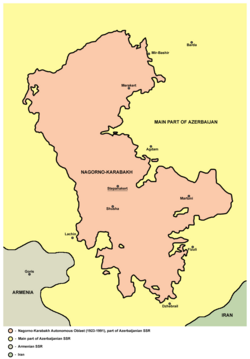
On July 7, 1923, the Nagorno-Karabakh Autonomous Oblast (NKAO) was formally established. The administrative center was moved to Stepanakert, named in honor of the revolutionary Stepan Shaumian. The oblast initially covered an area of 4,161 km² (1,607 sq mi).
The inclusion of Shusha, a principal city of the region, was a point of early contention. Initially, Shusha and its surrounding villages were to be excluded from the autonomy because they were predominantly Azerbaijani, following the massacre and expulsion of the majority Armenian population. However, this decision was reversed in 1923, and Shusha was joined to the NKAO despite protests from Muslim villages that preferred its inclusion in the Kurdistan uezd (a Soviet administrative district).
Demographic Shifts and Political Appeals
Demographics within the NKAO shifted significantly throughout the Soviet era. According to the 1926 Soviet census, the population stood at 125,200, with Armenians making up 89.2 percent. By the 1989 census, the Armenian share of the population had dropped to 76.9 percent. This decline was attributed to several factors: the Azerbaijani authorities' policy of settling Azerbaijanis in the region, the out-migration of Armenians, and a higher birthrate among the Azerbaijani population.
Throughout the mid-20th century, Armenian intellectuals and leaders periodically petitioned Moscow to transfer the oblast to the Armenian SSR. Notable attempts included:
- 1945: First Secretary Grigory Arutinov appealed to Joseph Stalin, but the request was vetoed by Azerbaijan's Mir Jafar Baghirov.
- 1956: Following Nikita Khrushchev's "Secret Speech," Armenian Catholicos Vazgen I wrote to Nikolai Bulganin regarding the region's status.
- 1962: Residents of the NKAO appealed directly to Khrushchev, citing grievances with Baku and requesting a transfer to either Soviet Armenia or the Russian SFSR.
- 1966: An appeal signed by 1,906 cultural and intellectual figures—including Martiros Saryan, Yervand Kochar, Hamo Sahyan, and Paruyr Sevak—was endorsed by Armenian leadership but vetoed by Baku, reportedly with the support of Mikhail Suslov.
Tightening Control and the Path to Conflict
The political climate shifted further in 1969 when Heydar Aliyev assumed leadership of the Azerbaijani SSR. Aliyev sought to tighten Baku's control over the NKAO and alter its demographics. In 1973–74, he purged the oblast's leadership, labeling them "Armenian nationalists," and appointed Boris Kevorkov, an Armenian from outside the region, as First Secretary. In 1977, author Sero Khanzadyan continued the push for annexation in an open letter to Leonid Brezhnev.
The arrival of Mikhail Gorbachev's policies of glasnost (openness) and perestroika (restructuring) provided the catalyst for a democratic mass movement. On February 20, 1988, the Supreme Soviet of the NKAO voted to unify with Soviet Armenia, sparking open conflict between the local Armenian population and the Azerbaijani government.
By the end of 1991, this escalation evolved into the First Nagorno-Karabakh War. On November 26, 1991, the Supreme Soviet of Azerbaijan formally abolished the oblast's autonomous status. In response, and with the support of Armenia, the majority Armenian population declared the independence of the Nagorno-Karabakh Republic on December 10, 1991.
Key Facts
- Established: July 7, 1923, as the Nagorno-Karabakh Autonomous Oblast (NKAO).
- Original Area: 4,161 km² (1,607 sq mi).
- Capital: Stepanakert.
- Demographic Change: Armenian population share dropped from 89.2% (1926) to 76.9% (1989).
- Key Turning Point: The 1988 vote by the NKAO Supreme Soviet to unify with Soviet Armenia.
- Final Status: Autonomous status abolished by Azerbaijan on November 26, 1991, followed by a declaration of independence by the Nagorno-Karabakh Republic on December 10, 1991.
| Year | Event | Outcome/Significance |
|---|---|---|
| 1923 | Formation of NKAO | Established as an autonomous oblast within Azerbaijan SSR. |
| 1926 | Soviet Census | Armenians accounted for 89.2% of the population. |
| 1969 | Aliyev's Leadership | Increased control from Baku and leadership purges in 1973-74. |
| 1988 | Unification Vote | NKAO Supreme Soviet voted to join Soviet Armenia. |
| 1991 | Abolition & Independence | Azerbaijan abolished autonomy; Nagorno-Karabakh Republic declared independence. |
Frequently Asked Questions
Why was the NKAO placed within the Azerbaijan SSR?
The decision was made by the Kavbiuro of the Bolshevik Party following the Sovietization of the First Republic of Armenia and the Azerbaijan Democratic Republic.
How did the demographics of the region change between 1926 and 1989?
The Armenian population share decreased from 89.2% to 76.9%. This was due to Azerbaijani settlement policies, Armenian out-migration, and a higher birthrate among Azerbaijanis.
Who was Boris Kevorkov?
Boris Kevorkov was an Armenian from outside the NKAO who was appointed as the oblast's First Secretary by Heydar Aliyev after the 1973–74 purge of local leadership.
What role did Gorbachev's reforms play in the conflict?
The policies of glasnost and perestroika inspired Karabakh Armenians to launch a democratic mass movement, leading to the 1988 vote to unify with the Armenian SSR.
When did the Nagorno-Karabakh Republic declare independence?
The Nagorno-Karabakh Republic declared its independence on December 10, 1991, shortly after Azerbaijan abolished the oblast's autonomous status.