Muonic Atoms: Exotic Matter and the Science of Muon-Catalyzed Fusion
In the realm of atomic physics, most of our understanding is based on atoms consisting of a nucleus orbited by electrons. However, scientists can create muonic atoms—exotic structures where a muon replaces one of the electrons. A muon is a lepton (a subatomic particle that does not experience the strong nuclear force), similar to an electron but significantly more massive.
Because leptons are only affected by electromagnetic, weak, and gravitational forces, these atoms are governed with extreme precision by electromagnetic interactions. This makes them invaluable tools for testing the laws of physics at a microscopic scale.
The Physics of Muonic Structures
The defining characteristic of a muonic atom is the mass of the muon. Because the muon is much heavier than the electron, the Bohr orbits (the theoretical paths electrons or muons take around a nucleus) are located much closer to the nucleus. This proximity increases the impact of quantum electrodynamics (QED), the relativistic quantum field theory of electrodynamics).
By studying the energy levels and the transition rates as these atoms move from excited states to their ground state, researchers can conduct rigorous experimental tests of QED.
Muonic Hydrogen and the Proton Radius Puzzle
Muonic hydrogen is formed when a negative muon orbits a single proton. This specific configuration is critical for scientists attempting to solve the proton radius puzzle, a discrepancy in the measured size of the proton.
Beyond single atoms, muonic hydrogen can form molecules. In these molecules, the distance between nuclei is hundreds of times smaller than in standard hydrogen molecules. This extreme proximity allows nuclei to spontaneously fuse, a process known as muon-catalyzed fusion.
First observed in 1957 between deuterium and hydrogen-1 nuclei, muon-catalyzed fusion has been proposed as a potential method for generating energy via fusion reactions within a room-temperature reactor.
Muonic Helium and the "Hydrogen-4.1" Phenomenon
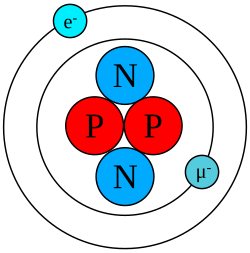
Muonic helium (He-μ) presents a fascinating case of chemical mimicry. This atom consists of a helium-4 nucleus (two protons and two neutrons) where one electron is replaced by a muon. Because the muon's orbital radius is less than 1/200th that of an electron, it effectively resides within the nucleus.
This creates a composite nucleus consisting of two protons, two neutrons, and one muon. Since the muon carries a -1 charge, the total nuclear charge becomes +1. With only one electron remaining in the outer orbit, the atom behaves chemically like an isotope of hydrogen rather than an inert helium atom. This exotic species is often referred to as Hydrogen-4.1, with the .1 representing the muon's approximate mass of 0.1 Da.
Key Facts
- Composition: Muonic atoms replace an electron with a muon, a heavier lepton.
- Orbital Radius: Muons orbit much closer to the nucleus than electrons do.
- Lifespan: While a free muon lasts 2.2 μs, muon capture in heavier atoms can reduce this to 0.08 μs.
- Fusion: Muon-catalyzed fusion allows nuclei to fuse at room temperature.
- Chemical Identity: Muonic helium behaves like hydrogen (Hydrogen-4.1) due to its +1 net nuclear charge.
| Feature | Standard Atom | Muonic Atom |
|---|---|---|
| Orbiting Particle | Electron | Muon |
| Orbital Radius | Standard | Significantly Smaller |
| Primary Interaction | Electromagnetic | Electromagnetic (High Precision) |
| Nuclear Proximity | Low | High (Enables Fusion) |
Frequently Asked Questions
What is a muon?
A muon is a lepton, a type of subatomic particle similar to an electron but with a much greater mass.
Why is muon-catalyzed fusion significant?
It allows atomic nuclei to get close enough to fuse spontaneously, potentially enabling fusion energy production in room-temperature reactors.
What happens to the muon in a muonic atom?
The muon will either naturally decay or be captured by a proton within the nucleus.
Why is muonic helium called Hydrogen-4.1?
Because the muon resides so close to the nucleus, it reduces the helium nucleus's charge from +2 to +1, making it chemically behave like a hydrogen isotope with a mass of approximately 4.1 Da.
How do muonic atoms help test physics?
Their unique energy levels and transition rates provide a high-precision environment to test the predictions of quantum electrodynamics (QED).