Motijheel: The Evolution of Dhaka's Historic Commercial Hub
Motijheel stands as a cornerstone of Dhaka's urban identity, transitioning from a serene garden estate to the city's primary Central Business District (CBD)—the commercial and financial heart of a city. Its history is a tapestry of spiritual heritage, colonial administration, and rapid economic modernization.
From Spiritual Roots to Colonial Elegance
The area's history dates back to the Bengal Sultanate, when it was home to the Sufi preacher Shah Jalal Dakhini. Today, his tomb remains a significant landmark located within the Bangabhaban premises. During the Mughal era, the region was known as the abode of Mirza Muhammad Mukim and later became famous as Dilkusha.
Dilkusha was once the site of the Dhaka Gardens, a lavish property owned by the Nawab of Dhaka. The area also hosted an Armenian community and served as the official residence for the Governor of Bengal and the Viceroy of India. This legacy of power continued as the site became the seat of the Governor of East Pakistan.
Currently, the Bangabhaban serves as the official residence of the President of Bangladesh. The presidential palace is enveloped by the Bangabhaban Gardens, which were formerly known as the Nawab's Gardens, Dilkusha, Dhaka.
The Rise of a Financial Powerhouse
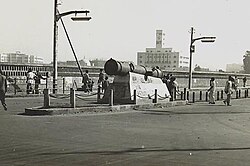
Following the partition of India, Motijheel underwent a dramatic transformation. During the 1950s and 1960s, it evolved into the primary CBD of Dhaka. A key milestone in the area's educational landscape occurred in 1954 when Notre Dame College relocated to its current Motijheel campus, producing many prestigious alumni.
The skyline of this era was defined by the Dhaka Improvement Trust (DIT) building, whose clocktower stood as the tallest structure in East Pakistan. The 1960s also saw the opening of the Purbani Hotel, further cementing the area's status as a hub for business and hospitality.
The Era of Skyscrapers and State Banks
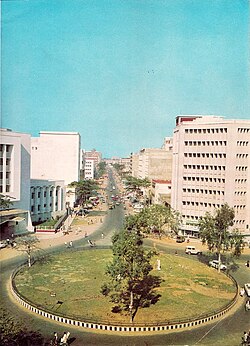
The 1980s and early 1990s marked a period of vertical expansion. Numerous high-rise buildings were constructed, primarily serving as the headquarters for state-owned banks of Bangladesh. For a significant period, the Bangladesh Bank Building held the title of the tallest building in the country.
More recently, the City Centre Dhaka building became the tallest structure in Bangladesh from 2012 until 2025, when it was eventually surpassed by the Pinnacle building located in the Tejgaon Industrial Area. While Motijheel remains iconic, the emergence of several new commercial districts across Dhaka has led to a relative decline in its prominence.
Key Facts
- Historical Name: Formerly known as Dilkusha.
- Presidential Seat: Home to Bangabhaban, the residence of the President of Bangladesh.
- Educational Landmark: Notre Dame College moved to Motijheel in 1954.
- Financial Hub: Houses the headquarters of various state-owned banks and the Bangladesh Bank.
- Architectural Milestone: City Centre Dhaka was the nation's tallest building from 2012 to 2025.
Summary of Motijheel's Evolution
| Era/Period | Key Feature or Landmark | Significance |
|---|---|---|
| Bengal Sultanate | Shah Jalal Dakhini's Tomb | Spiritual foundation |
| Mughal/Nawab Era | Dilkusha / Dhaka Gardens | Aristocratic residence |
| 1950s - 1960s | DIT Clocktower & Purbani Hotel | Emergence as Dhaka's CBD |
| 1980s - 1990s | State-owned Bank Headquarters | Financial centralization |
| 2012 - 2025 | City Centre Dhaka | National height record holder |
Frequently Asked Questions
What is the historical significance of Dilkusha?
Dilkusha was the historical name for the area now known as Motijheel and was the site of the Nawab of Dhaka's gardens, as well as residences for the Governor of Bengal and the Viceroy of India.
Which building was the tallest in Bangladesh before 2025?
City Centre Dhaka in Motijheel was the tallest building in Bangladesh from 2012 until 2025, when it was surpassed by the Pinnacle building in Tejgaon.
When did Notre Dame College move to Motijheel?
Notre Dame College relocated to its present campus in Motijheel in 1954.
Who currently resides at Bangabhaban?
The President of Bangladesh resides at the Bangabhaban, which is surrounded by the historic Bangabhaban Gardens.
Why is Motijheel considered less prominent today?
The emergence of multiple new central business districts in other parts of Dhaka has led to a gradual neglect of Motijheel as the sole commercial hub.