Mothers' Union: The History and Growth of a Global Support Network
The Mothers' Union began as a humble effort to provide mutual support and guidance for women navigating the challenges of parenthood. Founded on the belief that motherhood is a vocation—a strong feeling of suitability for a particular career or occupation—the organization evolved from a local parish gathering into a vast international network within the Anglican communion.
The Vision of Mary Sumner
The organization was founded in 1876 by Mary Sumner in the Church of England parish of Old Alresford, located near Winchester. The inspiration for the movement struck Sumner following the birth of her first grandchild. Reflecting on the difficulties she faced during her own early experiences as a mother, Sumner sought to create a space where mothers of all social classes could unite. Her goal was to foster a community where women could support one another and receive training in the art of motherhood.
From Local Meeting to Diocesan Organisation
For nearly a decade, the movement remained relatively small until a pivotal moment in 1885. Ernest Roland Wilberforce, the first Bishop of Newcastle, was scheduled to address churchgoing women at the Portsmouth Church Congress. Realizing he lacked a relevant message for the audience, he invited Mary Sumner to speak in his place. Despite her nervousness, Sumner delivered a passionate address regarding the capacity of mothers to positively transform the nation.
The impact of her speech was immediate. Many women were inspired to establish similar meetings within their own parishes. Consequently, the Bishop of Winchester, who presided over the congress, officially declared the Mothers' Union a diocesan organisation (an entity operating under the jurisdiction of a bishop's diocese).
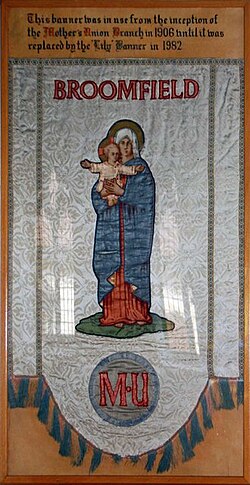
Factors Driving Expansion
The rapid growth of the Mothers' Union beyond the Diocese of Winchester was fueled by two primary factors: the Victorian British society's intense focus on morality and the desire to combat social ills, and the expanding reach of the Anglican mission across the British Empire.
Rapid Growth and Royal Patronage
The movement spread quickly through the United Kingdom, reaching the dioceses of Ely, Exeter, Hereford, Lichfield, and Newcastle. The scale of the organization grew exponentially during the late 19th century:
- 1892: 60,000 members across 28 dioceses.
- 1900: 169,000 members.
To manage this growth, annual general meetings were established in 1893, and the Mothers' Union Central Council was formed in 1896. Mary Sumner was unanimously elected president, a role she maintained into her nineties.
A significant milestone occurred in 1897 during her Diamond Jubilee, when Queen Victoria became the patron of the Mothers' Union. This royal endorsement provided an unprecedented level of legitimacy, facilitating the establishment of branches throughout the British Empire, starting in New Zealand, followed by Canada and India. Mary Sumner lived to see the first Mothers' Union Conference of Overseas Workers in 1920.
Following Queen Victoria, the organization continued to be supported by royal patrons, including Queen Elizabeth The Queen Mother, Queen Elizabeth II, and Sophie, Duchess of Edinburgh.
Key Facts
- Founded: 1876 by Mary Sumner in Old Alresford.
- Core Purpose: To provide support and training for mothers of all social classes.
- Turning Point: The 1885 Portsmouth Church Congress speech.
- Membership Growth: Increased from 60,000 in 1892 to 169,000 by 1900.
- Royal Patronage: First patronized by Queen Victoria in 1897.
- Global Reach: Early international expansion included New Zealand, Canada, and India.
| Year | Event / Milestone | Impact/Scale |
|---|---|---|
| 1876 | Founded by Mary Sumner | Local parish start in Old Alresford |
| 1885 | Portsmouth Church Congress | Became a diocesan organisation |
| 1892 | Membership expansion | 60,000 members in 28 dioceses |
| 1896 | Central Council formed | Mary Sumner elected president |
| 1897 | Queen Victoria becomes patron | Global expansion into the British Empire |
| 1900 | Turn of the century growth | 169,000 members |
| 1920 | First Overseas Workers Conference | Formalized international coordination |
Frequently Asked Questions
Who founded the Mothers' Union and why?
Mary Sumner founded the Mothers' Union in 1876. She was inspired by the birth of her first grandchild and her own memories of the difficulties of early motherhood, leading her to create a support network for mothers of all social classes.
How did the organization transition from a local group to a larger entity?
The transition occurred after Mary Sumner spoke at the 1885 Portsmouth Church Congress. Her passionate speech inspired women to start meetings in their own parishes, and the Bishop of Winchester subsequently declared it a diocesan organisation.
What role did the British monarchy play in the organization?
The monarchy provided significant legitimacy and support. Queen Victoria became the patron in 1897, followed by Queen Elizabeth The Queen Mother, Queen Elizabeth II, and Sophie, Duchess of Edinburgh.
Where did the Mothers' Union expand internationally?
The organization expanded throughout the British Empire, with early branches established in New Zealand, Canada, and India.
How many members did the Mothers' Union have by 1900?
By the turn of the century, the membership had grown to 169,000 people.