Most Recent Common Ancestor: Tracing the Roots of Life and Humanity
In the vast tapestry of biological history, every living organism shares a connection to a predecessor. This connection is defined by the Most Recent Common Ancestor (MRCA), also known as the last common ancestor (LCA). An MRCA is the most recent individual from which all organisms within a specific set are inferred to have descended. While the MRCA of a broad group (a higher taxon) is typically a species, the term is also applied to the ancestry of specific gene groups, known as haplotypes.
Determining the MRCA is a cornerstone of evolutionary biology, allowing scientists to reconstruct the "tree of life." By analyzing genetic markers and mutation rates, researchers can estimate the Time to Most Recent Common Ancestor (TMRCA), providing a chronological window into when different lineages diverged.
![Evolutionary tree showing the divergence of modern species from the last universal ancestor in the center.[6] The three domains are colored, with bacteria blue, archaea green, and eukaryotes red.](/images/9f/dc/9fdcc9e04e9a8822da9e8eb540a4c5d4974663c0d16beb34a7b8718d4dda42ef.png)
Key Facts
- LUCA (Last Universal Common Ancestor) is the ancestor of all current life on Earth, estimated to have lived 3.5 to 3.8 billion years ago.
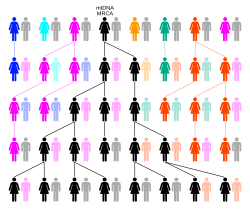
- Mitochondrial Eve (mt-MRCA) is the most recent common matrilineal ancestor of all living humans, estimated at roughly 200,000 years ago.
- Y-chromosomal Adam (Y-MRCA) is the most recent common patrilineal ancestor of all living humans, estimated between 237,000 and 581,000 years ago.
- The genealogical MRCA of all living humans is estimated to be much more recent than the genetic MRCAs, possibly as recently as 2,000 years ago.
- MRCA does not imply a "first couple" or a population bottleneck, but rather an individual with high reproductive success whose lineage eventually persisted in all descendants.
The Spectrum of Common Ancestry
The Last Universal Common Ancestor (LUCA)
At the very root of the biological tree is LUCA. Living during the Paleoarchean era approximately 3.5 to 3.8 billion years ago, LUCA is the ancestor of every bacterium, archaeon, and eukaryote alive today. Because LUCA did not leave fossils, scientists study its composition by comparing the genomes of modern descendants; one 2016 study identified 355 genes likely present in LUCA.
Species-Level Divergence
Beyond the universal ancestor, MRCAs define the relationships between different species. For example, the MRCA of all Carnivora (including cats and dogs) is estimated to have diverged about 42 million years ago, represented by the Miacidae. In his work The Ancestor's Tale, Richard Dawkins illustrates this by tracing 40 stages of "concestors" from humans back to LUCA, moving through hominins, hominids, and beyond.
Human Ancestry: Matrilineal and Patrilineal Lines
In sexually reproducing organisms, ancestry is split into two primary genetic pathways that do not shuffle during inheritance, making them ideal for tracing lineage.
Mitochondrial Eve (mt-MRCA)
Mitochondrial DNA (mtDNA) is passed from mothers to all children but only daughters pass it on. Because it is nearly immune to the recombination (shuffling) that occurs in nuclear DNA, it allows researchers to trace a direct matrilineal line. This leads back to "Mitochondrial Eve," the woman from whom all living humans inherit their mtDNA, estimated to have lived about 200,000 years ago.
Y-chromosomal Adam (Y-MRCA)
Similarly, the Y chromosome is passed from fathers to sons without recombination. This allows for the tracing of the patrilineal line to "Y-chromosomal Adam." Research published in 2013 suggests that with 95% confidence, Y-chromosomal Adam lived between 237,000 and 581,000 years ago.
Estimating TMRCA: Methods and Models
Calculating the time to the MRCA depends on whether researchers are looking at specific genetic markers or the general genealogical tree.
Genetic Marker Analysis
For mtDNA and Y-DNA, TMRCA is calculated using mutation rates. In mtDNA, scientists track the accumulation of mutations to define haplogroups. For Y-DNA, researchers look at single-nucleotide polymorphisms and STR (short tandem repeat) sequences. A "star cluster" in Y-STR analysis often indicates a population descended from a single ancestor, such as the descendants of Genghis Khan.
Mathematical and Theoretical Models
The genealogical MRCA—the ancestor shared by all humans via any line of descent—cannot be traced via DNA because most ancestral DNA is lost after a few hundred years due to recombination. Instead, mathematicians use computer simulations. One study by Joseph T. Chang and colleagues suggested the human MRCA might have lived as recently as 2,000 years ago, likely in East Asia, due to the region's proximity to isolated populations in the Americas and Australia.
| Ancestor Type | Genetic Marker | Estimated Age | Inheritance Path |
|---|---|---|---|
| Mitochondrial Eve | mtDNA | ~200,000 years | Matrilineal (Mother to Child) |
| Y-chromosomal Adam | Y-DNA | 237,000 – 581,000 years | Patrilineal (Father to Son) |
| Genealogical MRCA | N/A (Mathematical Model) | Possibly ~2,000 years | Any line of descent |
| LUCA | Comparative Genomics | 3.5 – 3.8 billion years | All life on Earth |
The Identical Ancestors Point
While the MRCA is the most recent person shared by everyone, there is a further point in the past called the identical ancestors point. At this point, every single person who lived was either an ancestor to everyone alive today or an ancestor to no one alive today. Beyond this point, there are no longer individuals who are ancestral to only some of the population.
Frequently Asked Questions
Was Mitochondrial Eve the only woman alive at her time?
No. Mitochondrial Eve was the woman whose mitochondrial lineage survived in all living humans. Many other women lived at the same time, but their matrilineal lines eventually ended or were lost over generations.
Did Mitochondrial Eve and Y-chromosomal Adam know each other?
Almost certainly not. They lived tens or even hundreds of thousands of years apart and in different eras of human evolution.
Does the MRCA pass all their genes to every living descendant?
No. Due to sexual reproduction and genetic recombination, an ancestor passes only half their genes to each child. After about 32 generations, the genetic contribution of a single ancestor may be less than a single base pair within the human genome.
Why is the genealogical MRCA so much younger than the genetic MRCAs?
Genetic MRCAs (like Eve and Adam) track a single line of descent (only mothers or only fathers). The genealogical MRCA tracks all possible paths. Because we have two parents, four grandparents, and so on, the number of ancestors grows exponentially, making it much more likely that a common ancestor is found in the recent past.