Morón: A Journey Through the History of a Buenos Aires Hub
From its origins as a settlement of the Querandí people to its evolution into a bustling suburban center, Morón has played a significant role in the development of the Buenos Aires Province. Once a strategic stop for travelers and a site of pivotal military conflict, the city has transformed through agricultural shifts, industrial growth, and waves of immigration.
Early Foundations and the Camino Real
The land that now comprises Morón was deeded in the late 16th century by Captain Juan de Garay to Captain Juan Ruiz de Ocaña. Its importance grew as it became a key stop along the Camino Real (the Royal Road), the primary route connecting Buenos Aires to Córdoba. This growth was accelerated in 1771 when Pedro Márquez constructed a pontoon bridge over the Morón Brook.
Officially established as Cañada de Morón in 1785, the village evolved into a favored vacation destination for the wealthy elite of Buenos Aires. During this era, Francisco de Merlo—the namesake of the nearby city of Merlo—emerged as the region's primary landowner.
The origin of the city's name remains a subject of historical debate. Theories suggest it may be named after Diego Morón (whose widow, Isabel Torres Briseño, owned land in the area), another landowner named Pedro Morán, the Spanish town of Morón de la Frontera in Andalucia, or San Pedro de Morón, a patron saint of a local prominent woman.
Military Conflict and the Battle of Márquez Bridge
In 1829, Morón became the center of a critical engagement in the Argentine civil wars: the Battle of Márquez Bridge. This clash pitted the Unitarians (who favored a strong central government) against the Federalists (who advocated for provincial autonomy).
The battle resulted in a decisive victory for the Federalists, led by Juan Manuel de Rosas and Estanislao López, the Governor of Santa Fe. The defeat forced General Juan Lavalle to give up the governorship he had seized five months prior, cementing Rosas' control over the Buenos Aires Province until 1852.
Modernization and Urban Growth
The mid-19th century brought economic transformation to the region. By the 1850s, wheat farms began replacing traditional cattle ranches. A major turning point occurred in 1859 with the arrival of the Buenos Aires Western Railway, which sparked rapid expansion.
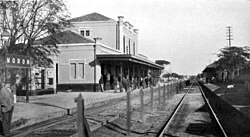
To manage this growth, the local gentry commissioned urbanist Pedro Benoit in 1859 to design a master plan for the city. This period also saw a significant influx of Italian immigrants, who founded a Mutual Aid Society in 1867 and eventually established an Italian consulate in the city. A small Jewish community also settled in the area during this time.
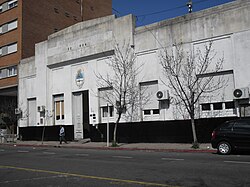
Religious and civic architecture further defined the city's identity. The Cathedral of Inmaculada Concepción del Buen Viaje opened for mass in 1871 and was fully completed by 1885. Later, in 1939, the Rationalist City Hall—designed by Alejandro Bustillo and featuring sculptures by José Fioravanti—was completed.
Industrialization and Political Evolution
The mid-20th century was marked by an industrial boom. Between the 1947 and 1960 censuses, the population of Morón tripled due to the growth of the manufacturing sector. This era of expansion led to the founding of the private Universidad de Morón in 1960.
As the city matured, its growth slowed, and it transitioned into a predominantly middle-class suburban profile. However, Morón remained politically active. In 1893, a Radical Civic Union uprising briefly deposed the National Autonomist Party government before federal troops intervened. More recently, in 1989, Mayor Juan Carlos Rousselot was impeached on corruption charges, though he was later returned to office by voters in 1991. The city has also produced national political figures, including Margarita Stolbizer and former Mayor Martín Sabbatella.
Key Facts
- Original Inhabitants: The Querandí people.
- Strategic Infrastructure: The 1771 pontoon bridge over Morón Brook facilitated travel on the Camino Real.
- Military Significance: Site of the 1829 Battle of Márquez Bridge, a victory for the Federalists.
- Urban Planning: Master plan created by Pedro Benoit in 1859.
- Demographic Shift: Population tripled between 1947 and 1960 due to manufacturing growth.
- Architectural Landmark: City Hall designed by Alejandro Bustillo (completed 1939).
| Period/Year | Event/Development | Significance |
|---|---|---|
| Late 16th Century | Land deeded to Juan Ruiz de Ocaña | Early colonial settlement |
| 1785 | Official establishment | Founded as Cañada de Morón |
| 1829 | Battle of Márquez Bridge | Federalist victory over Unitarians |
| 1859 | Arrival of Western Railway | Catalyst for urban and economic growth |
| 1939 | City Hall completion | Introduction of Rationalist architecture |
| 1960 | Founding of Universidad de Morón | Expansion of higher education |
Frequently Asked Questions
Who were the original settlers of the Morón area?
The location was originally settled by the Querandí people before being deeded to Spanish captains in the late 16th century.
What was the significance of the Battle of Márquez Bridge?
Fought in 1829, it was a pivotal engagement in the Argentine civil wars where Federalists under Juan Manuel de Rosas defeated General Juan Lavalle, leading to Rosas' long-term dominion over the Buenos Aires Province.
How did the railway affect the development of Morón?
The arrival of the Buenos Aires Western Railway in 1859 accelerated the town's growth, leading the local gentry to commission a formal urban master plan from Pedro Benoit.
Why did the population of Morón triple between 1947 and 1960?
The rapid population increase during this period was driven by significant growth in the city's manufacturing sector.
Who designed the Morón City Hall?
The Rationalist City Hall was designed by architect Alejandro Bustillo and features artistic bas-reliefs and sculptures by José Fioravanti.