Montpelier: The Architectural and Social History of James Madison's Estate
Nestled in the Piedmont region of Virginia, Montpelier stands as a profound testament to American history. Once the home of the fourth U.S. President, James Madison, the estate evolved from a colonial land grant into a sprawling plantation and, eventually, a preserved historic site. Its walls hold the stories of political leadership, the brutal reality of enslaved labor, and the equestrian legacy of the duPont family.
The Madison Family Legacy
The origins of the estate date back to 1723, when Ambrose Madison and his brother-in-law, Thomas Chew, received a patent for 4,675 acres of land. In 1732, Ambrose and his family established a plantation they named Mount Pleasant. However, Ambrose's tenure was short; he died six months after moving to the site, with court records indicating he was poisoned by three enslaved Africans. Following his death, his wife Frances and son, Colonel James Madison Sr., managed the estate.
James Madison Sr. expanded the property during the 1740s, introducing blacksmithing services and increasing the number of enslaved workers to cultivate tobacco. It was during the early 1760s that Madison Sr. built a new residence half a mile from the original site. Completed around 1764, this structure—featuring two stories of brick laid in a Flemish bond (a bricklaying pattern where headers and stretchers alternate in every course) and a low, hipped roof—became the core of what we now know as Montpelier.
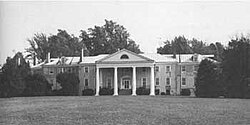
Evolution of the Main House
The construction of the main house occurred in three distinct phases:
- Phase 1 (1764–1797): The original brick dwelling built by James Madison Sr.
- Phase 2 (1797–1800): After returning with his wife, Dolley Madison, James Madison added a thirty-foot extension and a Tuscan portico.
- Phase 3 (1809–1812): Madison added a large drawing room and one-story wings at each end to provide separate living quarters for himself and Dolley.
James Madison retired to Montpelier full-time in 1817 after his second presidential term. He remained there until his death in 1836. Dolley Madison lived on the estate until 1844, when she sold the plantation to Henry W. Moncure. While Dolley was initially buried in Washington, D.C., she was later re-interred at Montpelier beside her husband.
The Meaning Behind the Name
The exact origin of the name "Montpelier" is not fully certain, though the first written record appears in a 1781 letter by James Madison. Madison preferred the French spelling, Montpellier, likely inspired by the famous resort city of the same name in France.
Slavery and Labor at Montpelier
The operation of Montpelier relied heavily on the labor of approximately 100 enslaved African people during James Madison's ownership. These individuals performed a wide array of essential tasks, serving as field workers, domestic servants, and skilled artisans in the forge, mill, and woodworking shops. Over several generations, many African Americans were born into slavery on the estate.
One of the most prominent figures was Paul Jennings (1799–1874), Madison's body servant. Jennings served at the White House starting at age 10 and later authored A Colored Man's Reminiscences of James Madison (1865), which is recognized as the first White House memoir. After being freed by Senator Daniel Webster in 1845, Jennings became a homeowner in Washington, D.C., and helped plan a massive escape attempt in 1848 involving 77 enslaved people aboard the schooner The Pearl.
Other residents, such as Catherine Taylor and her husband Ralph, faced complex paths to freedom. After Dolley Madison transferred most enslaved people to her son, John Payne Todd, legal and financial disputes delayed their manumission. The Taylors eventually petitioned for and received their freedom in 1853, relocating to the free black community in Washington, D.C.
The duPont Era and Equestrian Influence
After passing through six owners between 1844 and 1901, Montpelier was purchased by William and Annie Rogers duPont. An avid horse enthusiast, William duPont transformed the estate into a hub for Thoroughbred racing, constructing numerous stables and barns.
The duPonts also added a Hodgson House to the property—an early example of a prefabricated home that could be assembled in a single day—now known as the Bassett House. They significantly expanded the main residence, increasing the room count to 55 and covering the original brick with a light-colored stucco.

Their daughter, Marion duPont Scott, inherited the estate in 1928. While she preserved the core of the Madison home, she added a modern Art Deco music room featuring chrome, glass block, and laminated plywood. In 1934, Marion and her brother William founded the Montpelier Hunt Races, a steeplechase event using natural hedges that continues every November to this day.
Upon her death in 1983, Marion duPont Scott bequeathed the property and a $10 million endowment to the National Trust for Historic Preservation, ensuring the estate's survival for future generations.
Key Facts
- Original Patent: 4,675 acres granted to Ambrose Madison and Thomas Chew in 1723.
- Construction Phases: The main house was built in three stages between 1764 and 1812.
- Enslaved Population: Approximately 100 enslaved people worked the estate during James Madison's tenure.
- Historic Memoir: Paul Jennings wrote the first White House memoir based on his time serving Madison.
- duPont Expansion: The duPont family increased the home to 55 rooms and introduced Thoroughbred racing.
- Preservation: The estate was transferred to the National Trust for Historic Preservation in 1984.
| Period/Year | Owner/Key Figure | Major Development/Event |
|---|---|---|
| 1723–1732 | Ambrose Madison | Initial land patent and establishment of Mount Pleasant. |
| 1764–1797 | James Madison Sr. | Construction of the original brick main house (Phase 1). |
| 1797–1836 | James & Dolley Madison | Expansion of the house (Phases 2 & 3) and presidential retirement. |
| 1844–1901 | Various Owners | Property held by six successive owners including Henry W. Moncure. |
| 1901–1983 | The duPont Family | Addition of stables, Art Deco room, and the Montpelier Hunt Races. |
| 1984–Present | National Trust for Historic Preservation | Preservation as a historic site and museum. |
Frequently Asked Questions
Who was the first owner of the land that became Montpelier?
The land was originally patented in 1723 by Ambrose Madison and his brother-in-law, Thomas Chew, who established the first plantation site called Mount Pleasant.
What is the significance of Paul Jennings?
Paul Jennings was an enslaved body servant to James Madison who later wrote A Colored Man's Reminiscences of James Madison, which is considered the first memoir of the White House.
How did the duPont family change the estate?
The duPonts expanded the house to 55 rooms, added a stucco exterior, built extensive equestrian facilities for Thoroughbred racing, and introduced the annual Montpelier Hunt Races.
What happened to the enslaved people after James Madison's death?
Many were transferred to Dolley Madison's son, John Payne Todd. While his will called for their manumission, legal complications delayed this; some, like the Taylor family, had to petition for their freedom, which they received in 1853.
What is the Bassett House?
The Bassett House was originally a Hodgson House, one of America's first organized prefabricated homes, which could be constructed in a single day.