Money Orders in India and the United States
A money order is a secure financial instrument used to transfer funds from a payer to a payee. Unlike sending physical cash through the mail, which carries significant risk, money orders provide a documented and reliable method of payment. While the core purpose remains the same globally, the implementation and usage of these services vary significantly between countries like India and the United States.
Money Orders in India
In India, the money order service is managed by the Indian Postal Service. This system is designed to ensure that funds reach the recipient safely, regardless of their location. To initiate the process, a payer visits a post office, pays the desired amount plus a small commission, and receives a receipt. A postal employee then physically delivers the cash to the payee at the specified address after a few days.
To complete the transaction loop, the postal employee collects a receipt from the payee, which is then delivered back to the original payer. This system is particularly vital for transferring funds to remote or rural areas where bank branches are scarce or where recipients may not possess a bank account. For small sums, money orders remain the most economical transfer method in the country.
Money Orders in the United States
In the United States, money orders are widely available and can be purchased at post offices, grocery stores, and convenience stores. Some banks and credit unions provide them to their clients free of charge. Because they are considered certified funds—payments guaranteed by the issuing entity—they are trusted by the Internal Revenue Service (IRS) and other federal agencies.
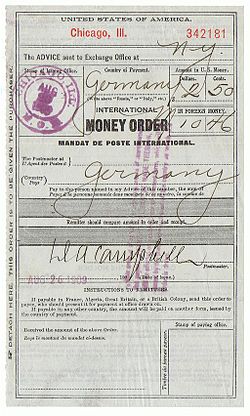
The United States Postal Service (USPS) introduced money orders as a safer alternative to sending currency through the mail, a strategy implemented by Postmaster-General Montgomery Blair between 1861 and 1864 to reduce post office robberies. While the USPS continues to issue money orders for a small fee, these are only negotiable within the U.S. and its possessions; the USPS ceased issuing international postal money orders after September 2024.
Beyond the postal service, various private vendors offer money orders to facilitate bill payments and international transfers in regions lacking reliable banking systems. Common providers include Walmart, CVS, Western Union, MoneyGram, 7-Eleven, QuikTrip, Cumberland Farms, and Safeway. It is important to note, however, that a business capable of issuing a money order may not necessarily be willing to cash one.
Key Facts
- India: Managed by the Indian Postal Service; involves physical cash delivery by a postal employee.
- USA: Recognized as certified funds by the IRS and federal agencies.
- USPS Limitation: As of September 2024, the USPS no longer issues international postal money orders.
- Accessibility: In India, they are essential for rural areas without banking access; in the US, they are available at diverse retail outlets.
- History: The USPS adopted money orders under Montgomery Blair (1861–1864) to curb robberies.
Comparison of Money Order Systems
| Feature | India (Postal Service) | United States (Various) |
|---|---|---|
| Primary Provider | Indian Postal Service | USPS, Retailers, and Financial Institutions |
| Delivery Method | Cash delivered by postal employee | Instrument delivered/mailed to payee |
| Key Advantage | Reach in rural/unbanked areas | Accepted as certified funds by government |
| International Use | Not specified in source | USPS international service ended Sept 2024 |
Frequently Asked Questions
Are money orders safer than sending cash?
Yes, money orders are significantly safer and more reliable than sending physical currency through the mail.
Who provides money orders in the United States?
They are provided by the USPS, various grocery and convenience stores (such as 7-Eleven, Safeway, and Walmart), and financial services like Western Union and MoneyGram.
Can I use a USPS money order internationally?
No. USPS money orders are only negotiable within the United States and its possessions, and the USPS stopped issuing international postal money orders after September 2024.
How does the Indian Postal Service handle money order delivery?
A postal employee delivers the cash directly to the payee's address and collects a receipt, which is then sent back to the payer.
Why are money orders used in rural India?
They are used because banks may not be conveniently accessible in remote areas, or the recipients may not have a bank account.