Monday Night Football: A History of Broadcast Innovation and Entertainment
Since its inception, Monday Night Football (MNF) has evolved from a simple sports broadcast into a cultural phenomenon. By blending high-stakes athletic competition with cinematic production values and celebrity appeal, the program has consistently pushed the boundaries of how sports are consumed on television.
Beyond the game itself, MNF has pioneered numerous technological advancements. The program introduced enhanced slow-motion replays and computerized graphics to the mainstream, transforming the viewer's perspective of the gridiron. To "liven up" the atmosphere, the broadcast frequently integrated celebrity guests. Notable figures have appeared in the booth, including former President Bill Clinton, former Vice President Spiro Agnew, singer Plácido Domingo, and even Kermit the Frog. One of the most surreal moments occurred on December 9, 1974, when John Lennon was interviewed by Howard Cosell while California Governor Ronald Reagan explained the rules of American football to Lennon off-camera.
Key Facts
- Technological Pioneer: Early adopter of enhanced slow-motion and advanced computer graphics.
- Viewership Peak: The 40th season (2009) saw the highest viewership since ESPN acquired the rights, driven largely by Brett Favre's game against the Green Bay Packers.
- Historic Matchup: The November 19, 2018, game between the Rams and Chiefs (54–51) stands as the highest-scoring game in MNF history.
- Broadcasting Milestone: Joe Buck and Troy Aikman became the NFL's longest-tenured broadcasting team after joining MNF.
- Digital Evolution: Introduction of the "Manningcast" and animated alternate broadcasts using player tracking data.
The ESPN Era: Themes and Transitions
When MNF debuted on ESPN in 2006, the network leaned heavily into high-energy production. Hank Williams Jr. re-recorded the opening theme with an all-star jam band featuring artists like Little Richard and Questlove. The broadcasts often began with cinematic teases; in one instance, Barack Obama spoofed his 2008 presidential candidacy announcement to support his hometown Chicago Bears.
Throughout the late 2000s, the opening sequences became increasingly elaborate. By 2008, CGI was used to show team helmets launching from a private residence and exploding at midfield. However, the relationship with Hank Williams Jr. ended abruptly in 2011 after controversial comments he made on Fox News, leading ESPN to remove his song, "All My Rowdy Friends Are Here on Monday Night," from the broadcast.
In the 2010s, the production shifted toward Hollywood-style aesthetics. A 2016 opening featured a red carpet entrance with active NFL stars and Hall of Famers, including Jerry Rice and Barry Sanders. Product placement also became more prominent, with GMC integrating vehicles like the Sierra and Acadia into the opening animations.
Modern Era: The Rise of the Megacast
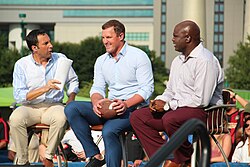
The 2020s marked a shift toward diversified viewing experiences. To celebrate the 50th anniversary in 2020, ESPN utilized a "Megacast" for the Las Vegas Raiders' home opener, simulcasting the event on ABC and providing an alternate broadcast on ESPN2.
One of the most significant innovations arrived in 2021 with the Manningcast. Produced by Omaha Productions, this alternate telecast featured Peyton and Eli Manning providing commentary alongside various celebrities. This approach to "alternate broadcasts" expanded further in 2023 and 2024 with the use of NFL player tracking data to create live animated versions of games featuring characters from Toy Story and The Simpsons.
Broadcasting Booth Changes
The commentary booth has seen frequent turnover to maintain freshness. In 2022, ESPN made a major move by hiring Joe Buck and Troy Aikman from Fox. This pairing eventually surpassed Pat Summerall and John Madden as the longest-tenured duo in NFL broadcasting history.
Additionally, the network introduced flex scheduling between Weeks 12 and 17 starting in 2023, allowing ESPN to swap matchups to ensure the most competitive games are aired on Monday nights.
MNF Broadcast Evolution Summary
| Era/Year | Key Innovation/Change | Notable Feature |
|---|---|---|
| Early Years | Entertainment Integration | Celebrity guests (e.g., John Lennon, Bill Clinton) |
| 2006–2011 | High-Energy Openings | Hank Williams Jr. theme and cinematic teases |
| 2013–2016 | Cinematic/Hollywood Style | GMC product placement and red carpet themes |
| 2021–Present | Alternate Broadcasts | Manningcast and animated tracking data games |
| 2023–Present | Strategic Scheduling | Implementation of flex scheduling (Weeks 12-17) |
Frequently Asked Questions
Who is the longest-tenured broadcasting team in NFL history?
Joe Buck and Troy Aikman became the NFL's longest-tenured broadcasting team after joining the Monday Night Football booth, surpassing the previous record held by Pat Summerall and John Madden.
What is the Manningcast?
The Manningcast is an alternate telecast produced by Omaha Productions featuring Peyton and Eli Manning, often accompanied by celebrity guests, airing on ESPN2 and ESPN+.
What was the highest-scoring game in MNF history?
The highest-scoring game occurred on November 19, 2018, when the Los Angeles Rams defeated the Kansas City Chiefs with a final score of 54–51.
How does flex scheduling work for Monday Night Football?
Starting in 2023, flex scheduling applies to games between Weeks 12 and 17, allowing ESPN to move more viable or competitive matchups into the Monday night slot.
Why was Hank Williams Jr. removed from the broadcast in 2011?
ESPN parted ways with Williams after he made controversial comments on Fox & Friends comparing a golf outing involving political figures to "Hitler playing golf with Netanyahu."