Mojave Desert: Geography, Climate, and Ecology of the High Desert
The Mojave Desert is a stark and beautiful landscape that forms part of the larger North American desert system, alongside the Sonoran, Chihuahuan, and Great Basin deserts. As the smallest and driest of these four, the Mojave is frequently referred to as the "high desert" because much of its terrain sits at elevations between 2,000 and 4,000 feet (610 to 1,220 m). Spanning approximately 54,000 square miles (140,000 km²), it is a region of dramatic contrasts, from the lowest point in North America to rugged mountain peaks.
The region is defined by basin and range topography, a geological pattern characterized by a series of parallel mountain ranges separated by wide valleys. This unique layout creates a diverse array of habitats that support a surprising variety of specialized flora and fauna.
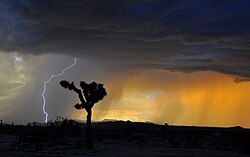
![The Joshua tree (Yucca brevifolia) is endemic to the Mojave Desert.[12]](/images/30/a5/30a50d6f2a98225fc665a1482c5b39ffe7c358d6b770ccf6bef86513e119f570.jpg)
Key Facts
- Location: United States (Arizona, California, Nevada, and Utah).
- Distinction: The smallest and driest of the four North American deserts.
- Lowest Point: Home to Death Valley, the lowest elevation in North America.
- Biodiversity: Supports 230 bird species and 98 mammal species.
- Climate: Classified as both cold desert (BWk) and hot desert (BWh).
- Key Flora: Endemic species include the Joshua tree (Yucca brevifolia).
Geography and Geology
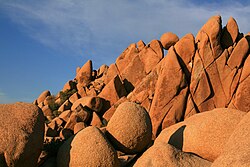
The Mojave's landscape is a product of millions of years of tectonic activity. The crust under western North America began stretching roughly 16 million years ago, a process believed to be caused by upwelling from the subducted spreading-zone of the Farallon Plate. This activity created the Basin and Range province, which eventually ripped the land apart to form Death Valley and Panamint Valley.
In Death Valley, the geology is exceptionally complex, featuring at least 23 sedimentary unit formations. Some of the oldest rocks in the area date back 1,700 million years. During the current ice age, these valleys were occasionally filled by lakes; Lake Manly was the largest, existing from 240,000 to 10,000 years ago. As these lakes dried up approximately 10,500 years ago, they left behind concentrated salts and minerals, shaping the arid environment seen today.
Climate and Weather Patterns
The Mojave Desert is characterized by extreme temperature swings. Summer months frequently see temperatures exceeding 100°F (38°C), while winters can bring freezing temperatures and strong winds. Precipitation is scarce, averaging between 2 and 6 inches (51 to 152 mm) annually, though higher altitudes like the San Gabriel mountains receive more moisture.
Most rainfall and snowfall occur between November and April, driven by Pacific cyclonic storms. These storms typically impact the mountains, often leaving the leeward slopes even more arid.
Regional Climate Comparison
| Location | Elevation | Avg. Precipitation | Notable Feature |
|---|---|---|---|
| Furnace Creek (Death Valley) | −190 ft | Low | Extreme summer heat (Record 134.1°F) |
| Las Vegas, NV | Low/Mid | Moderate | High sunshine hours (3,825.3 annually) |
| Searchlight, NV | 3,550 ft | 7.70 in | Typical "high desert" elevation |
| Mt. Charleston Lodge, NV | 7,420 ft | 23.09 in | Significant winter snowfall |
Urbanization and Human Activity
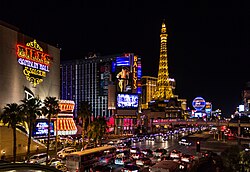
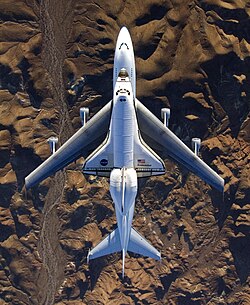
While largely sparsely populated, the Mojave has seen significant urbanization. Las Vegas is the largest urban center with approximately 2.3 million residents. Other notable areas include St. George, Utah (pop. 180,000), the Lancaster-Palmdale exurban area (pop. 400,000), and Victor Valley (pop. 550,000). The region also hosts critical military installations, such as Edwards Air Force Base and Naval Air Weapons Station China Lake, which are centers for experimental aviation and weapons research.
The desert is also a place of historical remnants. Ghost towns like Calico and Kelso serve as reminders of the silver and copper mining booms and the era of the railroad. Many other smaller settlements became ghost towns after U.S. Route 66 was replaced by the Interstate highway system.
Ecology: Flora and Fauna
Despite the harsh conditions, the Mojave supports a diverse biological community. The flora is marked by indicator species—plants that characterize the specific environment—such as the California Dalea and Goldenhead (Acamptopappus shockleyi). The creosote bush and silver cholla (Opuntia echinocarpa) are also common sights.
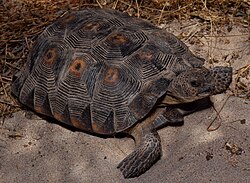
The fauna is equally specialized. The desert is home to 98 mammal species and 230 bird species. One of the most iconic residents is the desert tortoise, which has adapted to survive the extreme temperature fluctuations and limited water sources of the region.
Conservation and Protection
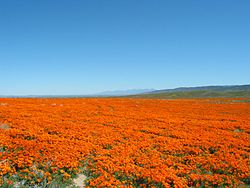
To protect these fragile ecosystems, several legislative measures have been implemented. The California Desert Protection Act of 1994 established Joshua Tree National Park, Death Valley National Park, and the Mojave National Preserve. Other protected areas include the Antelope Valley California Poppy Reserve and the Desert National Wildlife Refuge.
In 2013, the Desert Renewable Energy Conservation Plan (DRECP) further expanded protections, with the Bureau of Land Management designating 4.2 million acres of public land as protected wilderness.
Frequently Asked Questions
Why is the Mojave Desert called the "high desert"?
It is called the high desert because a significant portion of its elevation lies between 2,000 and 4,000 feet (610 to 1,220 m), which is higher than many other desert regions.
What is the lowest point in the Mojave Desert?
The lowest point is located in Death Valley, which is also the lowest elevation in all of North America.
Which plant is most endemic to the Mojave Desert?
The Joshua tree (Yucca brevifolia) is the most famous species endemic to the Mojave Desert.
How much rain does the Mojave Desert typically receive?
The desert receives an annual average precipitation of 2 to 6 inches (51 to 152 mm), though this varies by altitude.
What are the primary human activities in the region?
Human activities in the Mojave include recreation, ranching, military training, and the mining of gold, silver, tungsten, and iron deposits.