Mississippi Democratic Party: A History of Power, Segregation, and Transformation
The political landscape of Mississippi has undergone a profound evolution, shifting from a bastion of one-party rule rooted in segregation to a contested battleground of modern American politics. For over a century, the state's Democratic Party served as the primary vehicle for maintaining a social order based on states' rights and racial hierarchy, a period that defined the region as the Solid South.
Key Facts
- One-Party Dominance: Mississippi transitioned to a solid Democratic state during the Second Party System (1820-1860s).
- The Mississippi Plan: A strategy of force and violence implemented in 1876 to overthrow Republican rule and disenfranchise African Americans.
- The Dixiecrat Split: In 1948, southern delegates formed the States' Rights Party to oppose civil rights planks in the national Democratic platform.
- MFDP Challenge: The Mississippi Freedom Democratic Party challenged the all-white regular delegation at the 1964 Democratic National Convention.
- Political Shift: The state began a significant shift toward the Republican Party in the late 20th century, marked by the 1991 election of Governor Kirk Fordice.
Foundations of the Solid South
During the era of Jacksonian Democracy (roughly 1820-1860s), Mississippi moved away from a divided political system of Whigs and Democrats to become a one-party Democratic state. This iteration of the party was characterized by a fierce commitment to states' rights and the preservation of the slave system, leading to escalating tensions with northern Republicans and abolitionists.
These tensions peaked in 1860 when the Mississippi delegation walked out of the Democratic National Convention because the convention refused to allow slavery in the state. Shortly thereafter, Mississippi seceded from the Union to join the Confederate States of America.
Reconstruction and the Mississippi Plan
Following the American Civil War in 1865, the era of Reconstruction introduced laws granting suffrage (the right to vote) to African Americans. This shift outraged white Democrats, who responded with the Mississippi Plan in 1875. Implemented during the 1876 election, this plan used force and violence to dismantle Republican rule.
The success of this strategy established the "Solid South," a period where Democratic dominance was absolute. This political hegemony lasted for seventeen presidential elections until 1948, when the national Democratic Party began supporting the Civil Rights Movement.
The 1948 Schism and the Dixiecrats
The 1948 Democratic National Convention marked a breaking point. When Northern liberals successfully proposed a civil rights plank, 35 southern delegates—including all of Mississippi's representatives—walked out. These defectors formed the States' Rights Party, commonly known as the Dixiecrats.
The Dixiecrats nominated South Carolina Governor J. Strom Thurmond for president and Mississippi Governor Fielding L. Wright for vice president. Wright had previously described racial segregation as an "eternal truth." The movement aimed to force the election into the U.S. House of Representatives to leverage Southern bargaining power.
While the Thurmond-Wright ticket won Mississippi, South Carolina, Louisiana, and Alabama, Harry Truman won the national election. Despite this, Mississippi's Democratic leaders, including Senator James O. Eastland, eventually returned to the national party without repercussions.
The Civil Rights Era (1960–1963)
The 1954 Brown v. Board of Education decision triggered a backlash in Mississippi, where the legislature briefly considered abolishing the public school system to avoid integration. The state gained international notoriety in 1955 following the lynching of Emmett Till in Tallahatchie County.
By 1959, white Democrats elected Ross Barnett as governor. A staunch segregationist and member of the White Citizens' Council, Barnett refused to support either John F. Kennedy or Richard Nixon in 1960. Under his leadership, Mississippi became a primary target for civil rights activism, including the 1961 Freedom Riders—activists who rode interstate buses to challenge the ignoring of federal desegregation laws.
The Mississippi Freedom Democratic Party (MFDP)
In April 1964, the Mississippi Freedom Democratic Party (MFDP) was established to combat racial discrimination in the electoral process. Formed through the collaboration of the NAACP, SNCC, and CORE, the MFDP consisted primarily of disenfranchised African Americans.
At the 1964 Democratic National Convention in Atlantic City, the MFDP challenged the legitimacy of the all-white regular delegation, arguing they were illegally elected through a segregated process. The proceedings were televised, bringing national attention to the testimony of Fannie Lou Hamer, who detailed her brutal experiences as a sharecropper.
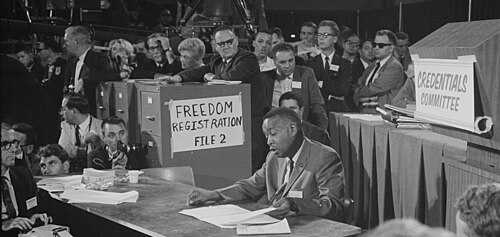
President Lyndon B. Johnson, fearing the loss of Southern support against Barry Goldwater, offered a compromise: two at-large seats for the MFDP that allowed them to observe but not vote. The MFDP rejected this offer. Although they failed to unseat the regulars, their efforts were instrumental in the passage of the Voting Rights Act of 1965.
Transition to the Modern Era
The 1968 election was the first in which African Americans were legally enfranchised in Mississippi. This period saw the rise of a "Loyalist" faction of the Democratic Party, which included the MFDP and NAACP, replacing the "old guard" regulars at the national convention for the first time in history.
However, the Democratic Party's grip on the state began to slip as conservative Republicans gained ground. In 1980, Ronald Reagan launched his campaign with a states' rights speech at the Neshoba County Fair, signaling a broader Southern shift toward the GOP.

The transition culminated in 1991 with the election of Republican Governor Kirk Fordice. By the late 1990s, Republicans held a majority of congressional seats and both U.S. Senate seats. The Mississippi Democratic Party evolved into a biracial organization, though it lost significant power at the state level.
| Era/Event | Primary Political Focus | Key Outcome |
|---|---|---|
| Second Party System | Jacksonian Democracy | Transition to one-party Democratic state |
| Reconstruction (1876) | The Mississippi Plan | Establishment of the "Solid South" |
| 1948 Election | Dixiecrat Movement | Temporary split over civil rights plank |
| 1964 Convention | MFDP Challenge | Paved way for Voting Rights Act of 1965 |
| 1980s - 1990s | Republican Realignment | Loss of Democratic control of governorship |
Frequently Asked Questions
What was the "Solid South"?
The Solid South refers to the period following the 1876 elections when several Southern states, including Mississippi, became solidly Democratic in their political nature, largely to maintain white supremacy and oppose Republican rule.
Who were the Dixiecrats?
The Dixiecrats, or the States' Rights Party, were Southern Democrats who broke away from the national party in 1948 to oppose the adoption of a civil rights platform.
What was the goal of the Mississippi Freedom Democratic Party?
The MFDP aimed to challenge racial discrimination in the electoral process and sought to replace the all-white, segregated regular Democratic delegation with a representative, biracial one.
How did the 1890 Constitution affect Mississippi?
The 1890 Constitution was explicitly crafted to replace the enfranchising constitution of the Reconstruction era. It imposed severe limitations on government and served to disenfranchise black citizens for decades.
When did Republicans gain significant power in Mississippi?
While the shift began in the 1980s, Republicans consolidated power in the 1990s, notably with the election of Governor Kirk Fordice in 1991 and gaining a majority of congressional seats by 1996.