Military Company Structure and Evolution
In military organization, a company is a fundamental tactical and administrative unit. Typically consisting of 100 to 250 soldiers, a company is usually commanded by a captain or a major. These units serve as the building blocks for larger formations, generally comprising three to seven platoons, though the exact composition varies based on the country, unit type, and specific organizational structure.
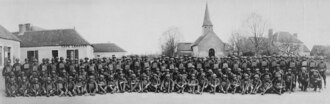
Most companies are grouped into larger entities known as battalions or regiments. However, some are organized as independent or separate companies for specialized missions—such as the 3rd Force Reconnaissance Company—reporting directly to higher-level commands like a Marine Expeditionary Force headquarters.
Key Facts
- Size: Typically 100–250 personnel.
- Command: Usually led by a Captain or Major.
- Composition: Generally consists of 3 to 7 platoons.
- Hierarchy: Multiple companies typically form a battalion or regiment.
- Psychological Basis: Unit size often aligns with Dunbar's number (approx. 150), the limit for stable human social relationships.
Historical Evolution of the Company
The concept of a 100-man unit dates back to ancient times. The Roman century is a primary example; while originally intended as 100 men, it later fluctuated between 60 and 80. This decimal-based organization allowed commanders to manage large armies while remaining small enough for a single leader to control the unit via voice, physical presence, and auditory cues like drums or trumpets.
Modern research suggests that groups of 100 to 250 members are the most cohesive. In the chaos of the fog of war—the uncertainty and confusion experienced by participants in military operations—smaller units are more efficient to control. Until the late 19th century, when infantry fought in close-order lines, companies generally remained at or below 100 personnel.
The American Experience (1700s–1917)
In the 18th century, British and American Colonial units varied widely. In 1775, a British infantry company had only 47 personnel, whereas by 1792, an American company grew to 98. The Continental Army adopted a Franco-Prussian model, utilizing a structure of one captain, several lieutenants, sergeants, and corporals, divided into two platoons.
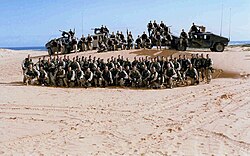
Throughout the 1800s, company strength fluctuated based on peace or war. During the American Civil War and the Spanish-American War, strengths often exceeded 100. By 1917, the U.S. Army adopted the "square division" structure for World War I, expanding the company to 256 personnel and adding a fourth platoon.
International Variations and NATO Standards
Across NATO member states, the term for a company varies by language and unit type. While "company" is standard for infantry, other terms are used for different branches, such as battery for artillery or squadron/troop for cavalry and armored units.
| Country | Infantry Term | Artillery/Cavalry Terms |
|---|---|---|
| United States | Company | Battery, Troop |
| United Kingdom | Company | Battery, Troop |
| France | Compagnie | Batterie, Escadron |
| Germany | Kompanie | Batterie, Staffel, Boot |
| Italy | Compagnia | Batteria, Squadrone |
Soviet and Russian Structures
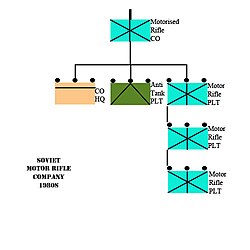
Soviet motorized rifle companies were typically mounted in either BTR armored personnel carriers or BMP infantry fighting vehicles. A BTR company generally consisted of 110 personnel and 12 vehicles, including three rifle platoons and a machine gun/antitank platoon. Soviet tank companies were smaller, typically consisting of 30 to 39 personnel and 10 to 13 tanks.
Modern US Marine Corps Rifle Company
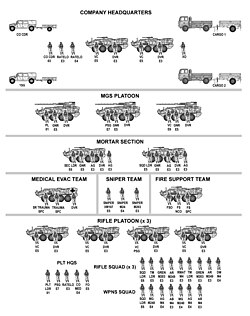
The modern USMC rifle company is a highly structured unit designed for versatility. It is led by a Company Commander (Captain) and an Executive Officer (First Lieutenant), supported by a First Sergeant and Gunnery Sergeant.
Unit Breakdown
- Rifle Platoons (3): Each led by a Lieutenant and Staff Sergeant, containing three rifle squads.
- Weapons Platoon: Provides heavy support, including:
- Machine Gun Section (M240G machine guns)
- Mortar Section (M224 60mm systems)
- Assault Section (Mk153 SMAW launchers)
Depending on the mission, companies may receive attachments such as medical teams, forward observers, tank sections (M1A2 Main Battle Tanks), or combat engineers.
Frequently Asked Questions
Who typically commands a military company?
A company is usually commanded by a Captain or a Major.
What is the difference between a company and a battalion?
A company is a smaller unit (100–250 soldiers) that serves as a component of a battalion, which is a larger formation consisting of several companies.
Why is the company size often around 150 people?
This aligns with Dunbar's number, a theoretical limit to the number of people with whom an individual can maintain stable social relationships, which enhances unit cohesion and command effectiveness.
What are the different names for a company in other branches?
While infantry use "company," artillery units typically use "battery," and cavalry or armored units often use "troop" or "squadron."
How are companies identified in the US Army?
Companies are typically identified by letters (e.g., Company A). In writing, they are often abbreviated to show their lineage, such as A/1-15 INF for Company A, 1st Battalion, 15th Infantry Regiment.