Microwave History and Technology: From Hertzian Optics to MMICs
The drive to exploit microwave frequencies was born from a practical necessity: the increasing congestion of lower frequency bands and the desire for smaller, more efficient antennas. What began as a series of physics experiments to prove the nature of light has evolved into the backbone of modern global communication, navigation, and domestic convenience.
Hertzian Optics and the Birth of Microwaves
In the 1890s, physicists viewed microwaves as a form of "invisible light." This perspective was rooted in James Clerk Maxwell's 1873 theory of electromagnetism, which predicted that coupled electric and magnetic fields travel through space as electromagnetic waves. In 1888, Heinrich Hertz became the first to demonstrate this by generating radio waves using a primitive spark gap radio transmitter.
Hertz and his contemporaries used short-wavelength radio waves in the UHF and microwave ranges to replicate classic optics experiments. By using quasioptical components—such as lenses and prisms made of pitch, sulfur, and paraffin—they proved that radio waves exhibit refraction, diffraction, polarization, and interference, just like light.
Following Hertz, several pioneers pushed the boundaries of frequency. In 1894, Jagadish Chandra Bose produced the first millimeter waves, reaching 60 GHz using a 3 mm metal ball spark oscillator. Bose also invented the waveguide (a hollow metallic pipe used to direct waves), horn antennas, and semiconductor crystal detectors. Other early contributors included Oliver Lodge and Augusto Righi, who experimented with 1.5 GHz and 12 GHz waves, respectively, while Pyotr Lebedev generated 50 GHz waves in 1895.
The Transition to Microwave Communication
Despite early successes, microwaves were initially limited by their line-of-sight propagation, meaning they could not travel beyond the visual horizon. Furthermore, early spark transmitters lacked the power for long-distance use. Practical communication didn't emerge until the 1940s, as standard triode vacuum tubes could not produce frequencies above a few hundred megahertz due to interelectrode capacitance and electron transit time.
The breakthrough came with the development of low-power microwave vacuum tubes in the 1930s, specifically the Barkhausen–Kurz tube and the split-anode magnetron. In 1931, an Anglo-French consortium led by Andre C. Clavier established the first experimental microwave relay link across the English Channel, transmitting data between Dover and Calais via 1.7 GHz beams. It was during the reporting of this project that the term microwave was first used to describe these ultrashort waves.
Radar and the Technological Leap of World War II
The urgency of World War II accelerated microwave technology. To fit radar antennas on aircraft, centimeter-wavelengths were required to create narrow beamwidths for precise localization of enemy planes. This led to the independent invention of the waveguide by George Southworth and Wilmer Barrow in 1936, and the horn antenna by Barrow in 1938.
Because vacuum tubes had too much capacitance for high-frequency reception, researchers returned to the point contact crystal detector (or "cat whisker" detector). The low capacitance of semiconductor junctions allowed them to function at microwave frequencies, paving the way for modern silicon and germanium diodes.
Two critical power sources emerged: the klystron tube (1937) and the cavity magnetron (1940). The magnetron, in particular, enabled 10 cm (3 GHz) radar on British warplanes by 1941, fundamentally changing the course of the war. The MIT Radiation Laboratory further expanded the theoretical knowledge required to implement these systems.
Post-War Commercialization and Consumer Tech
After the war, the high bandwidth (information-carrying capacity) of microwaves was utilized for transcontinental telephone and television relay networks. In the 1960s, the first communication satellites began relaying data globally via microwave beams. This era also saw the discovery of cosmic microwave background radiation in 1964 by Arno Penzias and Robert Woodrow Wilson.
The application of microwaves extended into the kitchen. While Ilia E. Mouromtseff explored microwave heating in the 1930s, Percy Spencer of Raytheon invented the microwave oven in 1945 after noticing a magnetron melted a candy bar in his pocket. This technology eventually moved from institutional kitchens to 25% of U.S. households by 1986.
In industrial and scientific fields, the traveling wave tube (TWT) provided tunable power up to 50 GHz, while the Russian-developed gyrotron tube produced megawatts of power for plasma research and nuclear fusion reactors.
The Evolution of Solid-State Devices
The 1950s shifted the focus toward semiconductor electronics and the principle of negative resistance. Since traditional feedback oscillators became unstable at high frequencies, one-port devices like diodes became the preferred source. Key inventions included the tunnel diode (1957), the IMPATT diode (1956), and the Gunn diode (1962).
Low-noise amplification was achieved through the maser (1953) and the varactor parametric amplifier (1956). The maser eventually led to the creation of atomic clocks, which maintain time via precise microwave frequencies emitted during electron transitions.
Microwave Integrated Circuits (MICs) and MMICs
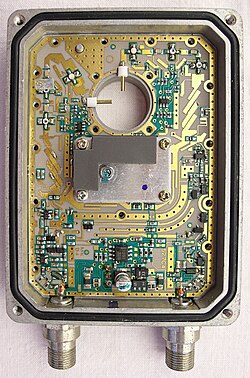
Until the 1980s, microwave circuits were bulky and expensive. The introduction of microstrip—a type of transmission line integrated into printed circuits—allowed for the cheap fabrication of capacitors, filters, and antennas on circuit boards.
The adoption of gallium arsenide (GaAs) in the 1970s was a turning point. GaAs has higher electron mobility than silicon, allowing devices to operate at four times the frequency. This led to the development of MESFETs (metal-semiconductor field-effect transistors) and HEMTs (high electron mobility transistors).
By 1976, this culminated in the Monolithic Microwave Integrated Circuit (MMIC). Unlike standard microwave integrated circuits (MIC) on PCBs, MMICs are single-chip solutions. Today, MMICs enable the existence of smartphones, Wi-Fi, Bluetooth, GPS, and satellite television.
Key Facts
- First Demonstration: Heinrich Hertz proved the existence of electromagnetic waves in 1888.
- Millimeter Waves: Jagadish Chandra Bose was the first to produce these in 1894, reaching 60 GHz.
- The Term "Microwave": First appeared in 1931 during the Anglo-French relay link project.
- War Effort: The cavity magnetron (1940) was a critical game-changer for WWII aircraft radar.
- Domestic Use: The microwave oven was patented by Raytheon on October 8, 1945.
- Material Shift: Gallium arsenide (GaAs) replaced silicon for high-frequency transistors due to superior electron mobility.
| Era/Year | Innovation/Discovery | Key Figure/Entity | Impact |
|---|---|---|---|
| 1888 | Electromagnetic Wave Demo | Heinrich Hertz | Proved Maxwell's theory |
| 1894 | Millimeter Waves (60 GHz) | Jagadish Chandra Bose | Invented waveguides and horn antennas |
| 1931 | First Microwave Relay Link | Andre C. Clavier | First use of the term "microwave" |
| 1940 | Cavity Magnetron | Randall and Boot | Enabled compact aircraft radar |
| 1945 | Microwave Oven | Percy Spencer | Revolutionized food preparation |
| 1976 | MMIC | Various (GaAs based) | Enabled smartphones and Wi-Fi |
Frequently Asked Questions
Why were microwaves not used for communication immediately after their discovery?
Microwaves are limited to line-of-sight paths, meaning they cannot travel beyond the visual horizon. Early spark transmitters also lacked the power to make them practical for long-distance communication compared to lower frequencies that could reflect off the ionosphere.
What is the difference between an MIC and an MMIC?
A Microwave Integrated Circuit (MIC) is a circuit built on a printed circuit board (PCB) using microstrip lines. A Monolithic Microwave Integrated Circuit (MMIC) is a single-chip device where all components are fabricated on a single semiconductor substrate, such as gallium arsenide.
How did the cavity magnetron change World War II?
The cavity magnetron allowed for the creation of high-power microwaves in a compact size. This enabled the development of centimeter-range radar that could fit inside aircraft noses, allowing Allied forces to localize enemy aircraft with high precision.
Why is gallium arsenide (GaAs) preferred over silicon for microwave devices?
GaAs has significantly higher electron mobility than silicon, which allows transistors made from it to operate at frequencies up to four times higher than similar silicon-based devices.
What is a waveguide?
A waveguide is a hollow metallic tube designed to direct electromagnetic waves. It was invented to replace conventional transmission lines, which suffered from excessive power loss at microwave frequencies.