Microeconomic Models: The Mechanics of Supply and Demand
In a market economy, prices and quantities are the most visible indicators of how goods are produced and exchanged. To explain how these variables coordinate, economists use the supply and demand model. This microeconomic framework describes price determination within a perfectly competitive market—a scenario where no single buyer or seller is large enough to influence prices, and there are no externalities, per-unit taxes, or price controls.
At its core, the model posits that the unit price of a good is established at the point where the quantity demanded by consumers exactly equals the quantity supplied by producers, resulting in a stable economic equilibrium.
Key Facts
- Market Equilibrium: Occurs when quantity supplied equals quantity demanded.
- Law of Demand: Price and quantity demanded are generally inversely related.
- Law of Supply: A rise in price typically leads to an expansion in supply.
- Perfect Competition: A market state where no individual participant has price-setting power.
- Equilibrium Drivers: Shortages bid prices up, while surpluses push prices down.
The Dynamics of Demand
Demand represents the relationship between the price of a commodity and the quantity that all buyers are willing to purchase. This is governed by constrained utility maximization, a theory suggesting that rational consumers choose the quantity of a good that provides the most preference (utility) given their constraints, such as income and wealth.
The law of demand states that as the price of a product increases, the quantity demanded decreases. This happens for two primary reasons: the substitution effect, where consumers switch to cheaper alternatives, and the income effect, where a price drop increases a consumer's overall purchasing power.
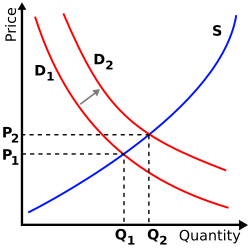
While price is a primary driver, other factors can shift the entire demand curve. For example, an increase in consumer income typically shifts the demand for a normal good outward.
The Principles of Supply
Supply is the relationship between the price of a good and the quantity available for sale. Producers, acting as profit maximizers, aim to supply the amount of goods that yields the highest possible profit.
According to the law of supply, a higher selling price makes increased production more profitable, leading producers to offer more of the good. Conversely, a fall in price leads to a contraction in supply. Similar to demand, the supply curve can shift due to external factors, such as technical improvements or changes in the cost of productive inputs.
Reaching Market Equilibrium
Market equilibrium is the intersection where the supply and demand curves meet. This point represents the price and quantity where the market is balanced.
- Shortage: When the price is below equilibrium, demand exceeds supply, which bids the price upward.
- Surplus: When the price is above equilibrium, supply exceeds demand, pushing the price downward.
From a marginalist perspective, the equilibrium price equates marginal utility (the value a consumer places on the last unit consumed) with marginal cost (the cost to the supplier to produce that last unit). In a perfectly competitive market, production stops when marginal profit reaches zero.
| Feature | Demand Side | Supply Side |
|---|---|---|
| Primary Goal | Utility Maximization | Profit Maximization |
| Price Relationship | Inverse (Price & Quantity) | Direct (Price & Quantity) |
| Key Constraints | Income and Wealth | Technology and Input Costs |
| Marginal Metric | Marginal Utility | Marginal Cost |
Short-Run vs. Long-Run Supply
The responsiveness, or elasticity, of supply depends on the time horizon. In the short run, some factors of production are variable (e.g., raw materials, overtime labor) and can be changed quickly. Other factors are fixed (e.g., plant equipment, key personnel).
In the long run, management can adjust all inputs. This difference in flexibility means that the supply curve reacts differently to market shifts depending on whether the timeframe is short or long.
Broader Applications of the Model
While often used for consumer goods, this analysis extends to factor markets, such as the labor market. Here, the wage rate (price) and the quantity of labor employed are determined by the demand from employers and the supply from workers. This helps explain unemployment, labor mobility, and productivity.
Beyond microeconomics, these principles are generalized in macroeconomics to explain variables across an entire economy, such as the general price level and total output, measured as real GDP (Gross Domestic Product).
Frequently Asked Questions
What happens to the price when there is a market shortage?
When the quantity demanded exceeds the quantity supplied, a shortage occurs, which typically bids the price upward until a new equilibrium is reached.
What is the difference between the substitution effect and the income effect?
The substitution effect occurs when consumers replace a more expensive item with a cheaper alternative. The income effect occurs when a decrease in price increases the consumer's actual purchasing power, allowing them to buy more.
How do producers decide how much to supply?
Producers act as profit maximizers, increasing production as long as the marginal revenue (the price in a competitive market) exceeds the marginal cost of producing an additional unit.
What is the difference between fixed and variable inputs?
Variable inputs, such as raw materials or temporary labor, can be adjusted quickly in the short run. Fixed inputs, such as factories or specialized equipment, require more time to change and can only be fully adjusted in the long run.
Can the supply and demand model be used for things other than physical products?
Yes, it is used in factor markets to determine the price and quantity of labor (wages) and capital, as well as in macroeconomics to analyze total economic output and general price levels.