Miami International Airport: A Global Gateway to the Americas
Miami International Airport (MIA) serves as a critical nexus for air travel, connecting the United States with Latin America, the Caribbean, and Europe. Operated by the Miami-Dade Aviation Department, this public airport is more than just a transit point; it is a massive economic engine for the Miami metropolitan area and a primary portal for international diplomacy and trade.
Since its opening on September 15, 1928, MIA has evolved from a modest airfield into one of the busiest airports in the world. Its strategic location makes it the ideal hub for airlines specializing in transatlantic and pan-American routes.

Key Facts

- Primary Hub: Major hub for American Airlines, which handles over 61% of the airport's passenger traffic.
- Passenger Volume: Processed 55,314,661 passengers in 2025.
- Cargo Powerhouse: Handled 3,448,913 tons of freight and mail in 2025.
- Infrastructure: Features four major asphalt runways, the longest being 13,016 feet.
- Global Reach: Serves as a hub for numerous cargo carriers including FedEx Express, UPS Airlines, and Atlas Air.
Historical Evolution

The airport's journey began nearly a century ago. In its early years, it established itself as a pioneer in international aviation. On January 9, 1929, Pan American Airways opened its new international passenger terminal, marking the first U.S. mainland port of entry for visitors arriving by air.

Over the decades, the facility expanded to accommodate the jet age. From the mid-century growth seen at the 20th Street Terminal to the modern, high-capacity concourses of today, MIA has consistently scaled its infrastructure to meet rising global demand.

Airport Facilities and Infrastructure

Miami International Airport is designed to handle a diverse array of aircraft, from regional jets to the massive Airbus A380. The airport is organized into several passenger facilities and specialized cargo zones.
Passenger Terminals and Concourses
The airport features multiple concourses to streamline the flow of millions of travelers. Concourse D and Concourse E are central to the passenger experience, while Concourse J in the South Terminal is the newest facility, specifically equipped with a gate capable of accommodating the Airbus A380.
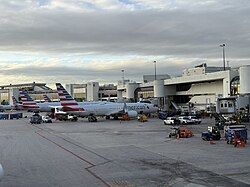
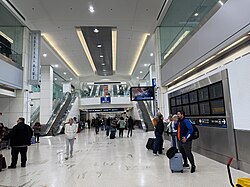
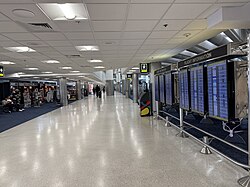

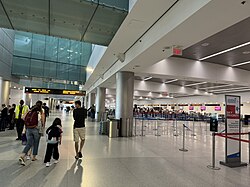
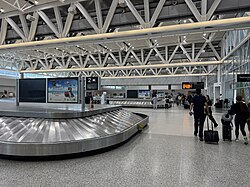
The South Terminal serves as a primary point for international arrivals, featuring comprehensive check-in counters and a large international baggage claim area.
Ground Transportation and Connectivity
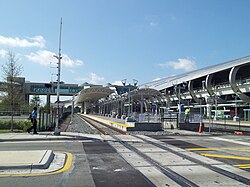
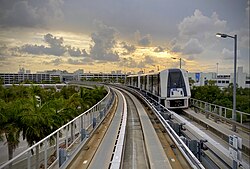
To manage the transition from air to land, MIA utilizes the Miami Intermodal Center (MIC), a massive hub integrating Tri-Rail and Miami-Dade Transit. Passengers are transported between the main terminal and the MIC via the MIA Mover, an automated people mover system.
Runway and Cargo Operations
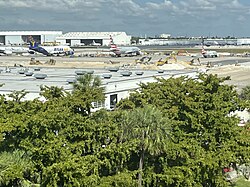
The airport's operational efficiency is supported by four asphalt runways. The cargo yard is equally vital, supporting a vast network of logistics providers that move millions of tons of goods annually.
| Runway | Length (m) | Length (ft) | Surface |
|---|---|---|---|
| 8L/26R | 2,621 | 8,600 | Asphalt |
| 8R/26L | 3,202 | 10,506 | Asphalt |
| 9/27 | 3,967 | 13,016 | Asphalt |
| 12/30 | 2,853 | 9,360 | Asphalt |
Airlines and Global Connectivity

MIA is most notable as a dominant hub for American Airlines, which maintains a commanding 61.5% share of the passenger market. Other significant carriers include Delta Air Lines, United Airlines, and Frontier Airlines.
The airport connects passengers to major global cities. Top domestic destinations include Atlanta, New York (LaGuardia and JFK), and Dallas/Fort Worth. Internationally, the busiest routes lead to London-Heathrow, Bogotá, and Panama City.
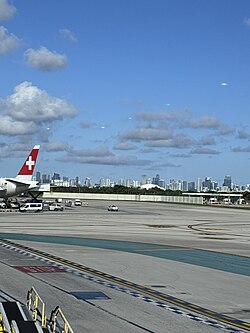
Cargo Hub Operations
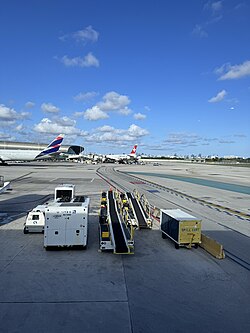
Beyond passengers, MIA is a critical logistics center. It serves as a hub for specialized cargo carriers such as ABX Air, Amerijet International, and various LATAM Cargo divisions, ensuring the rapid movement of goods between the Americas and the rest of the world.
Traffic Statistics and Growth
Passenger traffic at MIA has shown significant resilience and growth. After a dip in 2020 (18.6 million passengers), the airport saw a sharp recovery, reaching over 55 million passengers by 2025.
Frequently Asked Questions
Which airline has the largest presence at Miami International Airport?
American Airlines is the dominant carrier at MIA, operating as a primary hub and accounting for approximately 61.5% of all passenger traffic.
How do passengers get from the airport to other city transit?
Passengers use the MIA Mover to travel between the main terminal and the Miami Intermodal Center (MIC), which provides access to Tri-Rail and Miami-Dade Transit.
Can Miami International Airport accommodate the Airbus A380?
Yes, Concourse J in the South Terminal is specifically designed with a gate that can accommodate the Airbus A380.
What are the busiest international destinations from MIA?
The top international destinations include London-Heathrow, Bogotá, Panama City, São Paulo, and Lima.
How many runways does MIA have?
Miami International Airport has four asphalt runways, with lengths ranging from 8,600 feet to 13,016 feet.