Mesoamerican Codices: Classification and Types of Indigenous Pictorials
The study of Mesoamerican pictorial documents provides a vital window into the history, spirituality, and administration of indigenous Mexican cultures. These manuscripts, ranging from pre-Hispanic screenfolds to colonial legal documents, are not merely art but complex records of knowledge. To organize this vast array of documents, scholars Donald Robertson and John B. Glass proposed a comprehensive census, dividing these works into five primary categories based on their style, purpose, and origin.
Key Facts
- Five Primary Categories: Traditional codices, Relaciones Geográficas paintings, Techialoyan manuscripts, pictorial catechisms, and falsified pictorials.
- Origin Types: Documents are classified as pre-Columbian, produced under Spanish patronage, native colonial, or mixed colonial.
- Regional Schools: Major schools in Central Mexico include Tenochtitlan, Tlatelolco, and Tezcoco.
- Diverse Subjects: Topics range from ritual-calendrical and genealogical to economic and cartographic records.
- Materiality: Authentic documents often use amate paper (bark paper) or agave fibers.
The Primary Classification System
The framework established by Robertson and Glass allows researchers to categorize manuscripts by their function and historical context. While the primary system identifies five groups, scholars also distinguish documents by their geographical origin—spanning Western Mexico (Michoacán), Central Mexico, Oaxaca, Southeast Mexico (Chiapas and Yucatán), and Guatemala.
Traditional Mesoamerican Codices
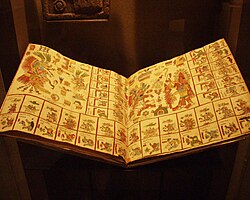
This is the most extensive and well-studied category, encompassing the majority of pre-Columbian and colonial pictorials. These documents are often grouped by shared prototypes or subjects. For example, the Borgia group focuses on ritual content, while the Maya screenfolds (such as the Dresden Codex) represent the sophisticated astronomical and calendrical knowledge of the Maya.
Within this category, documents are further split by their era of production:
- Pre-Hispanic: Created before Spanish contact (e.g., Codex Borbonicus, Codex Borgia).
- Spanish Patronage: Native works created for Spanish officials (e.g., Codex Mendoza, Florentine Codex).
- Native Colonial: Produced by indigenous people during the colonial era (e.g., Codex Xolotl).
- Mixed Colonial: Blended styles often used for genealogical or land records (e.g., Lienzo de Tlaxcala).
Paintings from the Relaciones Geográficas
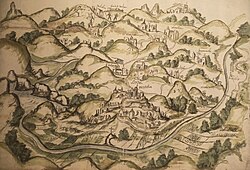
Between 1579 and 1585, the Spanish Empire under King Philip II distributed questionnaires to its territories to gather geographical and ethnological data. The resulting Relaciones Geográficas often included maps and paintings that blended Spanish requirements with native cartographical traditions.
Techialoyan Manuscripts
Named after the Codex of San Antonio Techialoyan, these 18th-century documents were created primarily as legal instruments for indigenous communities to prove land rights or status to the Spanish administration. They are characterized by the use of amate paper and Nahuatl alphabetic glosses. Some, such as the Codex García Granados, were later identified as forgeries.
Pictorial Catechisms
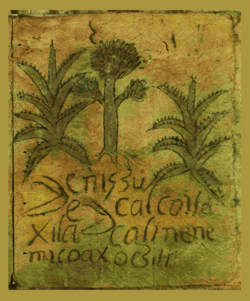
Also known as Testerian manuscripts, these documents used mnemonic images or specialized hieroglyphs to teach Catholic prayers and articles of faith. While once attributed to the friar Jacobo de Testera, many scholars now believe they were indigenous creations using a unique iconographic repertoire distinct from traditional Mesoamerican styles.
Falsified and Non-Pictorial Documents
The history of these manuscripts includes a dark side: forgeries created in the 19th and 20th centuries to deceive collectors. These fakes, such as the Codex Hall, often use a mix of materials like coconut fiber or animal skins. Additionally, some non-pictorial codices exist; these are textual descriptions of lost pictorials, such as the Códice Cabezón.
Summary of Manuscript Categories
| Category | Primary Purpose | Key Examples | Distinguishing Feature |
|---|---|---|---|
| Traditional Codices | Ritual, History, Genealogy | Codex Borbonicus, Codex Mendoza | Diverse pre-Columbian and colonial styles |
| Relaciones Geográficas | Administrative/Geographic | Map of Metztitlan | Response to Spanish imperial questionnaires |
| Techialoyan | Legal/Land Claims | Codex of San Antonio Techialoyan | 18th-century amate paper with Nahuatl glosses |
| Pictorial Catechisms | Religious Instruction | Testerian manuscripts | Mnemonic images for Catholic faith |
| Falsified | Deception/Profit | Codex Moguntiacus, Codex Hall | Inconsistent materials and styles |
Frequently Asked Questions
What is the difference between a pre-Hispanic and a native colonial codex?
Pre-Hispanic codices were created before the arrival of the Spanish, while native colonial codices were produced by indigenous artists after the conquest, often reflecting the changing social and political landscape of the colonial era.
What are Techialoyan manuscripts used for?
These manuscripts were primarily created in the 18th century to serve as legal documents, helping indigenous communities establish their rights and history within the Spanish colonial legal system.
Why are some catechisms called "Testerian"?
They were named after Jacobo de Testera, a Franciscan friar previously thought to have invented them. However, modern scholars often view them as indigenous creations because many are unrelated to Testera's work.
How can scholars identify a falsified codex?
Forgeries are often identified by their inconsistent use of materials (such as coconut fiber or animal skins) and the blending of disparate native styles that do not historically align.
What is the Borgia group?
The Borgia group is a collection of closely related ritual-calendrical manuscripts, including the Codex Borgia, Codex Cospi, and Codex Laud, which share a common stylistic and thematic prototype.