Medieval Latin: The Evolution of Europe's Intellectual Lingua Franca
Medieval Latin served as the primary vehicle for scholarship, religion, and diplomacy across Europe for nearly a millennium. Developing from Late Latin between the 4th and 10th centuries, it acted as a bridge between the rigid structures of the Roman Empire and the diverse vernacular languages of the Middle Ages. While it evolved significantly to accommodate new Christian concepts and shifting phonetic patterns, writers of the era generally viewed it as a continuation of Classical Latin rather than a separate language.
The transition from Late Latin to Medieval Latin is a subject of scholarly debate. Some historians mark the beginning with the rise of Ecclesiastical Latin (the language of the Church) in the mid-4th century, while others point to the year 500 or the emergence of written Romance languages around 900 AD.
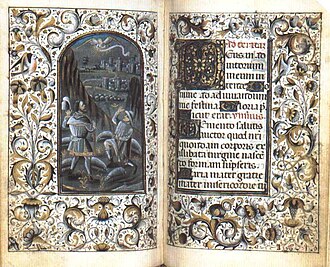
Key Facts
- Era: Developed from the 4th to 10th centuries; largely replaced by Renaissance Latin by the 14th century.
- Region: Predominant in Latin Christianity across most of Europe, including among Roman Africans and Mozarabs.
- Status: The de facto official language of most Catholic and Romance-speaking states during the Middle Ages.
- Function: Served as a lingua franca (a common language used between people who do not share a native tongue) for the educated elite.
- Writing System: Utilized the Latin alphabet, notably adopting Carolingian minuscule in the 9th century.
Linguistic Evolution and Influences
Medieval Latin was shaped by two primary forces: the formal traditions of the Church (Christian Latin) and the spoken, everyday variations of the people (Vulgar Latin). This created a linguistic divide. Learned writers, such as the theologian St. Thomas Aquinas or the historian William of Tyre, consciously resisted "incorrect" usages to maintain classical syntax.
In contrast, the language used by physicians, lawyers, and secular chroniclers—such as that found in the 11th-century Domesday Book—exhibited more pronounced shifts in grammar and vocabulary.
Changes in Syntax and Grammar
One of the most significant changes occurred in indirect discourse. Classical Latin used a subject accusative and infinitive construction. Medieval Latin replaced this with conjunctions like quod, quia, or quoniam (similar to the English "that"). The Venerable Bede famously used both styles within a single sentence, illustrating the overlap between old and new constructions.
Additionally, Medieval Latin adapted to translate Greek texts, which featured a "middle voice" (reflexive action) that Latin lacked. To compensate, Medieval Latin used passive voice forms to convey active, reflexive meanings. For example, in the translation of Genesis, the phrase "the Spirit of God was moved over the waters" actually expresses the Greek concept of God moving himself.
Orthography and Writing
The 9th-century Carolingian reforms introduced Carolingian minuscule, which established a clear distinction between uppercase and lowercase letters, greatly improving readability.
Spelling also shifted. Diphthongs like ae and oe often collapsed into a simple e (e.g., puellae becoming puelle). Conversely, some original e sounds were written as ae or oe, a trend seen in the English word "foetus." Due to a decline in Greek literacy, the letters y and i became interchangeable in loanwords, leading to spellings like sylva (forest), which persisted into botanical Latin.
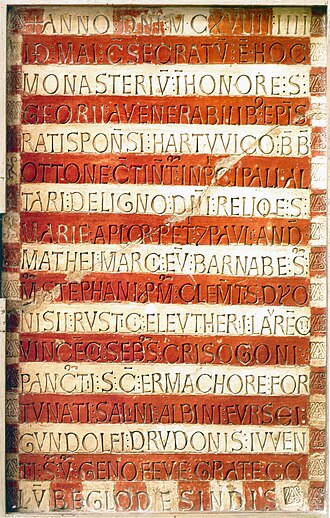
Medieval Latin in Society and Literature
By approximately 800 AD, Latin had ceased to be a spoken everyday language, becoming the exclusive domain of the educated upper class and clergy. While it was rarely used for casual conversation—even among some churchmen who could read but not speak it—it remained the essential tool for university lectures, legal charters, and long-distance correspondence.
Literary Milestones and Figures
The early period was dominated by the theological influence of Jerome and Augustine of Hippo. Later, figures like Boethius preserved Aristotle's logic for the West, and Isidore of Seville compiled the Etymologiae, essentially the first encyclopedia.
Monastic culture in Ireland played a crucial role in preserving Latin and Greek knowledge, eventually exporting this learning back to mainland Europe via missionaries like Columbanus. This environment also birthed the unique Hisperic Latin poetic style.
| Work/Author | Approximate Date | Significance |
|---|---|---|
| Etymologiae (Isidore of Seville) | c. 600 | Early comprehensive encyclopedia |
| Carmina Burana | 11th–12th Century | Collection of Goliardic poetry |
| Decretum Gratiani | c. 1150 | Fundamental canon law text |
| Magna Carta | 1215 | Constitutional legal charter |
| Summa Theologiae (Thomas Aquinas) | c. 1270 | Masterwork of scholastic theology |
Frequently Asked Questions
Was Medieval Latin a different language from Classical Latin?
While it featured significant changes in syntax, spelling, and vocabulary, contemporary writers did not consider it a fundamentally different language, but rather a continuation of the Latin tradition.
Who actually spoke Medieval Latin?
It was primarily a written language and a tool for the educated elite, such as clergy, lawyers, and academics. It was rarely used for casual, everyday conversation by the general population.
What is Carolingian minuscule?
It is a script developed during the Carolingian reforms of the 9th century that introduced a clear differentiation between capital and lowercase letters, standardizing written Latin.
How did the influence of Greek affect Medieval Latin?
Because the New Testament was originally in Greek, Medieval Latin adapted its grammar to express the Greek "middle voice" using passive forms. Additionally, a decline in Greek knowledge led to the interchangeable use of 'i' and 'y' in loanwords.
What was the role of Ireland in preserving the language?
Irish monasteries became centers of learning where Latin and Greek were preserved during periods of decline on the mainland, later reintroducing this knowledge to Europe through missionaries.