McCrory's Retail History and Corporate Evolution
For decades, McCrory's stood as a titan of the American retail landscape, embodying the classic "five and dime" variety store experience. At its peak, the company managed a massive network of 1,300 stores, operating not only under its own banner but also through a wide array of acquired brands. Its journey is a complex tale of aggressive expansion, strategic mergers, and the intricate financial maneuvering of the mid-to-late 20th century.
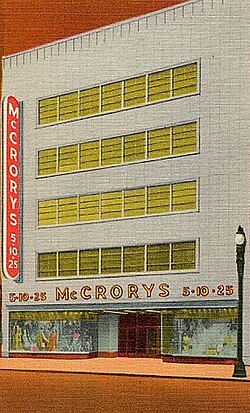
Key Facts
- Peak Scale: Operated 1,300 stores across various brand names.
- Market Position: Once ranked as the fourth largest retailer in the United States.
- Parent Company: Controlled by the Rapid-American holding company.
- Major Acquisitions: Included J.J. Newberry, S.H. Kress & Co, and G.C. Murphy.
- Headquarters: Moved to Springettsbury Township, Pennsylvania, in 1963.
The Era of Meshulam Riklis and Rapid-American
The trajectory of McCrory's changed significantly in 1960 when it was purchased by Israeli financier Meshulam Riklis. Riklis merged the company with its rival, the H.L. Green Co., and shifted the corporate headquarters to Springettsbury Township, Pennsylvania, by 1963. Under the management of Samuel Neaman, the company was controlled via the Rapid-American holding company.
Riklis became known for a specific financial strategy: shifting assets between his various companies and holding entities. This approach was most evident in his management of McCrory Stores, where he maintained the company's assets while the brand name itself eventually moved toward bankruptcy. During this period, the corporate umbrella also extended to other retailers such as Best & Co., Lerner Shops, and S. Klein.
Aggressive Expansion and Acquisitions
Throughout the 1960s and 1970s, McCrory's pursued a strategy of rapid growth through the acquisition of other variety store chains. In 1972, the company purchased the J.J. Newberry Company, which consisted of 439 stores. Rather than absorbing them immediately, McCrory's operated Newberry as a separate division and continued to open new locations under that name.
The expansion continued into the 1980s. On January 1, 1981, McCrory's acquired S.H. Kress & Co., another prominent five and dime chain, from the footwear retailer Genesco. This period of economic expansion led to exponential growth in both volume and profits, prompting the company to remodel existing stores and open new ones.
The TG&Y Transition and Challenges
In 1985, McCrory's purchased the TG&Y discount store chain. This acquisition proved problematic due to a mismatch in business models. While a typical McCrory store ranged from 10,000 to 15,000 square feet, TG&Y locations were significantly larger and featured a different merchandise mix. Because the TG&Y stores were unprofitable and drained corporate assets, McCrory's converted many of them to the Bargain Time brand before closing them by the end of the decade.
Final Major Acquisitions
Despite the struggles with TG&Y, McCrory's continued to consolidate the market. In 1987, the company purchased 76 remaining Kresge and Jupiter stores from Kmart, converting all of them to the McCrory brand. This was followed in 1989 by the purchase of the G.C. Murphy Co. variety store chain from Ames Department Stores, which included both G.C. Murphy and Bargain World stores.
Corporate Portfolio Summary
| Brand/Company | Relationship/Action | Key Detail |
|---|---|---|
| H.L. Green | Merged | Merged with McCrory's in 1960 |
| J.J. Newberry | Acquired | 439 stores purchased in 1972 |
| S.H. Kress & Co. | Acquired | Purchased from Genesco in 1981 |
| TG&Y | Acquired | Purchased in 1985; later converted to Bargain Time |
| G.C. Murphy | Acquired | Purchased from Ames Department Stores in 1989 |
| McLellan | Merged | Merged in 1958 |
Frequently Asked Questions
Who owned McCrory's during its peak expansion?
McCrory's was controlled by the Rapid-American holding company, which was owned by Israeli financier Meshulam Riklis and managed by Samuel Neaman.
Why was the acquisition of TG&Y unsuccessful?
The TG&Y stores were too large compared to the standard 10,000 to 15,000 square foot McCrory stores and had a different merchandise mix, making them unprofitable and a drain on assets.
Which other major variety chains did McCrory's acquire?
McCrory's acquired several major chains, including J.J. Newberry, S.H. Kress & Co., G.C. Murphy, and the remaining Kresge and Jupiter stores.
Where was the company headquartered after 1963?
Following the merger with H.L. Green, the headquarters were moved to Springettsbury Township, Pennsylvania.
What happened to the TG&Y stores after the acquisition?
Many of the TG&Y stores were rebranded as Bargain Time before being closed entirely by the end of the 1980s.