Matrícula de Tributos: Analyzing Aztec Imperial Taxation and Art
The Matrícula de Tributos serves as a vital historical record of the Aztec Empire's economic administration. This manuscript details the complex system of tribute—mandatory payments of goods and services—that provinces were required to send to the capital city of Tenochtitlan. By examining its structure and content, historians can reconstruct the geopolitical and economic landscape of the empire.
Structure and Artistic Composition
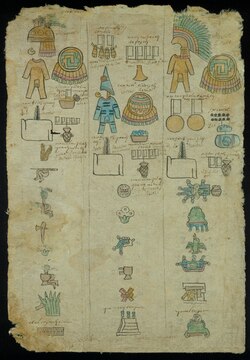
The manuscript follows a largely standardized formula, though it contains several unique anomalies. Most leaves depict a single province, with the exception of folio 8r, which shows two, and folio 10v, which depicts three.
Each standard page begins at the bottom left with a glyph (a symbolic character) representing the province's major city. Other towns within that province are listed ascending along the right edge of the page. The remainder of the folio is dedicated to the specific tribute items required by the empire.
Unique Folios and European Influence
The first three leaves (folios 1r, 1v, and 2r) differ significantly from the rest of the document. These pages are heavily damaged and feature red lines dividing the page. Folios 1r and 1v illustrate the empire's frontier regions, while folio 2r depicts the relationship between Tenochtitlan and Tlatelolco.
Research by Gómez Tejada indicates that these early folios, along with folios 13r and 14v, exhibit human facial features painted with European influence, suggesting a blend of indigenous and colonial artistic styles.
The Tribute System and Numerical Glyphs
The empire demanded regional items that were not readily available in the capital, such as cacao, cotton, seashells, dye, and feathers. To quantify these shipments, the Matrícula utilizes a specific system of numerical glyphs to denote the number of loads expected:
- White flag: 20 loads
- Black and white feather: 400 loads
- White pouch: 8,000 loads
The accuracy of these records is supported by comparative analysis. When the Matrícula is compared with the Codices Mendoza and Azoyú II, as well as other colonial documents, the tribute numbers for the Tlapa province remain consistent across all sources.
Warrior Attire and Imperial Symbolism
An analysis of the warrior attire required by Tenochtitlan reveals a curious distribution across five major regions. Despite having direct access to the feathers necessary for these garments, the Eastern and Southern regions were not required to send large quantities of warrior attire.
Conversely, the dry provinces surrounding the island capital of Tenochtitlan were burdened with the highest requirements for warrior attire. Because these provinces lacked the necessary raw materials, they were forced to trade with other regions to obtain feathers. This discrepancy suggests that the tribute requirements may have been based on a symbolic division of the empire rather than practical resource availability.
Key Facts
- The Matrícula de Tributos documents the goods provinces sent to Tenochtitlan.
- Numerical glyphs represent quantities: white flag (20), black and white feather (400), and white pouch (8,000).
- Folios 1r, 1v, and 2r are unique for their red dividing lines and depictions of frontier regions and Tlatelolco.
- European artistic influence is visible in the facial features of folios 1r, 1v, 2r, 13r, and 14v.
- The Tlapa province data matches records in the Codices Mendoza and Azoyú II.
- Provinces near the capital were required to send the most warrior attire, despite lacking the feathers to make them.
| Glyph Symbol | Numerical Value (Loads) |
|---|---|
| White Flag | 20 |
| Black and White Feather | 400 |
| White Pouch | 8,000 |
Frequently Asked Questions
What is the Matrícula de Tributos?
It is a manuscript that records the tribute items and quantities that various provinces were required to send to the Aztec capital, Tenochtitlan.
How can we verify the accuracy of the Matrícula?
Its accuracy is proven by comparing its data with other colonial documents and manuscripts, such as the Codices Mendoza and Azoyú II, which show similar tribute numbers for the Tlapa province.
What were some of the common tribute items?
Provinces typically sent regional goods not available in the capital, including cotton, cacao, seashells, dye, and feathers.
Why was the requirement for warrior attire considered symbolic?
Because the provinces closest to Tenochtitlan were required to provide the most warrior attire despite living in dry regions without the feathers needed to produce them, forcing them to trade with other provinces.
Are there any European influences in the manuscript?
Yes, Gómez Tejada found that human facial features on folios 1r, 1v, 2r, 13r, and 14v were painted with European influence.