Martín Fierro: The Vanguard of Argentine Avant-Garde Literature
Between February 1924 and 1927, the literary landscape of Buenos Aires was transformed by Martín Fierro, one of Argentina's most influential avant-garde magazines. Emerging during a period of intense artistic experimentation, the publication served as a catalyst for the modern movement, challenging traditional norms and redefining the intellectual identity of the region.
The magazine was founded by a collective of visionaries, including director Evar Méndez, José B. Cairola, Leónidas Campbell, H. Carambat, Luis L. Franco, Oliverio Girondo, Ernesto Palacio, Pablo Rojas Paz, and Gastón O. Talamón. Based in Buenos Aires, the publication achieved a significant reach, boasting a circulation of 20,000 copies.
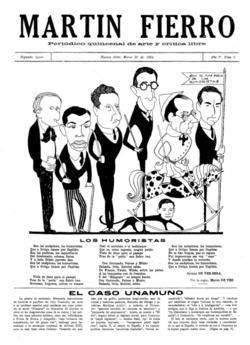
Key Facts
- Publication Period: February 1924 to 1927.
- Circulation: 20,000 copies.
- Location: Buenos Aires, Argentina.
- Philosophy: Adopted an "art-for-art's sake" approach, prioritizing aesthetic value over political utility.
- Key Figures: Founded by Evar Méndez and a group of avant-garde writers; featured contributions from Jorge Luis Borges.
Origins and Philosophical Shift
The name Martín Fierro was not an original creation for the 1924 publication. It was inherited from a short-lived 1919 magazine also directed by Méndez, which focused on social and political issues, as well as an anarchist magazine from 1904 where Macedonio Fernández had published poetry. The title itself pays homage to the gaucho outlaw of the same name from José Hernández's national poem, a cornerstone of Argentine identity.
However, the 1924–1927 iteration diverged sharply from its predecessors. It embraced the concept of art-for-art's sake—the belief that art should be judged by its own aesthetic standards rather than its moral or political message. This alignment closely linked the magazine to the Florida group, an artistic circle focused on innovation and cosmopolitanism.
A Hub for Intellectual Conflict and Collaboration
Despite its association with the Florida group, Martín Fierro remained a broad platform. It published works by a vast array of writers and artists, including Mario Bravo, Fernando Fader, Macedonio Fernández, Santiago Ganduglia, Samuel Glusberg, Norah Lange, Leopoldo Lugones, Roberto Mariani, Ricardo Molinari, Conrado Nalé Roxlo, Nicolás Olivari, Horacio A. Rega Molina, and Ricardo Rojas. The legendary Jorge Luis Borges also contributed poems and short articles.
The magazine was not without internal tension. Roberto Mariani, a member of the Boedo group (a circle known for its commitment to social realism and political engagement), sparked a debate within the pages of Martín Fierro regarding the role of political commitment in art. This tension led Arturo Cancela to suggest a merger of the two opposing factions under the name "Schools of Floredo street," proposing Manuel Gálvez as president due to his central location on Pueyrredón street.
Visual Arts and Global Influence
The publication was as much a visual experience as a literary one, with Lino Palacio contributing to its graphic design. It showcased the avant-garde art of Emilio Pettoruti and Arthur Honegger, and featured the work of Ramón Gómez de la Serna. Beyond its borders, the magazine took a defiant stance against the Spanish magazine La Gaceta Literaria, rejecting the notion that Madrid should be the "intellectual meridian" or the dominant authority over Latin American culture.
One of the magazine's most provocative features was its use of fake obituaries. These satirical pieces were used to mock a wide range of targets, from the writers of the Boedo and Florida groups to the established icon Leopoldo Lugones, whom the magazine frequently attacked as a symbol of the past.
The End of an Era
The publication came to an end in 1927. The decision to cease printing was reportedly made by Evar Méndez to maintain the magazine's independence. Some collaborators had pressured Méndez to use the publication as a tool for Hipólito Yrigoyen's campaign for a second presidential term, a move that would have contradicted the magazine's aesthetic autonomy.
| Feature | Details |
|---|---|
| Active Years | 1924–1927 |
| Primary Philosophy | Art-for-art's sake (Avant-garde) |
| Key Affiliation | Florida group |
| Notable Contributors | Jorge Luis Borges, Oliverio Girondo, Macedonio Fernández |
| Circulation | 20,000 |
Frequently Asked Questions
Who was the magazine named after?
The magazine was named after Martín Fierro, the gaucho outlaw who is the protagonist of Argentina's national poem written by José Hernández.
What was the difference between the Florida and Boedo groups?
The Florida group, which was closely linked to Martín Fierro, focused on avant-garde experimentation and aesthetics ("art-for-art's sake"), while the Boedo group emphasized social realism and political engagement.
Why did the magazine attack Leopoldo Lugones?
The magazine viewed Lugones as an icon of the past and a representative of an outdated literary tradition that the avant-garde movement sought to overcome.
What led to the closure of the magazine in 1927?
Director Evar Méndez decided to end the publication to avoid allowing the magazine to be used as a political tool for Hipólito Yrigoyen's presidential campaign.
Did the magazine only feature writers?
No, it was a multidisciplinary publication that featured graphic design by Lino Palacio and showcased the avant-garde art of figures like Emilio Pettoruti and Arthur Honegger.