Martin Block and the Legacy of the Make Believe Ballroom
Before the era of modern playlists and digital streaming, Martin Block revolutionized the way the world experienced music on the radio. By blending imagination with broadcasting, Block transformed the role of the disc jockey from a mere announcer into a storyteller, creating an immersive experience that captivated millions of listeners across North America.
Block's journey began in Los Angeles, where he worked in radio in Tijuana, Mexico, and later as a junior assistant to Al Jarvis at KFWB. Even in his early days, Block showed a knack for research, using publications like Billboard and Variety to provide listeners with detailed information about the records he played. After a brief stint selling household appliances and a childhood start as an office boy at General Electric, Block moved his family to New York, where his career truly ignited.
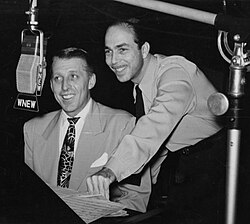
![Block's "Make Believe Ballroom" debuted on WNEW in 1935.[7]](/images/84/85/8485ece8a414e65f9868094be53aeb1a6b828911891e5708be2ae977615fcc85.jpg)
The Birth of the Make Believe Ballroom
In 1934, Block joined WNEW with a modest salary of $20 per week. His big break arrived in 1935 during the intense public interest surrounding the Lindbergh kidnapping. While listeners tuned in for news bulletins, Block filled the gaps by playing records, eventually launching the Make Believe Ballroom on February 3, 1935.
Borrowing the concept and title from Al Jarvis, Block created a sonic illusion: he made listeners believe they were attending a live performance by the nation's top dance bands in a grand ballroom. Because the station lacked a music library, Block personally purchased records from a local shop, selecting Clyde McCoy's "Sugar Blues" as the show's first theme song.
A New Style of Broadcasting
Block broke the mold of traditional radio announcing. While most announcers used a booming, theatrical voice, Block adopted a conversational, intimate tone, speaking as if he were having a one-on-one chat with the listener. This approach built an incredible level of trust and influence. When he advertised a refrigerator sale during a New York snowstorm, 109 people braved the weather to buy the product. By 1941, potential sponsors were placed on a waiting list to be part of his show.
Career Milestones and Cultural Impact
The Make Believe Ballroom became more than just a music show; it became a cultural touchstone. In 1936, the program inadvertently provided a legal alibi for a man accused of pickpocketing, who proved he was home listening to a specific on-air telegram regarding Guy Lombardo. By 1940, the show was nationally syndicated and hosted a legendary "$20,000 Jam Session" featuring jazz icons like Count Basie, Harry James, Gene Krupa, and the Dorsey brothers.
Block also demonstrated remarkable resourcefulness during the 1942–44 musicians' strike (the American Federation of Musicians recording ban). To keep his program fresh with orchestral music, he had friends in England send him UK recordings, as the ban only applied within the United States.
Expanding into Film and Television
Block's success extended beyond the radio booth. He signed a contract with Metro-Goldwyn-Mayer for a series of musical shorts titled Martin Block Presents and appeared in the 1949 feature film Make Believe Ballroom. He also became a sought-after announcer for high-profile programs such as The Chesterfield Supper Club, Pepper Young's Family, and the CBS Hit Parade. At the height of his success following World War II, Block was earning an astounding $22,000 per week.
Key Facts
- Debut: The Make Believe Ballroom premiered on February 3, 1935, on WNEW.
- Innovation: Block pioneered the "conversational" radio style, moving away from theatrical delivery.
- Industry Influence: He co-wrote the 1941 Glenn Miller hit "I Guess I'll Have to Dream the Rest."
- Talent Scouting: He is credited with giving Dinah Shore her professional name after a memory lapse during her audition.
- Legacy: Block was inducted into the Radio Hall of Fame in 1988.
| Period/Year | Achievement/Role | Key Detail |
|---|---|---|
| 1935 | Launched Make Believe Ballroom | Created the illusion of live ballroom performances. |
| 1940 | National Syndication | Hosted the "$20,000 Jam Session." |
| 1942-1944 | AFM Recording Ban | Used UK imports to bypass the US recording strike. |
| 1947 | MGM Contract | Produced Martin Block Presents musical shorts. |
| 1954 | ABC Radio | Hosted The Martin Block Show from WABC. |
| 1962-1967 | Guard Session | A scripted show simulating a recording studio. |
The Final Years and Later Iterations
Block officially retired from regular radio work in 1960, though he continued to appear on WOR/New York and hosted the Guard Session from 1962 until 1967. He passed away on September 18, 1967, in Englewood, New Jersey.
The Make Believe Ballroom continued long after Block's departure, hosted by figures such as Gerry Marshall, Art Ford, and William B. Williams. In the late 1980s, entertainer Steve Allen took the helm, shifting the format to be 70% comedy and 30% music. The original WNEW run ended on December 10, 1992, though the brand was later revived in the 21st century by DJ Claire Stevens via the Triumph Radio Network.
Frequently Asked Questions
How did Martin Block create the "Make Believe" effect?
Block used a combination of recorded music and descriptive announcing to create the illusion that he was broadcasting live from a ballroom where the nation's top dance bands were performing.
What was Block's contribution to the style of radio announcing?
He moved away from the loud, theatrical delivery common in the 1930s, instead using a natural, conversational voice that made listeners feel they were having a personal interaction with him.
How did Block keep his show running during the musicians' strike of 1942–44?
Since the American Federation of Musicians recording ban only applied to the United States, Block had friends in England send him UK recordings to ensure he had new orchestral music for his program.
Did Martin Block have any influence on other artists' careers?
Yes. He hired Joe Franklin as a "record picker," who later became a legendary New York broadcaster. He also accidentally gave Dinah Shore her stage name after forgetting her real name (Fannie Rose Shore) during an audition.
When did the original WNEW Make Believe Ballroom end?
The final broadcast of the WNEW version of the show took place on December 10, 1992, hosted by DJ Jim Harlan.